


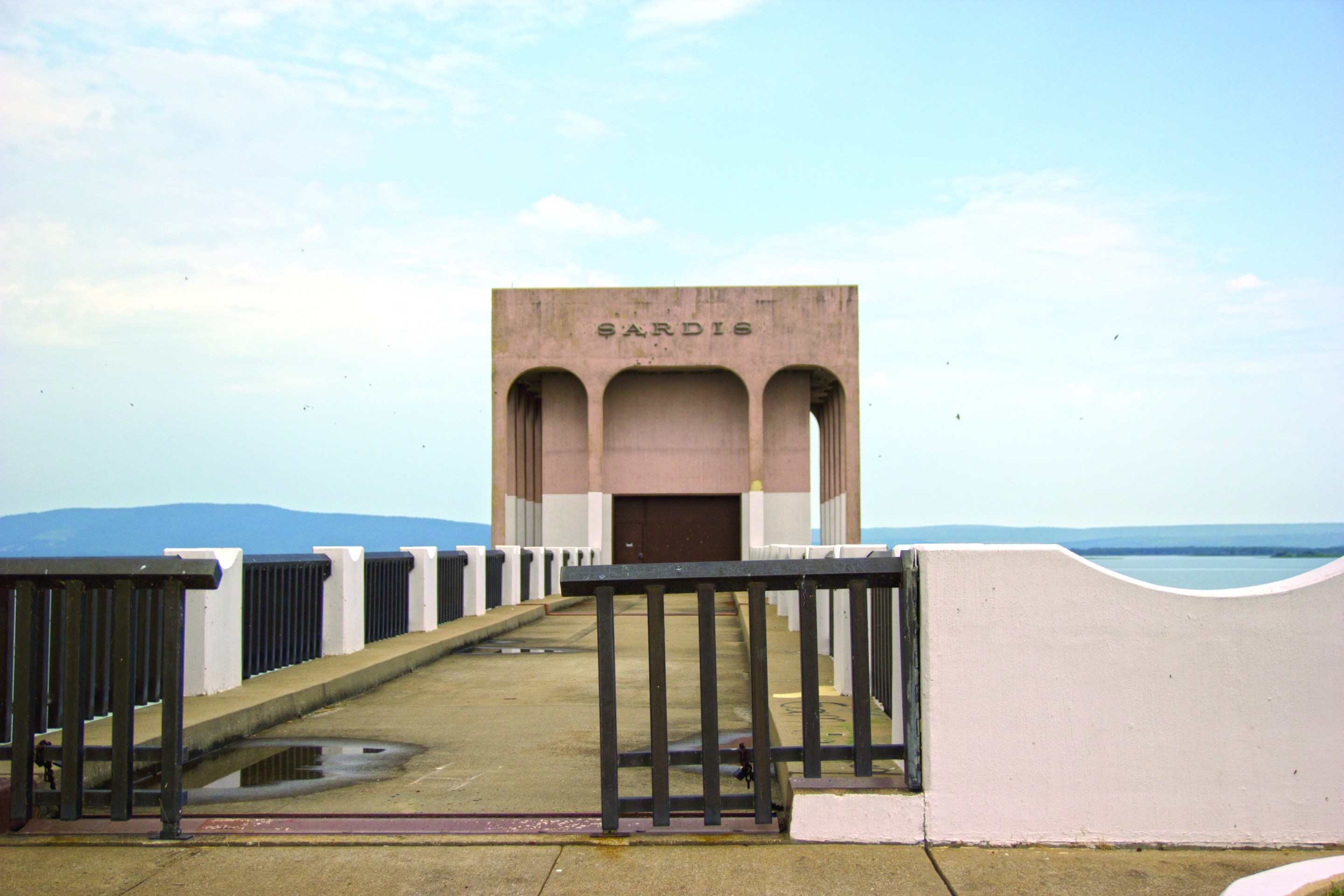
Editor's note: First published in three consecutive issues of This Land in 2012, science writer Ginger Strand's three-part Troubled Waters series zoomed out to a macro view of the state of Oklahoma's most critical natural resource. This is the first installment, originally published in This Land's Sept. 1, 2012 issue.
On Memorial Day weekend, Lake Sardis’s Potato Hills South campground is packed with groups of guys in pickup trucks—the kind of guys who travel with just the essentials: boat, pole, radio, beer. Potato Hills South is an Army Corps of Engineers Class B campground—no sinks, no showers, pit toilets. But if you follow the trail that starts behind the picnic table at campsite #1, an easy fifteen minute stroll will take you to the Potato Hills Central Class A campground, populated by families and retirees in RVs, the kind of people who travel with boat, pole, radio, beer, plus chairs, rugs, gazebos, televisions, small dogs, satellite dishes and carved wooden signs identifying themselves—“The Scudders: Josh and Patty”—to fellow campers. The trail leaves you right behind the shower building, meaning you can avail yourself of Class A hot water for the pit toilet price.
As you hike the trail in quest of water, you’ll see mosses growing beneath cedars, along with prickly pear cacti. Cacti and moss coexisting: it’s an apt symbol for Oklahoma’s hybrid hydrology—one foot in the arid West and the other in the flood-prone East—a geologic fact at the root of the “water wars” currently brewing over this very lake. Like several other big reservoirs in Southeastern Oklahoma, Sardis is a federal project, and multiple far-away cities hope to dip a straw into it. In June 2010, over a year before releasing its 50-year Comprehensive Water Plan, the Oklahoma Water Resources Board sold “storage rights” to 90 percent of the Sardis water to Oklahoma City, which plans to build a pipeline and pipe Sardis water 200 miles and 600 feet uphill. The move triggered a lawsuit from the Choctaw and Chickasaw nations and a threat of litigation from local activists.
Understanding what’s at stake in the water wars—which will ultimately reach well beyond Lake Sardis—requires taking a look not just at Oklahoma’s unique climate and landscape, but its equally unique history. Water disputes are common across the West, ever more so as populations grow and the climate becomes more extreme, but Oklahoma’s stand-offs are unlike the rest, because here the problem is not—or not yet—scarcity.
A STATE IN TWO WORLDS
Oklahoma has more eco-regions per square mile than any other state—from arid western plains to tallgrass prairie, cypress swamps, and Ozark forest. The western side of the state is part of the arid West—the land beyond the 100th meridian that John Wesley Powell declared no one should try to farm. The eastern side of the state has frequent rainfall and robust prairie rivers that tend to flood in the wet season. It’s not uncommon for part of the state to be awash in floods while another is parched with drought.
Oklahoma’s history is marked by both extremes. Shortly before the Dust Bowl and not long after it, floods on the Arkansas River swallowed whole towns. The problem has never been that the state doesn’t have enough water: it just doesn’t necessarily have water when and where it needs it.
The state’s variable hydrology means that its water laws are also a hybrid. Oklahoma recognizes riparian rights—the form of water law (common in the East) holding that property owners have the right to reasonable uses of waterways abutting their land. But it also recognizes prior appropriation—the doctrine whereby he who diverts the water first wins the right to continue diverting it. In the water-poor West, prior appropriation dominates, because most landowners do not have access to water except by diverting it.