


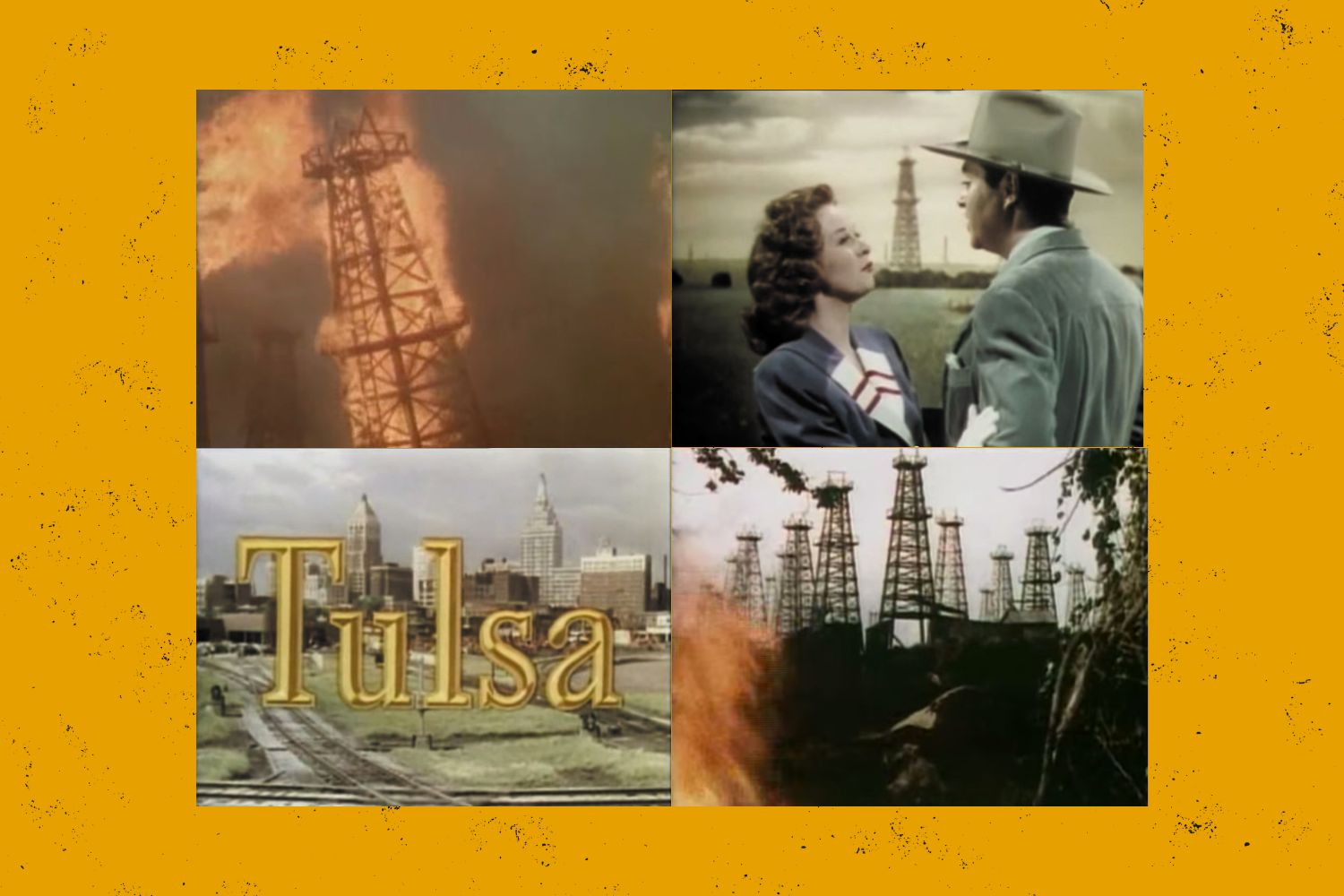
Editor's note: When a city's boosters partner with Hollywood, what makes the final cut? Originally published in This Land: Spring 2015, this tale from Charles Morrow looks back on Tulsa in the post-war era as it attempts to put its own mythology to film.
There’s Tulsa the city, and there’s Tulsa the movie. For a brief spell in the spring of 1949, when the movie premiered in its namesake locale, the business and political elite of Oklahoma joined forces with Hollywood luminaries in a common cause. The moviemakers sought to boost the oil industry, while the oil tycoons were delighted to see their endeavors saluted on the silver screen. The politicians, for their part, had hopes that the region might become a filmmaking center. It was a mutually beneficial arrangement, potentially lucrative for all.
A report issued by the Chamber of Commerce in March of 1949 offers a snapshot of Tulsa at this time: a dynamic metropolis, population 197,363. City fathers liked to call it the Oil Capital of the World, and this was a source of great civic pride. But the movie, an action-melodrama released in April of that year, paints a disturbing picture of the city’s history. According to the film, modern Tulsa is indeed “the nerve center of a mighty industry,” but this prosperity was achieved at a painful cost. In the days of unfettered wildcat drilling—a period the screenplay firmly consigns to the past—there was corruption at the top. In the headlong drive for profits grazing land was ruined, streams were polluted, and innocent people, principally Native-American landowners, were ruthlessly cheated. Strangely, Tulsa was planned as a celebration of robust capitalism. Whatever its creators’ intentions, however, the final product is more a cautionary tale than a straightforward tribute to the era’s petroleum-industry pioneers. And yet when it premiered, Tulsa the movie was rapturously greeted by Tulsa’s citizens, including many of those business leaders, in a lavish three-day blowout unlike anything witnessed in Oklahoma up to that time. Few of the goals shared by the oilmen, politicians, and moviemakers were achieved, but in the meantime they sure did throw one helluva party.
Cast of characters
Three individuals were essential players in the Tulsa phenomenon. First, the film project itself was initiated by producer Walter Wanger1, a 30-year veteran of motion pictures. Well-read, multilingual, and debonair, Wanger was nobody’s idea of a typical movie mogul. He was a tireless advocate of movies as cultural propaganda, especially as portrayals of the American way of life for international audiences, and he did not avoid sensitive social issues as subject matter. Behind the scenes, Wanger was active in liberal causes, and while his own patriotism was never seriously questioned, in the course of his career he was known to have hired “controversial” writers and actors. In the wake of the Hollywood Ten scandal of 1947, and subsequent Red Scare in the entertainment industry, Wanger was under pressure to demonstrate his allegiance to American values.2 One day while listening to his car radio, he heard a news report on Tulsa that emphasized the central role of the oil business. He was intrigued, and later said that this, weighed with the huge success of the Broadway musical Oklahoma!, inspired him to set plans in motion for the movie. Wanger announced that Tulsa would be the first in a cinematic series on the American free enterprise system, to be followed by films on the airline industry, the press, and coal mining. He explained that his purpose was to “show the entire world how great America is.”
For Oklahoma Governor Roy J. Turner, the second key figure in the story, Wanger’s project was perfectly timed. Just weeks after he was elected in November 1946, Turner launched an initiative to lure filmmakers to his home state. He appointed his friend and fellow cattle rancher Bill Likins to act as liaison between the governor’s office and Hollywood, and touted the state as an ideal place to shoot Westerns in color. The governor must have been tickled pink when he was shown the script for Tulsa, which concerned conflicts between oilmen and ranchers in the 1920s: Turner himself had co-founded the Harper-Turner Oil Company in 1928, and had used some of his proceeds to establish an impressive 10,000 acre ranch in Sulphur, Oklahoma, near Ada. He owned some of the finest Hereford stock in the world, and had even composed a cowboy ballad entitled “Hereford Heaven.”3 The governor happily offered his ranch to the filmmakers. Aside from a few quick shots of downtown landmarks, most of the location shooting for Tulsa took place there, 145 miles from Tulsa. The film was shot in Technicolor.
Wanger, who was producing on an independent basis at this time, was under contract to a British-owned company, Eagle-Lion Films. Soon after Tulsa wrapped in fall of 1948, two E-L advance men, Jerry Pickman and Richard Owen, arrived in the city to set the stage for a spring premiere gala. Determined to get local financiers on board, the duo approached the third major figure in the Tulsa story, 70-year-old William G. “Bill” Skelly. A quintessential self-made man, Skelly rose from humble beginnings to undisputed stature as a kingpin of the Oklahoma oil business. He had arrived in Tulsa in 1919, founded his eponymous company that year, and swiftly made a fortune. In 1923 Skelly co-founded the International Petroleum Exposition, an organization that held periodic trade fairs intended in part to boost public awareness of, and appreciation for, the oil industry. He had little interest in movies per se, but recognized a golden P.R. opportunity when he saw one. Skelly was instrumental in persuading his fellow oilmen to lay out $1,000,000 to finance the festivities surrounding the premiere of Tulsa, set for Wednesday, April 13. Governor Turner proclaimed the date “Tulsa Day in Oklahoma,” and preparations commenced.
Party prep