

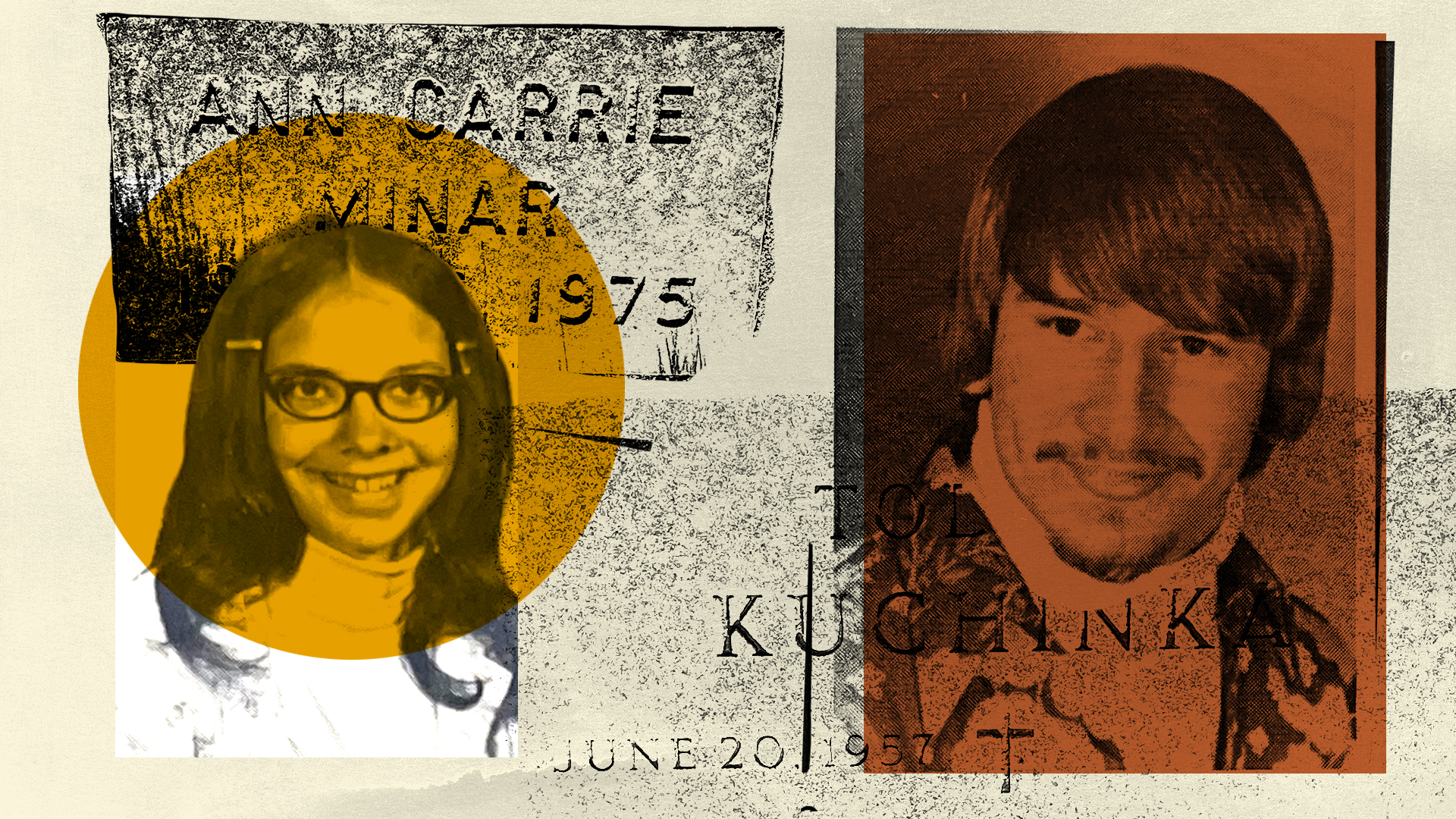

One of my aunts, Kate Minar, died last March, a few weeks away from her 82nd birthday. She was a nun for over 50 years and lived at Assisi Heights in Rochester, Minnesota, which is the motherhouse for the Sisters of St. Francis.
Kate was the second-oldest of seven Minar kids, and when I went to the funeral, all my mom’s living siblings were there: four other sisters and a brother. Nine Minar children were born to Kate’s parents, my grandparents, on the family farm in southern Minnesota, with two untimely deaths.
During the chapel service, stained glass and marble echoed each voice and movement as my mom and a couple of her sisters told their favorite stories about Kate: her devotion to the Minnesota Twins, their travels to national parks, her signature homemade cards with photos of her flowers. Afterward, we went via caravan to the nearby cemetery. Each of the nuns at Assisi Heights is cremated when they die, and their urns are buried in small plots with uniform gravestones.
It was chilly. The sun was out and the funeral group sang hymns together and took turns scooping handfuls of dried roses into the grave. Though Kate’s siblings don’t speak to one another regularly, and disputes and hurt feelings and illnesses and old age have gotten in the way of their once-close bond, they were all in attendance, some with their children and grandchildren, one tuning in over Zoom. The Minars had regrouped, as if no time had passed since my father’s funeral in 2005, or my aunt Barb’s in 2009, or my grandmother’s in 2013.
I’d never been to a funeral quite like this, where we each contributed something to the grave. It made it seem possible that grieving could be nourishing. Joining the ritual of death made me less fearful of it. It’s like it all made sense.
***
Not all deaths are peaceful. On May 23, 1975, my aunt Ann had just finished her last day of her junior year of high school, and her car was full of friends celebrating senior graduation. Odilia Sherman, Kari Sue Ceplecha, Jean O’Brien, and Chris Malecha were heading to a party. Ann was driving, and Odilia was in the front seat.
There was music and laughing. Stories and jokes. Jean had her legs crossed on the seat in the back, and others had their hands out the window, feeling the breeze on Highway 60, about three miles west of Faribault near Cannon Lake and a beach they called Malibu. They were done with the school year, ready for respite from the cold Minnesota winter that always lasts late into spring.
Years later, some would say the girls hadn’t made it to the party yet. Others recall that they’d been there already and were headed back to Faribault—where four of the girls lived—and then to Northfield, where Ann lived on the family farm. The police report shows the car was headed east, toward the towns and away from the lake, when something triggered Ann to briefly veer onto the shoulder. A comment from the back? An obstacle on the road? A split-second of not holding the wheel tightly enough?
Whatever happened, she lost control of her father’s 1966 Ford Galaxie sedan and overcorrected, colliding head-on with a truck in the oncoming lane.
Ann and Odilia were killed instantly, and the other three survived with injuries. To this day Highway 60 has a reputation as a killer highway, according to Tim Halverson, a police officer who was on duty the night of the crash. “It’s a windy road, and there’s lakes all over God’s creation out there,” he told me in his thick, pleasant Minnesota accent.
The two small towns were immediately shaken by the accident. Other high school kids had been following the girls in the cars behind them, and word traveled fast.
Soon, two nuns from Bethlehem Academy, where the girls attended, appeared at my grandparents’ door to deliver the news. Ann and Odilia would be forever 17, the missing core of a group of close friends.
***
My parents settled in Oklahoma in the 1980s for my dad’s college teaching job, and my brother and I grew up with Minnesota as a second home, road-tripping there at least once a year to see both sides of the family. Stories of loss in the Minar family colored our view of the Northfield farm and its frigid Christmases: Ann’s accident in 1975, and another loss back in 1946, when baby Margaret, the third-oldest sibling, drowned in a cow trough outside the family home. Though our annual family gatherings were full of love, we knew that under it all was a sort of ruthlessness on the farm that bred resentment, alcoholism, and sorrow. The barren, icy land in front of us each late December spoke for itself.

I was born more than a decade after the car accident, but my family always said I resemble Ann. We were close in height. I keep a dress she made in her home ec class in my closet, a navy-blue floral with large wooden buttons that fits me perfectly.
When friends and family talk about Ann, they remember her as smart, kind and warm. She excelled at science and math and was headed for college.
But beyond basic details, no one in the family really talks about her much, perhaps not wanting to revisit the pain. It’s hard to tell—in Minnesota, older generations tend to keep their cards close to the chest. But it’s also possible that all of this was just so long ago that they really don’t remember.
Around the time of the accident, Ann had made a list of her “likes,” which my aunt Kate kept in her journal that detailed nearly every moment of May 23 and 24 that year when she found out about Ann’s death. Before she died last year, Kate passed along Ann’s journal to my mom, knowing I was looking into Ann’s life. Some of Ann’s likes were riding horses at sunset, basketball games, windy days, driving on a freeway, wildflowers, forests, birdcalls in the morning, and Burt Reynolds.
***
On a spring day in 2016, a man in his late fifties visited my family’s farm in Northfield, Minnesota. He was hoping to catch my uncle Jim, who built a house on the same farmland where he’d grown up with my mom and her siblings. Jim wasn’t home, so the man instead spoke to my cousin Angela. He said his name was Todd Kuchinka and he wanted to buy the cemetery plot next to my aunt Ann’s.
No one in my family knew Todd Kuchinka or recognized his surname, which is pronounced koo-hink-ah. But he was adamant that Ann had been the love of his life. That he and Ann had promised each other an engagement in some stairwell at, or outside of, one of their high schools. She had attended the Catholic school, Bethlehem Academy, in neighboring Faribault, and Todd went to Faribault High.
Ann’s siblings were perplexed and irritated. It was impossible, they said, that Ann had been engaged without someone knowing, at least a sister, or a friend. Todd was a stranger, and his claims challenged their perception of her. To believe him would be to accept that Ann had lied by omission to her own friends and family, at best.

Angela “shut him down pretty hard,” by her recollection, sending Todd away. One of my aunts ran a background check on Todd at the time, but found nothing, and didn’t dig into his story beyond that. They wrote him off as a creep and moved on with their lives.
The story of Todd’s visit gnawed at me for years. Whether or not his claims about Ann held water, the idea of a stranger lying next to my aunt in the afterlife left me unsettled. And I’ve never been good at letting things go.
So I set about learning everything I could about Todd and Ann. Was he making this up? Did he once mistake her kindness for something more? Did they even know each other at all? And why did he want to be buried next to her? I had to know what this guy was up to.
***
Together in life, together for eternity. As far back as 4,600 years ago, humans with shared DNA have been found buried together, suggesting that the nuclear family has been around at least that long. And some scientists believe that deliberate burials existed even hundreds of thousands of years before that.
Other species exhibit mourning and burial behaviors, including elephants. Even small insects like bees and ants have processes in place to dispose of carcasses, more like cleaning up. But most burial rituals as we know them connect us to the spiritual realm. Now, we might go pay our respects to a dead family member’s grave, but ancients worshipped their ancestors as a way to link the living and the dead, and to honor their lineage.
Qafzeh Cave in Israel is thought to be the oldest intentional human burial site, dating back around 100,000 years. Archaeologists believe that the ocher tools found next to modern human remains are signs that a death ritual was involved.
Indigenous Americans in the Mississippian culture, once prevalent in the Midwest, South, and Southeast, built mounds as burial sites to honor loved ones and community leaders. Craig Mound at the Spiro Archaeological Center in eastern Oklahoma is one such site. Archaeologists believe it contains the remains of Caddoan leaders going back to 950 A.D. The site protected human remains and valuable artifacts for centuries, until treasure hunters unearthed them in the 1930s.
Before modern cemeteries emerged in the U.S. in the mid-1800s, Americans buried their dead in churchyards, town commons or municipal burial grounds. These eventually grew crowded with the dead, threatening public health. Today’s large, rural cemeteries were the answer to the spread of disease, but also rising real estate prices.
As Evelyn Waugh satirically depicts in his novel The Loved One, feelings of comfort associated with death rituals aren’t reserved for human family members. People become so attached to their pets, their special loved ones, that they require the same ritual to initiate the grieving process and often desire pet burial services. In a small cemetery in Texas, my partner’s grandfather is buried next to his beloved chihuahua, Prissy.
When I was in Minnesota last year, I visited a few cemeteries to locate relatives’ graves on both sides of my family. I found the grave of my dad’s grandfather, Ole Boe, who was struck by a taxi and killed in 1937 in Albert Lea. Next to him was his wife, Gertrude. Other Boes lay nearby, many I’d never heard of. But I was able to trace how we’re related, including my great uncle Irvin and his wife, Esther.
Calvary Cemetery in Northfield, where the Minar family is buried, is quiet and spread out over lovely rolling hills. Nearby are sprawling Victorian homes and the Northfield Golf Club. My grandparents’ grave is marked with a large headstone with Minar in big letters, and nearby are small headstones for their daughters, Margaret and Ann. My aunt Barb, Uncle Jim’s wife, is buried there too, but her grave is still unmarked.
I find satisfaction in locating the headstones of people I’m related to. Does that come from the innate sense that families belong together? Somehow, it becomes more meaningful when there’s a process or a ritual or a shared space where we all end up.
In 2013, I watched as my grandmother’s coffin was lowered into her plot at Calvary Cemetery. With the ground opened up, I could see the side of my grandfather’s casket, which had been there since 1976. Ann’s had been nearby since 1975. I had a visceral reaction to seeing that old casket, a few shades darker than my grandmother’s. In that moment, death became something else entirely, something real and close and uncomfortable. There are few moments in our modern death rituals when we’re faced with the grittier side of nonexistence. It’s easy to forget that one day, we’ll all be there.
It was more than obligation that compelled me to look into Todd. Since that day, our family’s burial place had come to feel sacred to me. I felt protective. I had to know why Todd was trying to disrupt it, and what about his relationship with Ann—if it even existed—gave him the right to.
***
People searches on Ancestry and Google made it easy to confirm that Todd grew up in Faribault and played football in high school. He got married at 25 and divorced at 46, Minnesota court records showed. Now, he lives in Red Wing, Minnesota, a river town on the Mississippi about an hour from Faribault, known for some of the first ski clubs in the U.S. and for its clay pottery. Kuchinka is an eastern European surname, just like Minar, which is Czech.
Faribault and Northfield are the largest cities in Rice County, Minnesota, which is now home to nearly 70,000 residents, about 30,000 more than lived there at the time of the accident. Ann’s friend Chris Kern (formerly Chris Malecha) said that their class size at Bethlehem Academy, where Ann attended, was about 86. Faribault High School, where Todd attended, was over twice the size. The towns have always been rivals. Northfield, with two private liberal arts universities, is considered the cultural hub, while Faribault is more industrial and working-class.
When I was in Minnesota for my aunt Kate’s funeral last spring I visited the Northfield Historical Society to see if they had any records on the Minar family. The young staff member greeted me early one sunny morning in Northfield’s quaint downtown, next to the Cannon River and not far from the campuses of St. Olaf College and Carleton College. She led me down to the old building’s basement, where she had a stack of files waiting: small manila envelopes on a large conference table.
The files, which weren’t many, were organized by first name. There were graduation and wedding announcements, a news story and photograph from when my aunt Kate received her habit, and photographs from school activities. Ann’s file had just one clipping. “Northfield girl killed,” the headline read, along with an original school photograph.

Visits to Northfield and Faribault Libraries turned up similar newspaper clippings in the microfilm. I also went to the Rice County Historical Society in Faribault and found yearbooks from both Faribault High School and Bethlehem Academy. There, the elderly volunteer staff member watched me from the corner of her eye in bemusement as I scanned every yearbook page so as to not miss evidence of someone I was searching for: Todd, Ann, her friends, anyone with the last name Kuchinka.
I found Todd in his junior and senior yearbooks—the first and last photos I’ve ever seen of him. He had shaggy dark-blonde hair and a serious expression. And in his senior photo, a mustache that made his slight smile appear bigger. He looked like any teenage guy.
In the Bethlehem Academy yearbook from 1975, an “In Memoriam” page was dedicated to Ann and Odilia and includes a poem my aunt Agnes wrote, “A Sister’s Farewell.” Odilia looks young in her photo, but Ann looks like she could have been at least 20, with her cat-eye glasses and collared, bookish blouse. She looks a lot like her sisters with her large, expressive eyes, soft features, and dark hair.

I looked for hours, but couldn’t find any evidence directly linking Ann and Todd. Looking at her school photos, I wondered what she would think about all this if she were still alive. I wondered if she had really been capable of fooling her friends and family, if they hadn’t known about a whole secret dimension of her life.
I reached out to Sue Hollinger, who handles plot sales for Calvary Cemetery, and asked about Todd. She said it’s not uncommon for people to secure their place of rest well before their death, whether to lessen the burden on their family members or to have their own say in their final resting place.
Sue told me she had contacted our family after Todd’s request, wondering if anyone knew him. After all, being buried next to Ann meant he’d also be close to a handful of other Minars. Sue had gone to school with my uncle Jim and knew my grandmother well when she was alive.
With some more Googling, I found that Todd’s deceased father was buried in Maple Lawn Cemetery in Faribault, alongside a plot reserved for his mother, still living. The cost of a plot in Maple Lawn is almost half as much as Calvary. Why wouldn’t he want to be buried among his family where he grew up? It seems Todd didn’t want to secure a place there. He wanted to pay a premium to be laid to rest in Northfield, where he never lived, beside a woman he claimed to have promised himself forever.
***
Jean O’Brien was one of the other girls in the car accident that killed Ann and Odilia. She is now a professor of American Studies at the University of Minnesota, specializing in Native American and Indigenous Studies.
Like the other three survivors, Jean is now in her late 60s. Her long brown hair is parted in the center, and her eyes are warm and attentive. She told me that the five friends in the car were incredibly close in high school, an inseparable pack, talking every day and acting like too-cool outsiders, not unusual for clever small-town kids who dreamed of leaving. Ann and Kari Sue worked at the Dairy Queen together outside of school. Before the accident, Ann was newly dating Brian Doherty, a graduating senior and a year older, who my aunts and Ann’s friends said was a really good guy, charming and good-looking.


But Jean said that before Brian, she and Ann were never that interested in having boyfriends. Ann “was a brain,” she said. “She was brilliant.” Their group was interested in learning and academics more than anything. And friends. “In a place that didn’t feel very kind, we were kind to each other,” she said.
I also talked to Brian on the phone, who describes Ann as smart and shy at school, but she’d open up to him in the short time they dated. “I don’t think you’d get a bad word out of anybody about her,” he said. “She definitely left an impression. I still think about her.”
Most of the people I spoke to lived in Faribault and were the same age or a year older than Todd Kuchinka, yet no one remembered his name, or anyone with that last name. Their relationship didn’t ring a bell with anyone. No one even recognized Todd’s photograph I found in the 1976 Faribault High yearbook.
Jean and Chris said the two high schools didn’t really interact. It wasn’t that surprising to them that they didn’t know Todd; it was strange that anyone from Bethlehem Academy would have been involved with someone from the town’s public high school. They both said that it would have been memorable because it didn’t happen much.
When I brought up Todd’s claims about Ann, Brian described them as absurd. “There’d be no way,” he said. “Like I said, Ann was a smart girl, and I don’t think there’d be any way she’d be engaged when she was a junior in high school.”
“I definitely thought he was mentally unsound,” said my cousin Angela, reflecting on the day Todd visited the family farm. “It’s just not something a normal person does… he just made me uncomfortable, I guess.”
Jean said the situation is bizarre, and that “it doesn’t make any sense, period, given [Ann’s] character. She was a very straightforward, honest, direct, lovely person.” If Ann had had some other boyfriend, her friends would have been the first to know. When we discussed Todd’s possible motive, Jean said, simply, “fantasy.”
***
Tracking down people who knew Todd proved to be much more difficult. After several months of phone calls and emails, I reached out to his niece and nephew over social media. They put me in touch with Todd’s younger brother, Tom, a friendly guy in his sixties, who’s married with a few grown kids. He told me he and his family knew nothing about Ann Minar until about the same time Todd inquired about the cemetery plot, around 2015 or 2016. He said he basically knew the same story I did.
“The only thing I could ever get out of my brother about that situation is that he knew her when she was young, met her in Faribault,” Tom said. Todd had three of Ann’s eight-by-ten school photographs framed and hanging on his wall, and when Tom asked Todd about them, he told him the teenager in the picture was his wife. “What are you talking about your wife?” Tom laughed uncomfortably, recounting the story. “I didn’t even go there because it was just so bizarre.”
Todd had been married and divorced since high school, making his claims about Ann even stranger. I tried contacting his ex-wife, who is now remarried, but my emails, voicemails, and even a letter returned nothing.
Tom does believe that Todd knew Ann somehow because he had those photos, and “just the way he expressed it.” Tom remembers that she had cat-eye glasses in the pictures. He thinks Todd really believed he was engaged to her back then.
I pressed Tom for more details about their conversation. Todd told Tom that he met Ann at Al’s bar in Faribault, now the Elks Club. When I said that Ann was only 17 when she died, and therefore couldn’t legally enter the bar, Tom admitted to some uncertainty. Maybe they didn’t meet there, he said, and just had gone there together at some point? He referred me to a family friend, Susie McShane, who had been aware of the situation.
I tracked down Susie and spoke with her as well. She had attended Bethlehem Academy in the class above Ann, whom she remembered as “very small and very sweet.” While she also knew Todd Kuchinka and his parents, she couldn’t recall anything about Todd and Ann dating, and doesn’t think they were even acquainted with one another.
“It’s very strange to us as well,” Tom told me. “My brother is a very, very private person.”

Tom and Todd had grown up together, but Todd was about five years older than Tom, and after he left home for vocational school, they lost touch. Todd didn’t talk to anyone in the family for about a decade, and now, they still don’t talk much. “Since he was 18 years old, I really can’t give his life story. I really don’t know what he’s been through,” Tom said.
I also talked to Nita O’Connell, who lived next to Todd in Red Wing for many years. Though I didn’t get to visit the town on my trip, I found online records from the homes on his street and got in touch with Nita by phone. She said Todd was a “very nice man, a very quiet neighbor, but really kept to himself.” He never shared anything personal with her, and they would only talk about their gardens. She did remember that he worked several different jobs during her time there. And as far as she knew, he always lived there alone.
One of Todd’s current neighbors, Andrew Glander, has lived across the street from Todd for 15 years but never knew his name until I called him. It took him a few minutes and some Googling to figure out which house on the street I was talking about. Once he figured it out, he said, “Oh, yeah. The red house. I have never spoken a word to that man. He’s very private. But there’s never been a problem at his house.”
“We treated him, always, very, very well. I mean, we’re not any different than any other normal family,” Tom said. When they would try to talk to Todd about his life, about all the years they didn’t know what he was doing or where he was, “he would just look away and stare somewhere in the distance,” he added.
And yet, Tom said he’s still the closest one to him. “It’s not going to help you to go further than me,” he said.
***
Eventually, my search for answers got stonewalled. But Todd’s insistence on intruding on our family burial plot continued to bother me. It was still on my mind when I drove to the Spiro Mounds Archaeological Center from Tulsa this spring, in search of, I don’t know, something, anything, to help me make sense of it.
The narrow roads wound through small towns, past abandoned lots and buildings, forgotten potholed roads, and overgrown pastures. The remote site near the Arkansas border spans 80 acres. I looked around when I pulled into the small parking lot that only held a couple of other cars. I’d expected to see the mounds right away; I thought they’d be unmistakable. There was a small mountain far in the distance, which I quickly learned from the tour guide and the center’s director, Anna Vincent, was just a hill—probably a remnant of the Ouachita or Ozark Mountains—and had nothing to do with Spiro.
There are 12 ancient mounds at Spiro, the earliest constructed around 900 A.D. by the Caddoan Mississippian people. The largest, Craig Mound, which came into view once we passed the visitor center, was a dedicated burial mound. The smaller house mounds acted as through-ways, or processing centers, as Anna put it, when someone in the community died. The Caddoans would leave the bodies there to decompose before transporting the remains to the larger mounds, which held more impressive artifacts. Researchers believe these were the burial sites for Caddoan spiritual leaders. Craig Mound has the largest collection of artifacts from any single Mississippian site, including Olivella shells, copper plates, ceremonial weaponry, and effigy pipes.
The meadows were peaceful, interrupted only by the mounds’ ascent, with their tall grass and beds of Indian paintbrush. Anna’s extensive knowledge of the site made for easy storytelling. And learning of the 1930s lootings that cleared out not only the burial artifacts and structures, but also the bodies themselves, colored everything sad.

But most illuminating was the significance of the mounds to the Caddoan people, which archaeologists infer from the care they took in constructing them. Anna said she has to remind people that the mounds were more than piles of dirt. “There was a lot of purpose and intentionality behind it,” she said. The Caddoans used different kinds and colors of soil for each layer of the mounds, for instance, and they would repeatedly resurface them, maintaining them for centuries.
The Caddoan people believed in a “cosmological three-layered universe,” Anna said, where they lived in the middle, between the above and below worlds. Some researchers speculate that the mounds served as a way for them to connect all three realms in death. Anna said the mounds were likely meant to be a “physical representation of a larger cosmological worldview.”
These carefully crafted structures indicate just how much consideration the Caddoan Mississippians gave to the afterlife. Though our knowledge of their society is limited, that fact seems evident.
The mounds at Spiro would be unrecognizable as anything but small, unassuming knolls if Anna hadn’t told me otherwise. These people didn’t necessarily want to be remembered. The tomb inside Craig Mound, sealed shut and full of precious artifacts, wasn’t ever meant to be opened; just left alone.
As Anna said repeatedly on the tour, there’s a lot we simply don’t know about the mounds. We don’t have all the facts about the everyday lives of the Caddoan people. We don’t know exactly why they came to the Spiro site and later abandoned it. We can only speculate that they left behind these monuments to the deceased, whether to help them into the next life, to honor them, or perhaps to grieve.
The burial site is all that’s left for the living to decipher. We all have our own ways of reckoning with the mystery of death. Honoring those we’ve lost and keeping shared rituals are part of the process, but they also bring comfort to the living.
Fear of death can get the best of us. Before modern medicine, it wasn’t uncommon for someone to be presumed dead and buried alive. George Washington and Hans Christian Andersen both provided strict instructions on what to do with their bodies to ensure they weren’t still alive before burial. Beside Andersen’s bed was a note that read, “I only appear to be dead.”
Even Walt Whitman, the humble “Good Gray Poet,” whose work seemed to embrace death as a natural process, may have panicked when he knew his time was limited. He commissioned a large tomb in Camden, New Jersey, for $4,000—more than twice the cost of his house.
Salvador Dalí famously designed his Theatre-Museum to showcase his work and included the tomb where he’d be buried—itself a kind of performance piece, easily accessible to museum visitors today. The director of the Gala-Salvador Dalí Foundation, Félix Roca, once told a reporter that Dalí was fascinated by immortality and the afterlife, wanting to be eternal himself by living through his art. His body was exhumed in 2017 because of a paternity dispute, and according to one of the forensic scientists present, his infamous mustache was intact, “still pointing at ten and two.”
***
The first time I tried Todd’s phone number, he picked up. He was friendly at first, saying he recognized Ann’s name when I told him who I was. He chuckled uncomfortably. I explained that I was looking into her life and his plot purchase at the cemetery and had a few questions for him. Despite the confrontation at the family farm a decade ago, he didn’t want to talk about it now. “I have nothing to say,” he said before hanging up on me. I called him again a few more times over the next few months with the same result.
It’s hard to know for sure if there’s any truth to Todd’s claims. It seems unlikely that he and Ann tricked everyone in their lives and kept a high school love affair a secret. It could be that he’s confusing her with someone else, or that he mistook Ann’s signature kindness at the Dairy Queen one day for something more. Perhaps his desire to be memorialized next to somebody he remembered loving once came about out of fear of his own demise, even if that memory wasn’t based in fact.
Todd has the legal right to be buried next to my aunt Ann, her parents, her sister, her sister-in-law, and likely other Minars down the line. To Calvary Cemetery, Todd’s request was simply business—the plot wasn’t owned by anyone, so it was fair game.

Sue Hollinger had sold him the plot, after all. When a plot is purchased, she sends out a notarized cemetery easement or deed that confirms the purchase and the grave number, and the buyer is responsible for purchasing a gravestone and maintaining it. What was once associated with ritual, spirituality, and ancestry above all can now feel like just another transaction in the marketplace.
Resting in the once-open space next to Ann’s headstone is now a much larger one, with the date of birth of 1957 and no death date. Todd Kuchinka. It made me angry to see it. To a stranger, it would look like he’s part of our family, too easy for someone to assume he was Ann’s husband. To me and my family, it reminds us of her lack of agency in this whole ordeal.
“I can’t dictate where someone wants to buy a grave at the cemetery,” Sue told me, a little defensively. “If they want to buy a grave, they can choose wherever they want to be buried.”


