



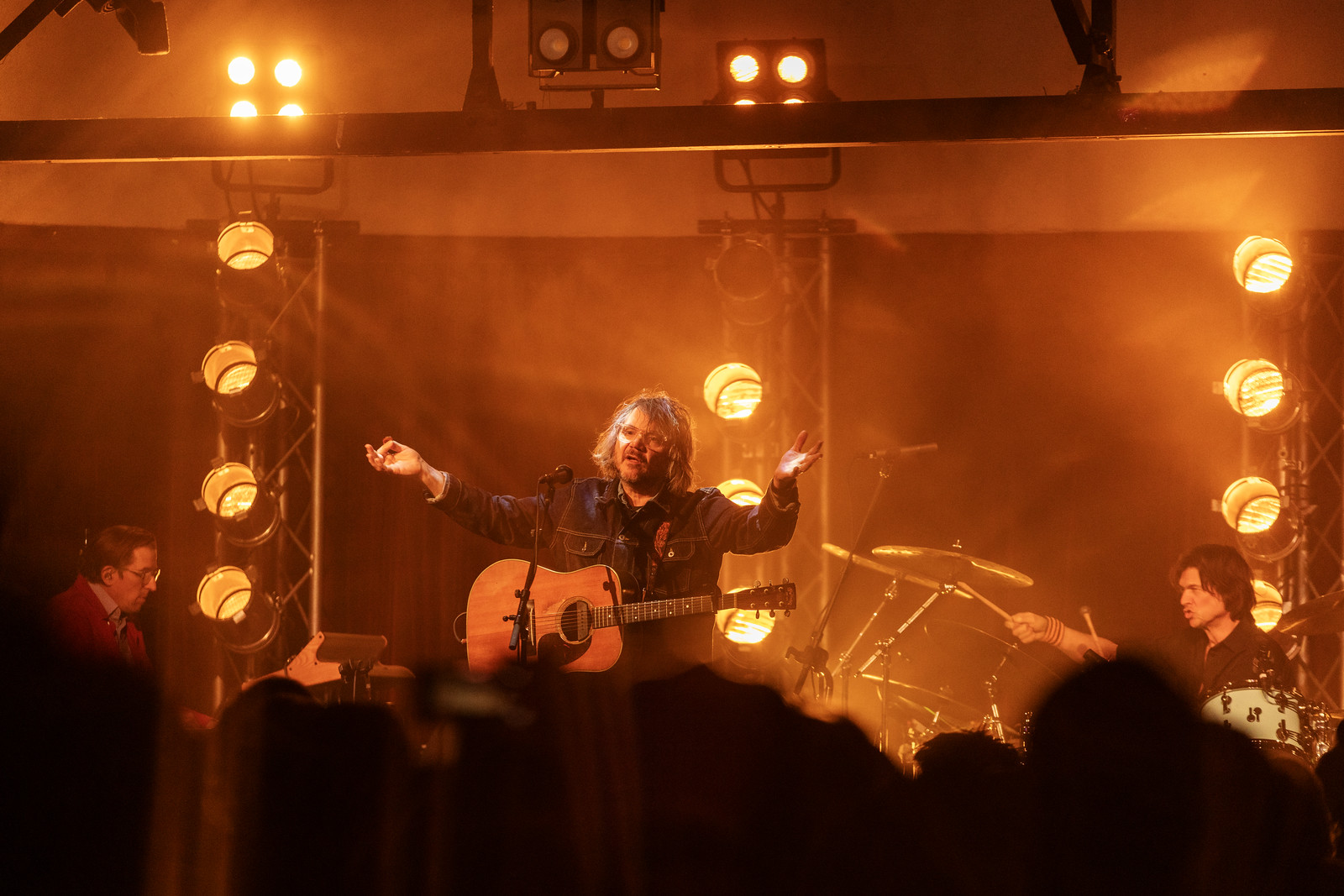
After we put our kids to bed, me and the other white millennial dads of Tulsa linked up with elder fathers and various flannel-wearing audio geeks and schlepped ourselves to Cain’s Ballroom for two straight nights with Wilco. Why did we bravely ignore our lower back pain, stay up past 11:00 and suffer the indignity of an early alarm clock to do this, not once but twice?
Well, for many of us, Jeff Tweedy certainly cuts an aspirational figure. In the same way that 26-year-old bisexuals want to be Chappell Roan, we want to be Tweedy. He’s got it all: a stable entrepreneurial enterprise that centers his creative interests and skills, a seemingly healthy family dynamic, industry achievements and recognitions, and of course, a big bus for roadtripping with his buds. What could be better than that?
Wilco was an important band to me growing up; a favorite history teacher set my life on a track out of Christian butt rock territory when he loaned me his copy of Summerteeth. Since then their music has accompanied me on roadtrips, cemented friendships and even smuggled itself into my subconscious. But the band really earned my respect when I saw them twice in a two-year span in my 20s.
The first time was at Cain’s in 2008, when they played a set heavy with pretty, melodic Woody Guthrie covers (five) and those fun alt-country numbers from their early albums. Tweedy wore a sparkling white nudie suit onstage in homage to the western swing forebears who first filled the room, and had the crowd eating out of his hand by the end of the night. The second was in London late in 2009, where they showed how big their wheelhouse was by playing two and a half hours’ worth of diametrically opposite music centering Nels Cline’s improvisational genius–call it “krautrock onslaught”–just as well.
And so, here they returned to Cain’s, for a two-night engagement sandwiched between similar three-night stints in Austin and Minneapolis that they’re calling the “Winterlude” tour. Tweedy insisted that Tulsa was at the top of the list for this exercise, which they’ve been doing for a few years now in Chicago exclusively. I imagine it frees them from the burden of audience gratification, only to saddle them with the new burden of rehearsing some 100 songs. No matter for a band that plays 60 or so shows in a year.
Onstage Tweedy insisted both shows wouldn’t just be “Wilco 101,” which registered a chatty excitement among the fans. This approach to the business of playing live music seems carefully designed to tempt the most dedicated among us out for both nights. I definitely noticed when the first night’s set didn’t include any songs from “Summerteeth,” then woke up the next morning and promptly bought a ticket to the second show. If gatekeeping a particularly beloved album from night one was a ploy, it worked on me.