

Skip to Content
Reviews

ASL Sensor Gloves As Musical Instrument And Other Observations From David Alan Broome’s ‘Musical Science Theater’

An overflow crowd gets out to get weird

photo by Alicia Chesser

David Alan Broome: “Music For The Senses”
LowDown
March 9, 2024

I never thought I’d see an overflow crowd show up for an experimental music gig in Tulsa, but Tulsa has a way of upending my expectations. It’s part of what keeps me here, keeps me out there: you never know when some new eddy is going to surface in the current, however familiar you are with the stream. 

As LowDown filled with people last Saturday night, I kept overhearing versions of the same comment: “I’m not really sure what this is going to be?” Preview materials for Tulsa-based pianist and musical adventurer David Alan Broome’s “Music For The Senses” (sometimes listed as “Music Of The Senses”) promised something about machine learning, something about American Sign Language, something about original compositions. Social media hinted that there might be a string quartet involved. Word got around that singer Annie Ellicott might be performing, too, and that it would be her birthday. All of this proved intriguing enough to pack the house with an unusual mix of music nerds, weird-art aficionados, Tulsans with hearing loss and tech people. 

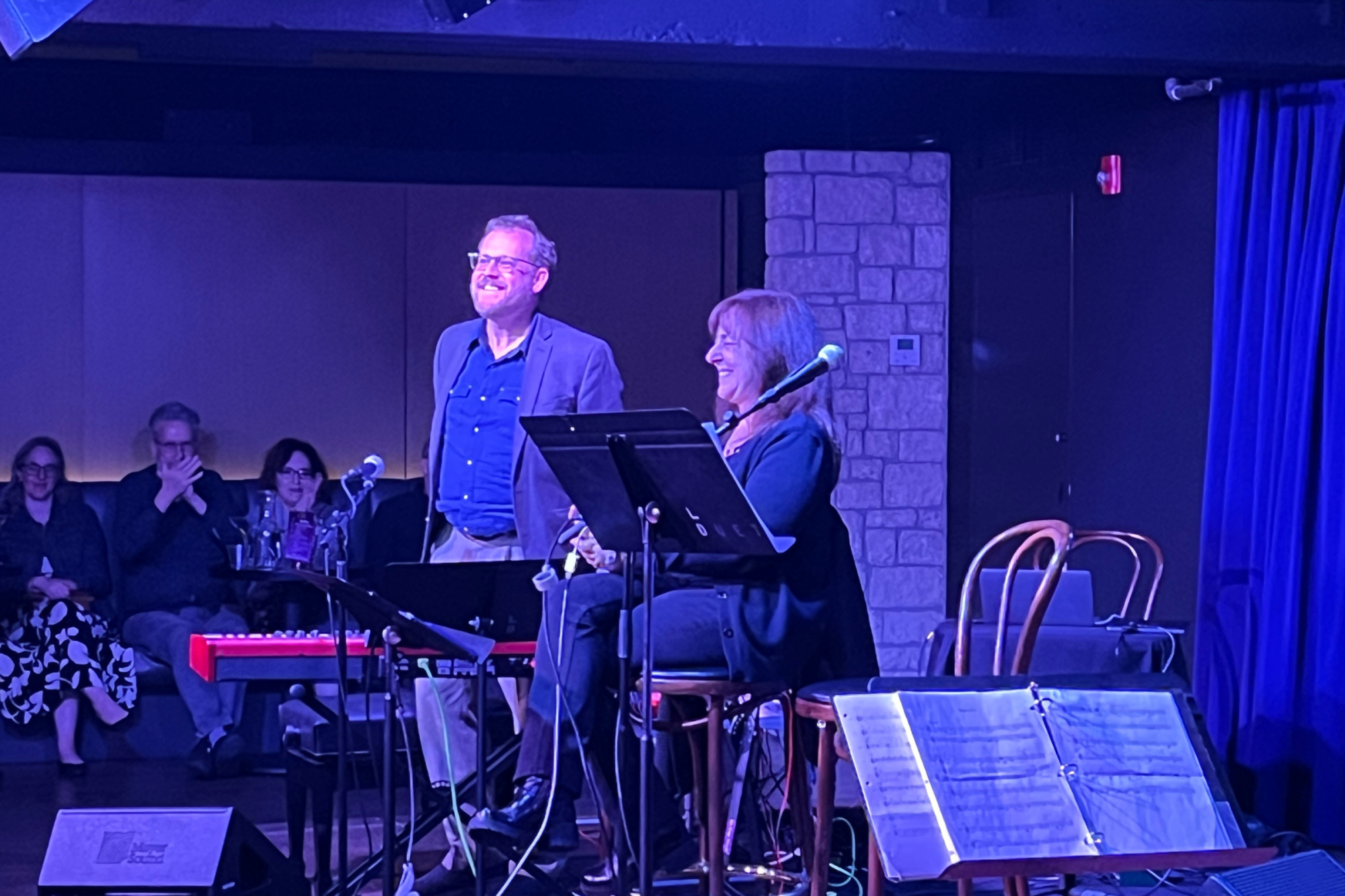
It was a four-act show—well, five, if you count the inadvertent performance art piece that ended the night, in which the candles on a birthday cake some friends brought in for Ellicott set off the fire alarm and all the buildings on the block got evacuated. The uncertainty around “what was generating what” in these pieces was one of the primary delights of the concert, which Broome described as “musical science theater.” 

As part of NYC-based Ensemble Pamplemousse, Broome has been exploring the realm of experimental chamber music for many years. His opening composition on this night merged strings, synth, and voice with uncanny sound effects produced by the light-responsive-sensor-studded gloves worn by ASL interpreter Sandie Busby, as she translated AI-generated text that was delivered in real time via technologist Aaron Bean and sung by Ellicott. (Here’s a podcast episode where Broome and Bean discuss their collaboration.) 

That sounds like … a lot. But the result was a seamless whole, a sophisticated composition evoking a nighttime landscape full of growls and sparkles. Two violins, a viola, and a cello rose, seethed, and collapsed; at one point, the musicians breathed through harmonicas as they played. Long, piercingly dissonant high notes from violinist Kiersten Moser became icicles of harmony picked up by the ensemble, then resolved into a gentle melodic line. Gamelan effects from Broome’s piano spangled alongside Ellicott’s reedy voice as she found the song in the poetic text that appeared in front of her on an iPad: “thunderclouds poised in the distance … seeker of the hidden truths told by the clouds in the eyes of the sky … weaving the world’s scales … gone from sight but not from mind.” A bending line in the music became visible in a soft sweep of Busby’s hand across her face. Her movement, producing its own “voice” through a modular sound box, told the unheard story. 

After a long break, an untitled piece from Broome and Moser’s ongoing project doom.kit—a mesmerizing drone—kept the meditative energy of the first half going. Moser masterfully ranged through dimensions of stretched lines, noise, and fuzz on her violin, sometimes vocalizing too, as Broome modulated her sounds through his synth and weaved in rainy drip-drops and soft, loose chords. 

We were prepped to see the music, by this point; as the show transitioned into its third act, we were invited to be the music. At the piano, martini in hand, Broome called out prompts to the audience—name a natural phenomenon! a barnyard animal! a problem!—as Ellicott, Bean, and Busby retook the stage with roguish smiles. Bean fed the responses into the AI (with the added input of “in the style of”), which instantly created poems that Ellicott and Broome then improvised songs from. On the spot, they generated fully-realized tunes about an aurora borealis (in the style of Samuel Beckett), an alpaca (in the style of Dr. Seuss), and stepping on a LEGO (in the style of Mark Twain), with the performers barely holding it together at times as they delivered the incredible goods for an audience that could not believe what they—what we—were doing. 

Finally, after a “happy birthday” singalong for Ellicott, Broome said we were finally going to get some answers as to the mechanics of these performances. The explanation was as mischievously confusing and perfectly executed as the performances themselves. “There have been a lot of questions about what’s going on up here with these objects and how they interact with each other, and I just wanted to take a moment and … have Sandie explain it to you,” Broome said—and the audience laughed as Busby started ASL-interpreting a written statement in front of her. We heard snippets of Broome’s recorded voice, but they soon became completely distorted by effects from Busby’s sensor-gloves as she translated his script. The hoped-for description became an absurdist performance of its own: six minutes of gleeful obfuscation that was nonetheless brilliantly clear.

After the show, I walked across Guthrie Green with the sound of the birthday cake fire alarm fading behind me, as evacuated Tulsa Artist Fellows and Duet Restaurant patrons made their own impromptu ensemble sounds on the sidewalks. Suddenly I couldn’t tell where the concert stopped and life began. It was like the night’s experiments had fled their lab and were prankishly following me outside. When I unlocked my car, it beeped in the same pitch as the alarm—a synchronicity I was fully primed to enjoy thanks to Broome and his friends.  

If you liked this story, please share it! Your referrals help The Pickup reach new readers, and they'll be able to read a few articles for free before they encounter our paywall.

Stay in touch

Sign up for our free newsletter

More from The Pickup

Meet The Composer Turning The Spotlight Theater Into A Living Soundscape 

In “Architectural Counterpoint,” Bruce Goff and Olinka Hrdy's designs become part of the composition

March 3, 2026

At The Spotlight, The Rivalry Between OKC And Tulsa Is Made Musical 

The historic venue hosted a night of rappers and DJs, put together by ThunderWof. and dj noname.

March 3, 2026

Welcome To Goff Week

We’re celebrating Tulsa's wild wizard of modernism with a full slate of stories

March 3, 2026

Tom McCarthy On The Goffness Of Tulsa Club

Tulsa was once on the cutting edge, and Bruce Goff was a big reason why

March 3, 2026

Let’s Dig Through TFA’s Trove Of Bruce Goff Material

Inside the archives of an “architect’s architect"

March 3, 2026

In Chicago, Bruce Goff Finally Gets His Due 

The Art Institute’s “Bruce Goff: Material Worlds” shows Goff as he was meant to be shown

March 3, 2026
See all posts