
Editor's Note: This article was originally published in the Spring 2015 issue of This Land.
In 563 BCE, on the full moon day of April, a prince was born, named Siddhartha Gautama, who would leave his kingdom and abandon the material world in pursuit of freedom from old age, sickness, and death. At 35, while meditating beneath a bodhi tree, Siddhartha conquered the demons of his mind, liberated himself from the cycle of reincarnation, and achieved a complete awakening. After that, he became known as Shakyamuni Buddha, the father of Buddhism, and he spent the rest of his life leading others to the path of enlightenment.
In May of this year, 2,639 years after Buddha’s birth, around 200 Vietnamese Buddhists celebrated the event with a ceremony and festival at Chùa Tam Bào, Tulsa, Oklahoma’s only Buddhist temple. (Chùa means “temple” in Vietnamese. Tam Bào means “three jewels” and refers to the three jewels of Buddhism: the Buddha, the Dharma, and the Sangha.)
Tam Bào was established in 1993, when Buddhist Vietnamese refugees, who began to settle in Tulsa after the fall of Saigon in 1975, pooled their resources to buy five acres of land in east Tulsa, at 16933 E. 21st Street. The property included a house—where the temple’s abbot, monks, and nuns live, and where community gatherings are held—and a 3,300-square-foot metal building, which was converted into the temple. At the time, the Tulsa World reported that roughly 1,700 of Tulsa’s 2,500 Vietnamese citizens practiced Buddhism. But Buddhism doesn’t require temple attendance, and the temple’s abbot, the Venerable Thich Duc Tri, said between 70 and 80 people participate regularly in Sunday services. Upwards of 300—from Tulsa and across the country—attend special events, like the Buddha’s birthday festival, called Dai Le Phat Dan in Vietnamese.
The temple added an English-language service in 1998, and the abbot was appointed to the temple in 2005. Sunday services are held in English at 9 a.m. and in Vietnamese at 10:30, and the temple is open every day for chanting and meditation. In fact, the temple is rarely closed. The doors stay unlocked; anyone can come in and meditate or chant the sutras anytime they like. And the gates of the grounds are open to Buddhists and non-Buddhists alike who might want to wander among the 18 arahan—statues of historical figures that represent virtues that Buddhists should try to attain.
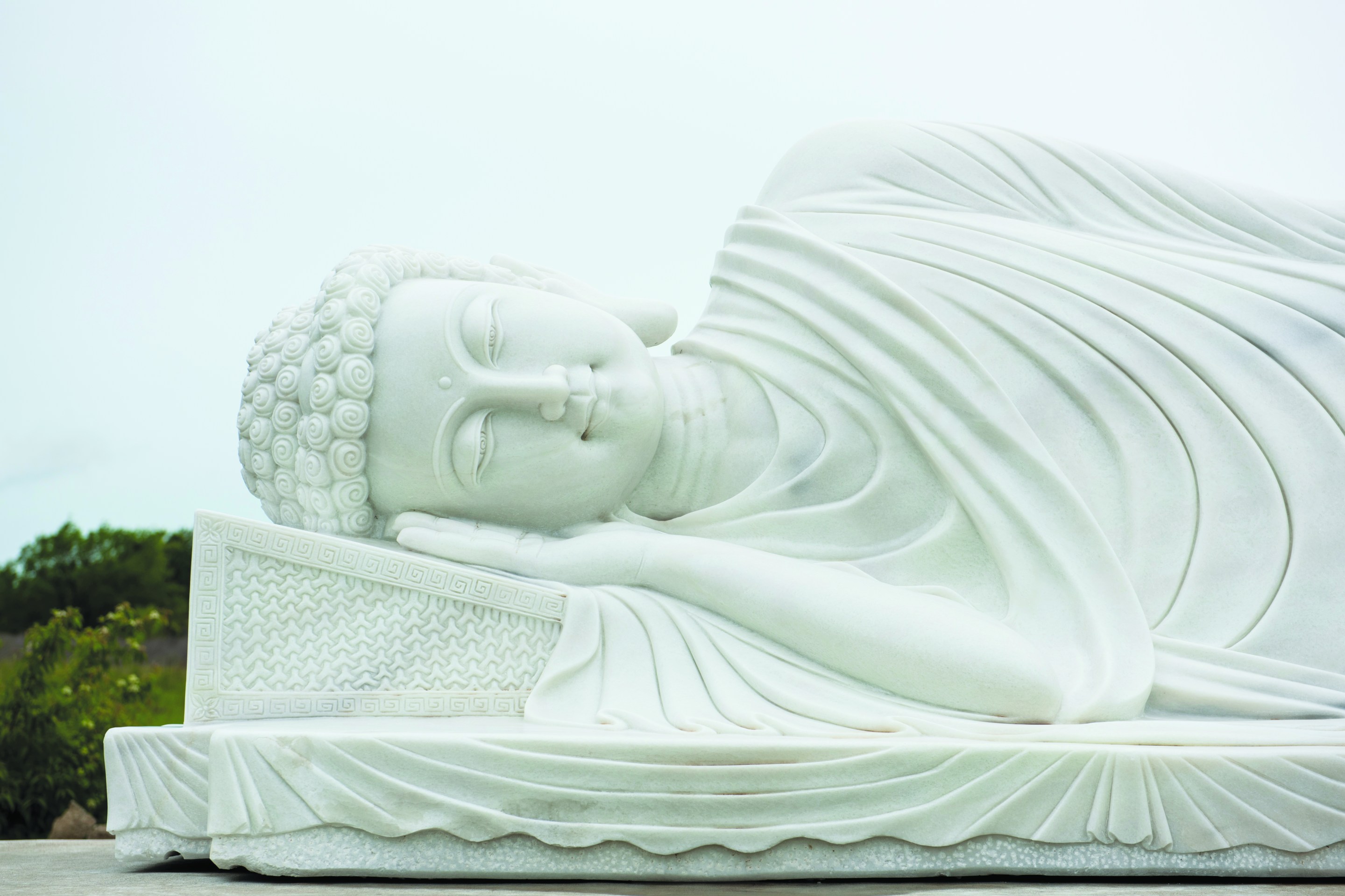
Many of the random daily visitors aren’t Buddhists at all, but gawkers, admirers of one of Tulsa’s lesser-known roadside attractions: a 57-foot-tall granite statue of Quan Âm (commonly known by her Chinese name, Kuan Yin), a bodhisattva who represents mercy, compassion, kindness, and love. A bodhisattva is a “being of bodhi or enlightenment—one who has earned (the opportunity) to leave the world of suffering and is destined to become a Buddha, but has forgone the bliss of nirvana with a vow to save others,” explained the temple’s secretary, Uyen Nguyen.
The 400,000-pound Quan Âm was sculpted in Vietnam and shipped to Tulsa in 12 pieces, which represent her 12 vows, and erected on the temple grounds in 2011. The process of fundraising, permitting, and logistics for the statue took two years and about $350,000.
In a 2011 story in the Tulsa World, Bill Sherman wrote that the members of the temple sought to erect the statue, not only as a reminder to themselves to embody the virtues of Quan Âm—compassion and kindness—but also as an act of gratitude and appreciation to the United States, which accepted them as refugees, and as a beautification effort for the city of Tulsa. Temple abbot Duc Tri told the World: “We want to contribute to the society the symbol of the compassionate love to all beings and also to beautify the city of Tulsa.”
Not every Tulsan appreciated their effort. In 2009, when the Board of Adjustment was deciding whether or not to approve the statue, three people spoke in opposition to it, including a city councilor at the time, David Troyer, who said that “the proposed statue was different, for example, from the ‘Praying Hands’ and Prayer Tower on the Oral Roberts University campus,” according to a Tulsa World report.
“This is a deity which they worship, therefore making it a god, making it a deity, and that’s the difference. That is another reason why so many people oppose it,” Troyer said.
Others, including one board of adjustment member, expressed concerns about the statue’s height and its proximity to 21st Street—300 feet.
Troyer’s claim was incorrect. Bodhisattvas are not deities, nor are they worshiped; rather, they serve as examples of the enlightenment Buddhists should try to attain by abiding by their virtues and helping others. The Buddha himself is not worshiped but emulated. In his remarks during the Buddha’s birthday celebration, the Venerable Thich Duc Tri said: “Buddha said that ‘I was a Buddha and you are a Buddha to be.’ Everyone can become Buddha. The historical figure of the Buddha helps wake up or recognizes our inherent Buddha nature.”
There’s another major difference between Buddhism and Christianity, Duc Tri explained during an interview prior to the festival: Buddhists don’t try to convert others. The temple keeps its doors open and welcomes anyone who wants to enter, but it doesn’t try to convince others that Buddha’s way should be their way.
During the ceremony, Duc Tri said: “Buddha taught that everyone is equal; there is no discrimination when everyone’s blood is red, and sweat is salty. That is the humanity concept; the Buddha is in his universal, impartial, and equal attitude towards all beings. In his teaching, there is no discrimination; if anyone can practice compassion and love then they can achieve peace and happiness.”
The focus of the Buddha’s birthday ceremony culminated when the monks and abbots bathed a statue of the Buddha as a baby with water, and then invited everyone in the congregation to bathe the Buddha as well. The act of bathing the Buddha is intended to signal to the Buddhist that he or she should also bathe his or her soul. It’s an opportunity to “cleanse yourself of any dirtiness or attachment you’ve accumulated over the year,” said Steve Le, a doctor visiting from Houston. “This isn’t the only day you should do it, but it serves as a reminder.”