


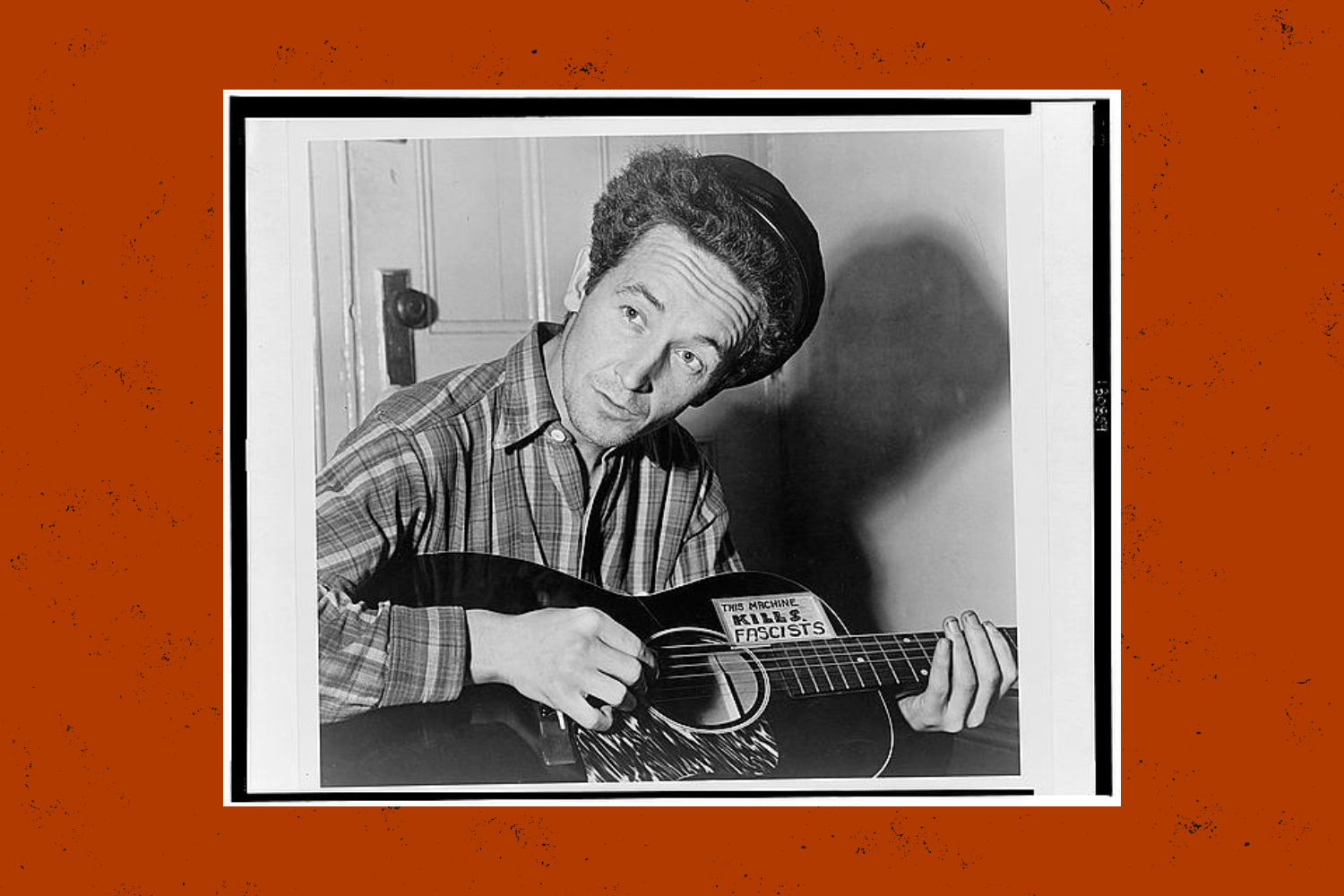
Editor's note: The subjects of Woody Guthrie's songs never stopped being an issue. Immigration reform, bank foreclosures, poverty, ecological disasters—all remain material today. But when you peel back the songs, the humor, the mythology, what's left? Originally published in the July 2012 issue of This Land, Matt Carney conveys a biographer's attempt to understand Woody Guthrie the man.
It’s easy to want to idolize Woody Guthrie. The guy was an adventurer, a wandering bard with a soft spot for people denied their fair shake. He riled his era’s villains (Joseph McCarthy1) and rubbed shoulders with its geniuses (John Steinbeck2), all while looking like he’d just hopped off the nearest freight car. Guthrie frequented political rallies and scribbled endless prose, articulating in words and song the feelings that the country’s poorest, out-of-luck inhabitants could only express in grumbles. He traveled like a jolly thief, reinforcing the east and west coasts’ perception of good Midwesterner humor that Will Rogers first introduced them to.
Guthrie lived a romantic life, one envied, admired, emulated, and recorded by so many after him that it all inevitably snowballed into a great big honking mythology, one so large as to overshadow his failings. And up until 1980, when he read Joe Klein’s definitive biography, Woody Guthrie: A Life, Bob Santelli was one of the many devout followers of Saint Woody, an unrealistic man who, in his eyes, did no wrong.
Santelli grew up in West New York, New Jersey in the 1950s and ’60s, where he first encountered “This Land is Your Land” the same way many a grade-schooler did. And like so many other Baby Boomers, Santelli eventually worshipped Guthrie through another of his heroes. That was Bob Dylan, whose “Song to Woody” appeared on side two of his 1962 eponymous debut album. From there, Santelli devoured everything he could find that bore Guthrie’s name, including the memoir Bound for Glory.
“Prior to [reading A Life ] I’d seen the movie that was made about Woody Guthrie’s life [the David Carradine-starring 1976 film Bound for Glory ], I’d read everything I could about him, got his albums, knew his music, but I didn’t know much about the man,” said Santelli, now the Grammy Museum’s executive director and a many-times-published rock historian. “Joe Klein’s book … he’s the one who shed light on the fact that this man—as interesting as he was—had faults. And I didn’t think he had any.”
While loving and playful, Guthrie—who was born in Okemah in 1912 and grew up mostly there and in Pampa, Texas—made a habit of setting out on the road to scare up work as a singer and performer of odd jobs, instead of tending to his eight children and three wives. The man was undeniably impulsive; he “roamed and rambled,” as his famous song says, setting west for California and east for New York on several occasions, whether driving or thumbing his way along the highway, leaving those closest to him far behind in the Oklahoma dust. He’d send money when he could, but while he was out surveying the people, places, and things that constituted the wide country he lived in, his first wife Mary and their children found themselves stuck at home, mired in the terribly unpredictable poverty of the Great Depression.
“Back in Texas and California, when Woody was with Mary, he was young, wild, and reckless; he didn’t really know the meaning of fatherhood. Immaturity and a constant thirst for adventure and music always seemed to get in the way,” Santelli wrote in his recently published This Land is Your Land: Woody Guthrie and the Journey of an American Folksong . “He wasn’t even the best of friends to people who considered him a friend,” Santelli added in his conversation with me.
By the early 1950s, alcohol and Huntington’s disease amplified Guthrie’s volatility. “The respect that fellow folksingers and people in New York folk circles had for Guthrie never wavered, but increasingly they saw him as a tragic figure,” Santelli wrote. “At home, [second wife] Marjorie witnessed wild mood swings; sometimes there was no alcohol involved, which at first puzzled her, then frightened her. The worst part was that Woody was growing violent, and more than once she feared for her life and the welfare of their children.”