


"Song Of The Council Oak"
Chimera Ballroom
February 23, 2025
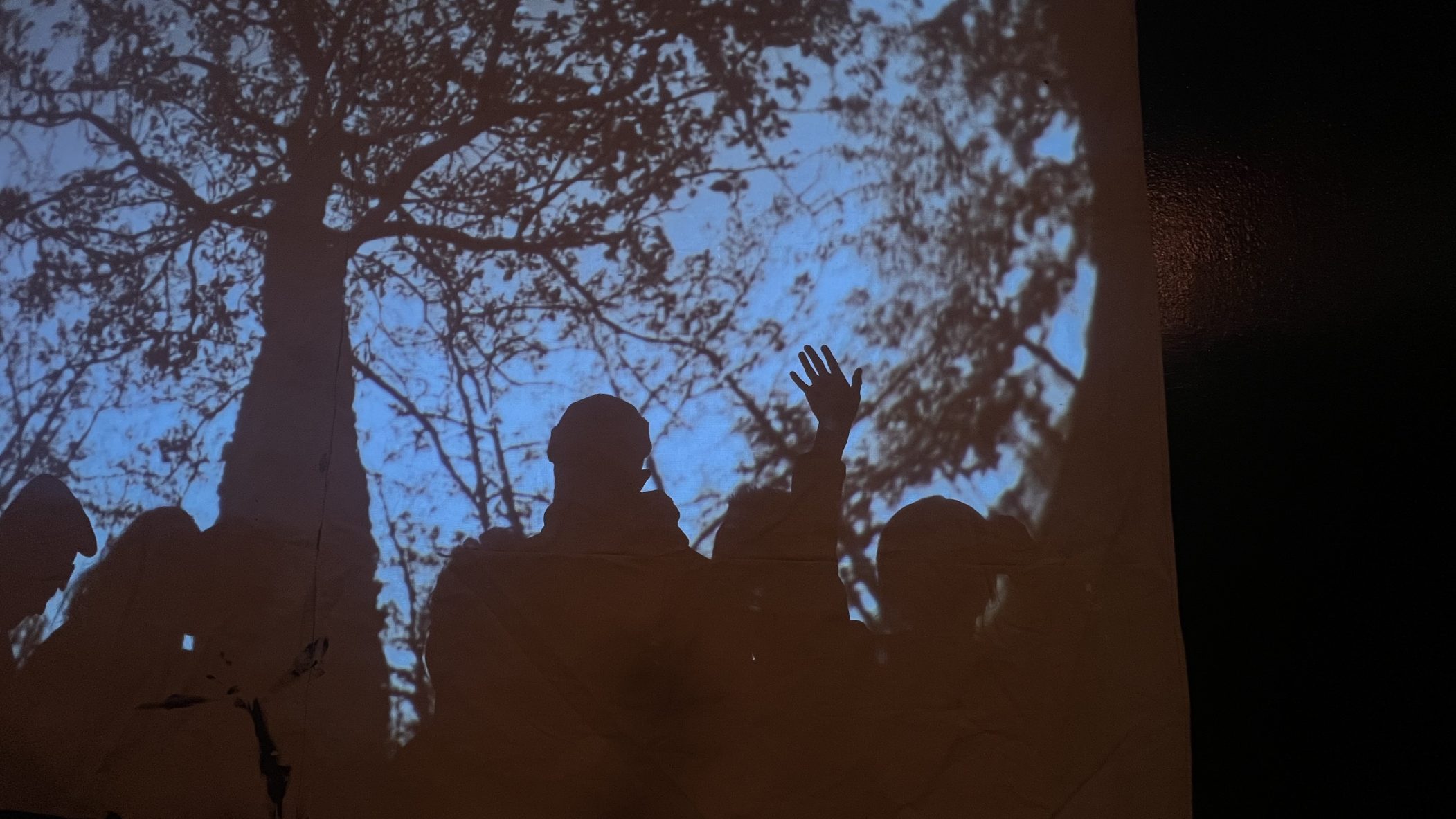
Chimera’s darkened ballroom glowed beneath a portrait of the Council Oak Tree at the premiere of “Song of the Council Oak,” which brought together composer and electronic musician Mark Kuykendall, Mvskoke-Creek/Chickasaw historian J.D. Colbert, and a capacity crowd for an evening of deep listening.
All living beings emanate bioelectric fields—even trees. Curious about the relationship between plants and music for decades, Kuykendall sought to find what the Council Oak Tree may have been saying to us during its 400-year life—and what it’s still saying. To create this piece, he connected diodes to the tree and recorded its electrical impulses (its voice, if you will) in real time using biofeedback technology, which he then processed and arranged through audio software and a Buchla synthesizer to build a four-part ambient symphony.
Next to houseplants and vines that twinkled with projection-mapped lights, Kuykendall sat under the image of the tree and played us its song. Sometimes it sounded like a benevolent warning, one you might hear from a mother figure. Sometimes I heard a whisper, a warm trill, a growl of hunger. The sounds ranged from ominous and erratic to fervent and almost hopeful as Kuykendall shaped the tree’s complex tonal energy. The fourth and last movement ended with Kuykendall letting unprocessed sounds from the Council Oak itself pour out in a wave of fierce noise: warbling, formless notes growled from the tree like the song of a whale.
Before each movement—one for every hundred years of the tree’s life—Colbert gave a historical introduction that shared a story parallel to the tree’s: that of the Muscogee (Creek) people who were forced from their homes in Alabama and made a new home here, right on the site of the Council Oak Tree. He noted that Indigenous medicine people have practiced interpreting nature for millennia, listening to all living beings as a form of prayer. With this interplay between history and sound, Kuykendall and Colbert suggested that the Council Oak has been a witness to the footsteps that drove entire communities into displacement and resettled them here, as well as to the earth’s own upheaval.
At the end of the evening, Kuykendall invited audience members to the stage to experiment with the same biofeedback technology he used to listen to the Council Oak. We attached diodes to our fingertips that picked up our bodies’ electrical impulses, then linked hands and made a circuit of sound. The human heart, Kuykendall said, emits four volts of energy. That’s far less than the Council Oak, but it was still enough to produce a song we wouldn’t have heard without his guidance.