Skip to Content
Culture

The Collage of Memory

Zach Litwack's mixed media show reflects on living (and not living) with nostalgia.

3:11 PM CDT on July 26, 2023

Zach Litwack’s “Phantom Limb”

|photo by Alicia Chesser

Phantom Limb: Mixed Media Works by Zach Litwack

Liggett Studio

July 14-August 4, 2023

Who are you when you lose part of what makes you “you”? 

Zach Litwack started asking that question in the depths of the early pandemic when his filmmaking work had shut down, and like everyone else, he was forced to find other ways to get through the days. So he dug into his creative toolkit (he’s worked as a writer, educator, musician, visual artist, and more), picked up scissors, paint, and glue, and started building mixed-media pieces and character studies about loss, memory, identity, and what he calls “the pitfalls of nostalgia.” The art that emerged—collected in “Phantom Limb,” on view at Liggett Studio through August 4—pulls together many elements of Litwack’s creative intelligence into a body of work that, with its striking visuals and gentle pressure on tender psychological places, resounds like a quiet gong.

On its surface, “Phantom Limb” explores the physical phenomenon where people continue to feel sensation in a part of their body that has been removed. But Litwack takes the prompt further, as he notes in his artist statement, “to not only include arms and legs, but any part of the human body that may be detached in some way, and importantly, trigger memories and emotions as a result of being absent.”

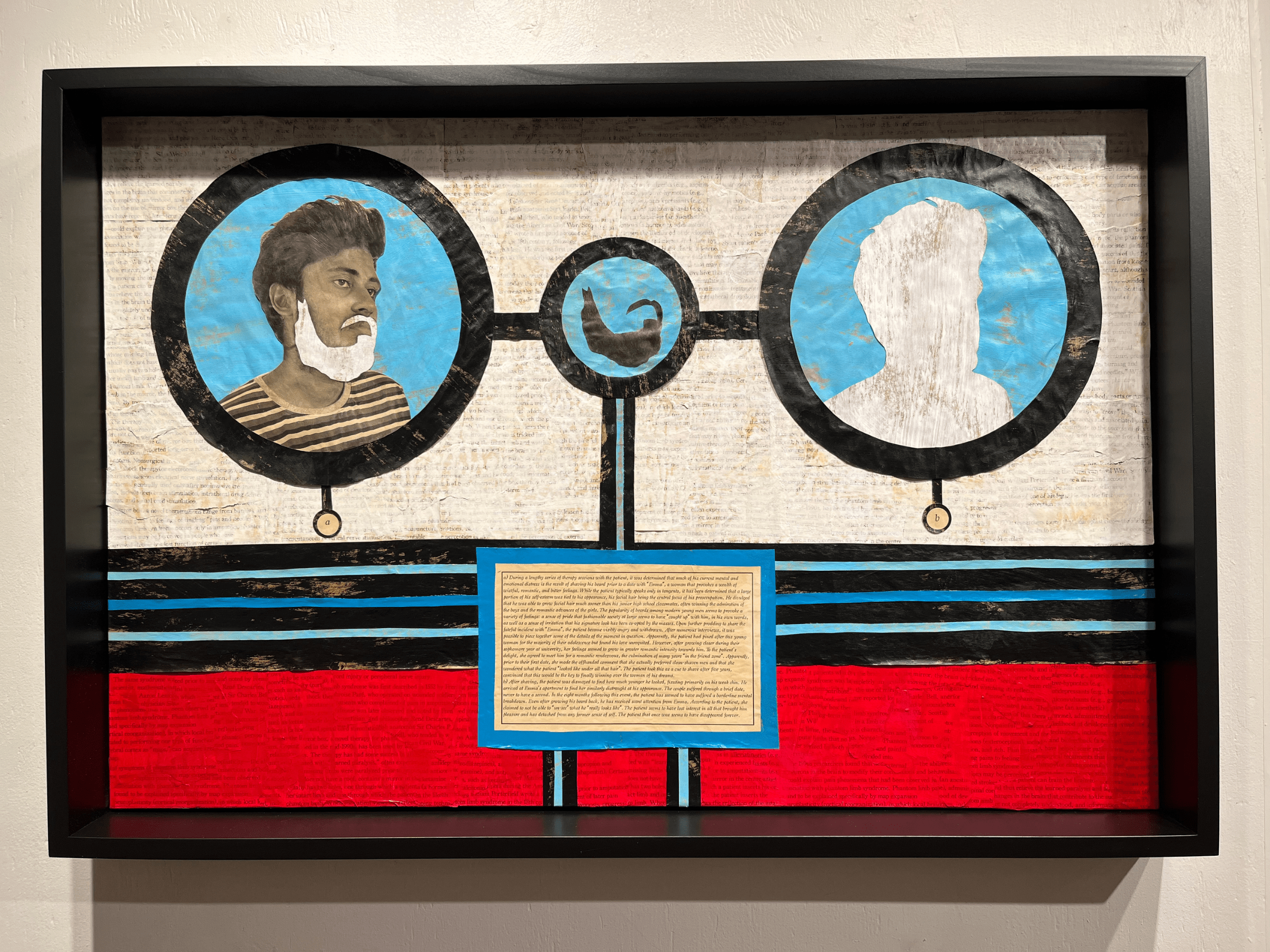
With their minimal color palette (white, black, blue, red, sepia), high-impact graphic design, tactile collage and paint techniques on rough wood panel, and sharp focus inspired by vintage anatomical drawings and medical illustrations, these pieces hit the eye from across the room like contemporary icons. Lines radiate from bodies and hang from horizontal stripes, strongly punctuated by dots like train terminal markers on a map, or the ends of beaded curtains, or the “anklebone connected to the kneebone”-shaped hole in the Operation game. Energy released outward from the figures turns right back around and comes in again; each piece is somehow both static and vibrating. Body parts are isolated, identities unmoored, new ones still in process—as in the process of collage itself. 

Art by Zach Litwack | photo by Alicia Chesser

Litwack created a narrative for each of these figures, and in the form of a medical history interview the narrative is typed in old-fashioned font and pasted onto each panel. In some cases the text reads like something from the 1890s, while in others references to things like Facebook posts bring the action speeding toward the present. Each lettered point in the documentation corresponds to a marker on the image above. Each memory has a physical location. Some narratives are harrowing, some amusing; others bring a cringe of secondhand … something, not shame exactly, but acknowledgement of loss, followed by relief that that “something” could be brought to the surface, held together, seen. 

The figures, taken from old magazines, are blown up to a size that makes them feel a little eerie: not quite still a cut-out, yet not quite human-scale. Eyes look out steadily, both direct and remote. A Russian prisoner whose larynx had been removed reveals that he used to be a singer, nicknamed “Angel.” A woman who’s lost part of her brain can no longer recognize key moments in her own traumatic past. Mirror neurons start to fire as one stands in front of these characters. In what sense is a life ever a seamless whole? Aren’t we always living with separation, fragmentation, scattered bits of history that still speak in our own bodies? Yet aren’t we still here, standing in galleries and talking with friends and doing the shopping, with these absences present, pasting together some life that can hold it all at once? 

"Phantom Limb" opening reception | photo by Alicia Chesser

Litwack’s show achieves that rare thing: it finds a form that’s detailed and thorough enough to allow a resonant metaphor to move through it with subtlety and power. It quietly invites us to accept that we aren’t now what we were, whether specifically post-pandemic or after any radical loss. What’s more, it invites us to rethink how we value “what we are”: as limited, as beautiful, as grieving, as transformed. 


The Pickup's reviews are published with support from The Online Journalism Project.

If you liked this story, please share it! Your referrals help The Pickup reach new readers, and they'll be able to read a few articles for free before they encounter our paywall.

Stay in touch

Sign up for our free newsletter

More Stories

Tulsa’s Theatre Workers Take A Well-Earned Bow

At the fourth annual Potate Awards, community theatre artists honored their own with an end-of-season party. We've got the full list of winners here—including one for The Pickup's own theatre critic!

July 24, 2026

The Comedy Wing Of The Dirtbag Left Lets Loose At Cain’s

"Last Podcast On The Left" delivered a live show that was a mess, but not necessarily a miss

Is Markwayne Mullin Making A Killing In Artisanal Kratom?

A new investigation suggests the head of homeland security is playing a key role in a Trump administration campaign to boost an industry he has a stake in.

July 22, 2026

Gen Z Is Finding Their Way To Woody Guthrie

From Solid Sound to WoodyFest to Tulsa, our correspondent tracks Guthrie's legacy beyond nostalgia and into the future.

July 21, 2026

The Best Tulsa Events: July 22-28

"Oklahoma!", Benson Boone, Tulsa Fringe Festival, and more!

July 21, 2026

Let’s Take A Trip To Imaginary Oklahoma

Heat crazed? Get into the spirit with selections from This Land Press' flash fiction series, in which 46 of America's most important writers spun their own takes on the 46th state—from cryptid fables to surreal situations.