

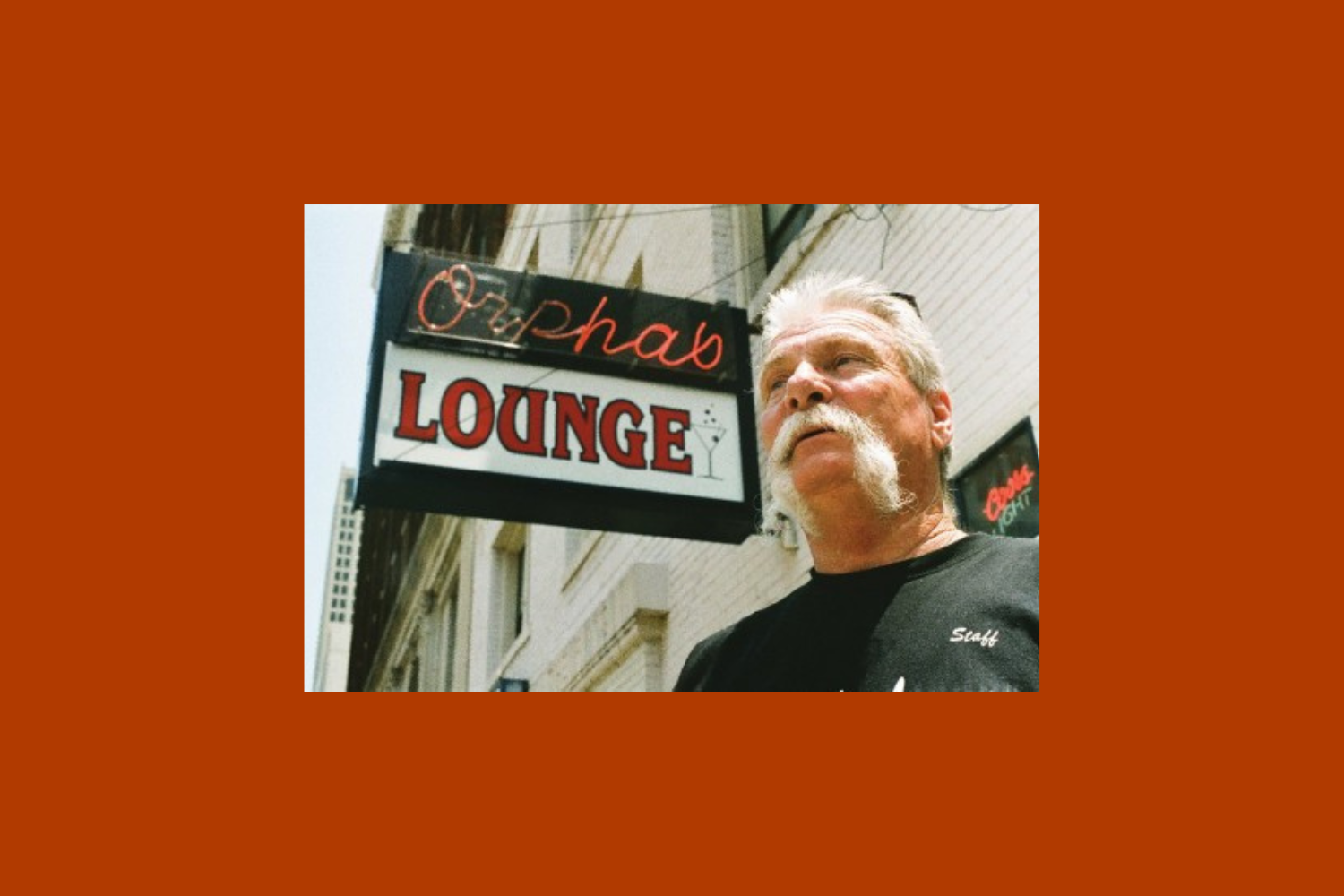
Editor's note: When Natasha Ball captured this portrait of Orpha's Lounge in the July 1, 2011 issue of This Land, the notorious dive was beginning to see downtown change around it. As the newly opened BOK Center brought sports fans and concert-goers by the thousands, Orpha's preserved a world of its own by continuing to cater to a revolving cast of Tulsans living on the edges of society. It seems like that's how the bar's namesake would've wanted it.
The 1970 Cole’s Cross Reference Directory—an avocado-green volume in the corner of the fourth floor of Tulsa's Central Library—lists 112 W. Fourth St. as the home of Orpha’s Lounge. Upstairs, at 110 ½, was Orpha’s Hotel. On the same page, there’s a number for Oral Roberts University and its Dial-A-Prayer line, and a listing for the Orpheum Building. There’s also a personal address tucked among the commerce listings: Orpha Satterfield. She’s been dead more than 10 years, but she continues to receive mail at the address.
Orpha’s Lounge, Inc. management says that the bar opened in the three-story Irving Building in 1958. In the years between, the street and phone directories show Satterfield operated a bar northeast of Orpha’s on Second Street, a place listed as the Post Office Bar. A space in her name lingered in the direct vicinity until she bought the Irving Building with the help of a small loan from her son-in-law. She moved in above the lounge two years after it appeared in the listings on Fourth Street, between the Coney Island Hot Weiner Shop and the Downtowner Motor Inn.
Satterfield, who also owned and managed apartment buildings at 1901 Riverside Drive, ruled her properties from behind a desk on the second floor on Second. She’d sit there watching daytime TV in the breeze of a small desktop fan, her presence like gravity on tenants and what they owed for rent. Her neighborhood was flush with attorneys’ offices, stenographers services, insurance and financial companies, hotels and barber shops. When her family came to town to visit, she pretended to live in an apartment at her 19th-and-Riverside property, the one with the wrought-iron fence and award-winning gardens.
Satterfield—who in her later years looked not unlike Momma in Throw Momma From The Train—had been in Tulsa since the mid-Fifties, when she worked at Bishop’s Restaurant. The Norman-born Orpha Mae Gibbs, whose name means “neck” in Hebrew, served the governor, local celebrities and entertainers at the downtown lunch spot. It was a far cry from the clientele she served at her mother’s restaurant and at the Burger King in Bristow, where she worked as a teenager. By the time she was 18, she’d married William Satterfield, an oil refinery worker. She was a housewife before she stuck herself out as a bar owner and landlord.
Orpha’s Lounge, Inc. was in Orpha’s name until 1996; she died at her Mansion House apartment in 1999 at the age of 85, on the first day of June. She was survived by at least 20 children, grandchildren, great-grandchildren and, yes, great-great-grandchildren, many of whom resided in Oklahoma at the time of Orpha’s death.
“If someone showed up at her place hungry, Orpha made sure you were fed,” her obituary read. “If you needed some cash, she could find an odd job for you to do. She would cook holiday meals and feed anyone who showed up.” A former tenant of hers remembers how she’d offer beer coupons to anyone who paid their rent on time and in cash. She made mothering a lucrative business.
Since Orpha’s time, the neighborhood along Fourth Street has changed a bit. The BOK Center opened in the fall of 2008, putting Orpha’s Lounge on a thoroughfare between a couple of Tulsa’s renovated hotels, a vast inventory of surface parking lots and the 19,000-seat arena. It brought nearly 200 events and more than 360,000 ticket holders to downtown in 2010. On nights when the BOK Center doors are open, the crowd at Orpha’s turns into a mix of regulars and ticket holders, sharing cue sticks and turns at the jukebox.
Orpha’s Hotel is now a set of 18 efficiency apartments, lining the halls of the second and third floors with single occupants and communal bathrooms. Jerome Garvin, an Orpha’s Lounge regular, manages the business. He can’t say how many fights he’s gotten into downstairs. It’s not because he’d rather not say. It’s because he’s lost track.
“The BOK arena has had this drastic ripple effect on downtown, especially Orpha’s,” he said. “They get so much business from people going to and from the shows that they were forced to clean the place up. There aren’t stabbings there anymore.”
Jerome was living in one of the apartments when the owners of the building asked if he’d be interested in managing the property. He was the resident who’d been around the longest when the last manager quit, so they offered him the job.
The apartments rent for about $100 per week. It’s a rate that Garvin said serves as a stepping stone for residents of the nearby homeless shelters, the people on a first-name basis with the women who tend the bar downstairs. He said the old hotel is just as storied as the lounge, allegedly serving over the years as a drug house, a whorehouse and a residence for oil field workers during Tulsa’s boomtown days.
“Managing this place has been gratifying, but it can also be really disappointing,” he said. “There’s a reason that person is on the streets. Some people make it, others don’t. When they don’t, and it’s at my expense, it bothers me bad. I don’t like to kick people out when they don’t pay their rent, but yeah, they gotta go. No pay, no stay.”
It was Thanksgiving Day the first time Lee Sales went to Orpha’s. According to the tradition established by Orpha herself, the bar offers a full spread on major holidays. Sales ate supper and washed his hands of the place. He didn’t return until years later. He took over as manager of the bar about three years ago.
“The people who ran this place after Orpha would let people get piss-on-themselves drunk, and then they’d just drag them out the front door and leave them,” Sales said, shifting his large frame in his barstool. “When I first started to come down here, you’d have to step over people to get into the doorway.”
His first order of business once he stepped in as the main man was to shoo troublemakers.
“There are a lot of places I can’t go here in town now,” he said, grinning. “Some of the people I had to kick out I liked, but they had to go. When I took over, EMSA was in here three and four days every week. Someone would go into a seizure, or someone would get into a fight. I mean, God, it was pretty bad.”
The 61-year-old Sales—whose congeniality and smile belie his history as the manager of some of the roughest bars from New York City to his native California—drives to work at Orpha’s nearly every day from Wagoner, a round trip of about 80 miles.
“Where else can you work and get paid for shooting pool?” he asked, his smile showing from under his white Fu Manchu. The back of his gray mullet had curled with sweat. “Audrey’s the one who really runs things. She’s the ramrod. Anytime someone’s causing trouble, I tell them, you can deal with Audrey.”
Audrey had been behind the bar for three years when Sales took over at Orpha’s Lounge. She’s a westside girl, brought up in Garden City, the riverfront neighborhood known for its shotgun shacks, refineries and how it took the brunt of the flood back in ‘86. She’s built like a linebacker, and she carries herself like she’d be the only grandma to play the strongman game at the fair and win the five-foot teddy bear. Though she wouldn’t look me in the eye, she called me honey when she pointed me toward an open barstool at Orpha’s.
The interior of the lounge is situated so that everyone, especially Audrey or whichever bartender is on duty, faces the entrance. Everyone sees anyone who walks through the door—what they’re wearing, what they’re carrying, the color of their skin. The barflies studied me with something between suspicion and something like incredulity. Maybe they thought I was there to pass out tickets to everyone who had double-parked their junked-out shopping carts.
There’s a small door along the east wall of the bar. It’s easy to miss because the wood of the door matches almost exactly the wood paneling on the walls. Sales told me that he’d heard Orpha rigged a dumb waiter/elevator behind that door, and that she used it to go between the bar and her room upstairs. Behind me the walls were covered in signed dollar bills and birth announcements, scrawled on printer paper with photos of babies Scotch-taped to the bottom. Below were Easter Sunday’s pool tournament brackets, barely readable in the light of neon signs.
In June 2008, Tulsa World reported a stabbing at Orpha’s. A young man picked a fight with a few patrons. Audrey, the bartender on duty that night, told him to go. Her back was turned when she felt the man’s knife rip twice through the skin on her back.
“Who told you that?” she asked, looking up at me from underneath her long, dishwater-colored bangs as she dug for ice under the bar. She was wearing an extra-large Orpha’s t-shirt, the kind that looked like she’d bought it at an airport. “Yeah. I let my guard down, but he got it, too.”
She explained that a few regulars pinned the offending customer onto a table.
“I beat him senseless,” she said, looking toward the door. “I just wanted to draw blood.”
Two days later, Audrey was back behind the bar. For the time she was out, it was Misty, another long-time bartender at Orpha’s, popping tops and pulling drafts. Not long after Sales took over, Misty added Orpha’s to her family tree as well as her resume—she married Sales’s son, and now they have a baby boy. Ashley is the newest member of the staff, and though she’s too chatty to be tough as nails, Sales thinks she has potential.
While Tulsa’s Banana Republicans sipped martinis at the bar on the roof of the Mayo Hotel and lounged at the tables on the oasis-like patio at Arnie’s, a trio of drunks wearing dirty jeans and truckers’ hats sat slumped over the bar at Orpha’s. One shouted repeatedly for Audrey as she uncapped bottles of three-two beers for a couple of pool players.
“Audrey’s a pretty gal,” Sales said. “She’s got beautiful blue eyes. But I’ve watched her come out from behind that bar, and when she does, her shoulders drop and her blue eyes turn to little, tiny red spots. She gets on them ol’ stocky legs and whenever she grabs you—she grabs you on about a half a run, low—and she’ll carry you straight through that door. I’ve seen her do it more than once.”
The eyes of everyone sitting at the bar were on Audrey and this man. She turned and put her hands on her hips, and her head nodded as she shouted in the man’s face: “What do you want, you old bar drunk?”
He giggled, like a little boy who says dirty words solely to get his mother’s attention. He only had a few crooked, yellow teeth. I could see that Audrey was laughing too. For awhile she propped herself on her elbow and joked with the man and his friends, until a regular shuffled to the bar and wanted to trade her a CD and an old desk calendar for a bottle of beer.