



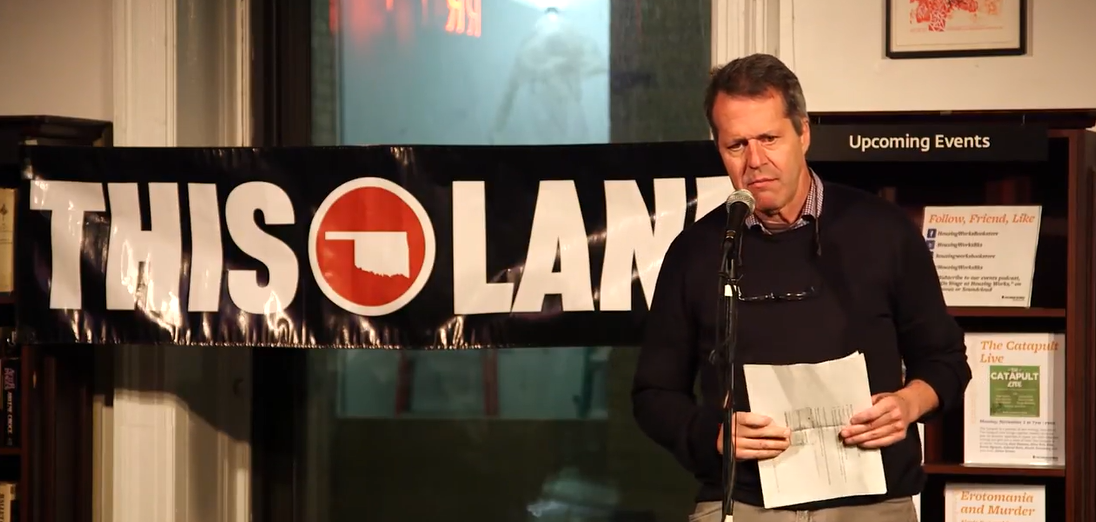
Because Mark Singer was so closely associated with the witty sophistication of The New Yorker—his wry profiles of Manhattanites like Donald Trump probably have something to do with that—it may come as a surprise that he had a lifelong fixation on his home state. As he told an audience for Storytelling with This Land Press in New York, “what I care about most is this place that won’t ever go away for me.”
Singer died last week in Manhattan, but he was born in Tulsa in 1950 to a Jewish family in the oil and gas business and his early life embodied the paradox of mid-century Jewish life in the oil capital. His father’s company, Singer Brothers, prospered, but Mark never felt like he entirely fit in. He once told me that no matter how much money his father made, he would always feel like an outsider. The social clubs that ran Edison High School in the 1960s did not accept him, and yet Singer was the valedictorian of his class.
His friend Laura Dempsey remembers him as a mischievous and funny kid at Barnard Elementary (which closed in 2011) and Edison High School who could not stop asking impertinent questions. Some of those questions reached deep into the heart of race and identity. Singer recalled that well into the 1960s, “it was possible to spend twelve years in a [Tulsa] public school—as I did—and never encounter a person of color.”
The whole experience left Singer feeling like “something was profoundly wrong with this place, but I didn’t know what that something was.”
Singer went to Yale, studied writing under the famous William Zinsser and then landed a job at The New Yorker right out of college. The magazine was known at the time for crushing aspiring writers with its high standards of reportorial exactitude and literary stylishness.
Stay in touch
Sign up for our free newsletter, The Talegate
Singer thrived in that environment, and for years tried to convince his editor to send him back to Oklahoma on an assignment. In 1979, the magazine published “Prince,” which followed a rakish Oklahoma state senator named Gene Stipe as he campaigned against the “goody goody opportunist” David Boren. Singer found Stipe much more interesting than the future President of OU.
Singer followed Stipe as he was confronted about the culture war issues of the late 1970s. Was Stipe in favor of handing over the Panama Canal to the Panamanians? “If it ran through my district, I’d have a strong position on it,” Singer heard him say.
A woman in Boise City tried to needle him on Stipe’s support for the Equal Rights Amendment. Was he for it or against it? Stipe hadn’t given the ERA much thought, so he asked the woman if she was for it. “I’m not running for public office,” she responded.
“Well, until my people tell me they’re for it, I’ll be against it,” Stipe said.
Stipe’s shamelessness appealed to Singer, who in 2015 said he was always guided by an overarching question when it came to power and money in Oklahoma—“What the fuck?”
Singer temporarily relocated to Oklahoma City in the mid-1980s for his book Funny Money about the collapse of Penn Square Bank, a drive-thru operation in a strip mall that jeopardized a good portion of the mainstream U.S. financial system. The rascally Okies who ran Penn Square Bank had somehow convinced bankers in Chicago and New York to invest billions in risky drilling operations in Oklahoma’s Anadarko Basin. When the promise of oil and gas wealth dissipated, banks like Chase Manhattan and Continental Illinois were left holding the bag.
He coined a term in Funny Money that captured the charisma, hubris, and grift endemic to a certain class of Oklahoma oilmen: Okiesmo. As someone descended from a line of Tulsa oilmen with this unique set of characteristics, I was immensely grateful to Singer; he had figured out what was wrong with this place but managed to diagnose the problem with a flair for the bon mot. He didn’t take himself too seriously, another of Singer’s qualities I have tried—with uneven results—to emulate.
Singer’s recipe of humor, curiosity, and anthropological detail led him to his biggest fish, Donald Trump. His 1997 profile of Trump concluded with the memorable observation that the future president “had aspired to and achieved the ultimate luxury, an existence unmolested by the rumbling of a soul.”
For many years, Singer hung a framed note from Trump in response to the profile. “‘Mark, you are a total loser! And your book (and writings) sucks!”
In recent years, Singer had been coming back to Tulsa for one more book, this one that would finally crack the code of his hometown. I was honored to talk to him about it. Tulsa beguiled him more than any subject he had ever approached. He never finished the book, but he inspired another generation of writers to ask that same overarching question about the bizarre configuration of this place: What the fuck?