


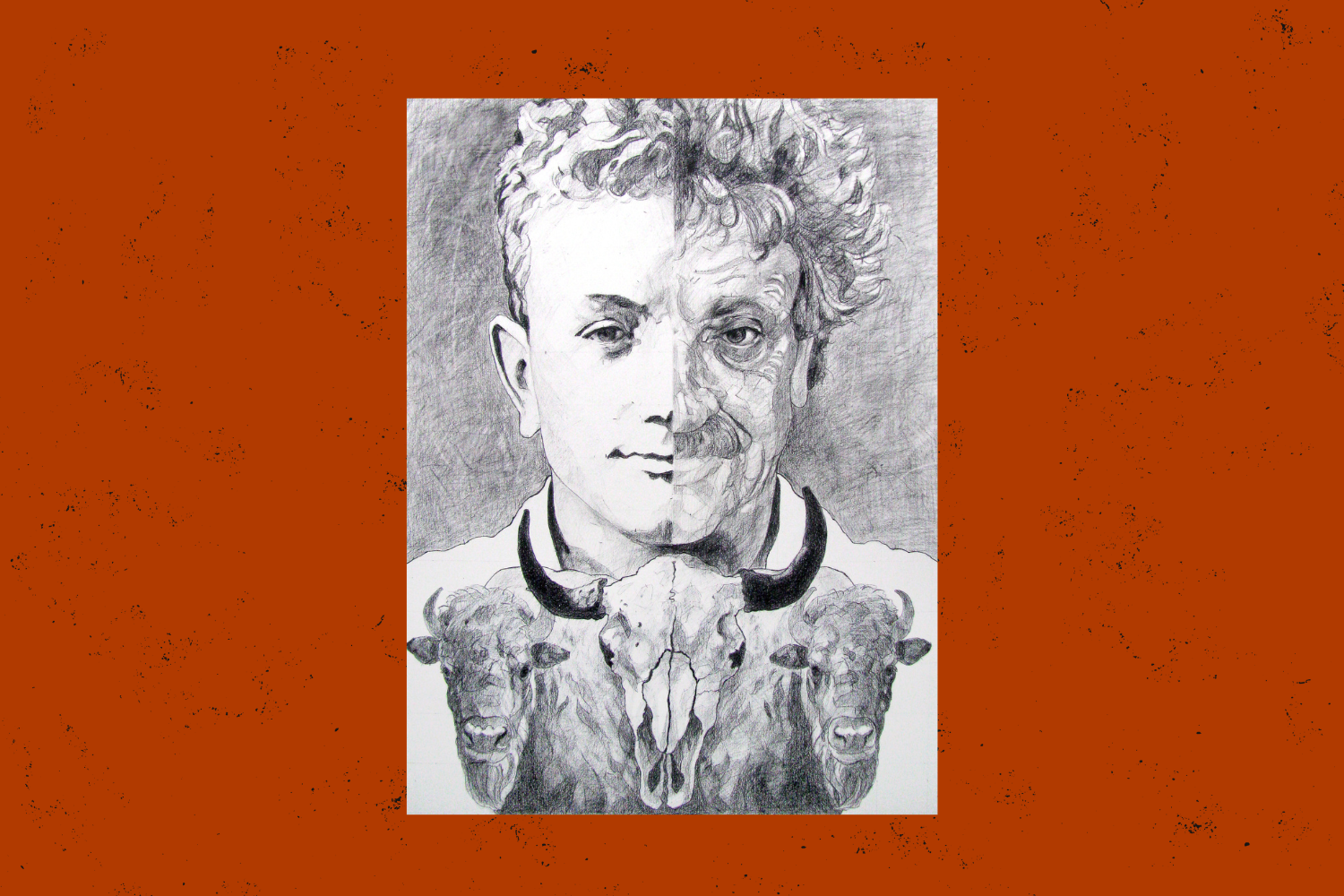
Editor's note: Perhaps it's unsurprising that Kurt Vonnegut's boyhood observations of Oklahoma turned out to be as funny, heartfelt and sarcastic as his best fiction. Viewed another way, we knew this kid was going places! Ginger Strand dives into Vonnegut's diary in an article first published in This Land's Spring 2016 issue.
On a warm day in December, Woolaroc ranch hands are rounding up the bison for the annual inspection and culling. A stampede of black fur and rolling eyes is thundering through the paddock when a bull and a cow, calf in tow, make a break for it. The trio bolts across the ranch road and into the fields beyond, as if escaping from a painting by Frederic Remington. As if saying, “We are free.” As if saying, “This is God’s country.” Frank Phillips might have planned it this way, a self-reliant family of buffalo to represent his beloved Wild West. It’s what the Okie oil baron—founder of Phillips 66—monumentalized by building Woolaroc Ranch.
The bisonic getaway occurs less than a mile from the Woolaroc gatehouse. “Uncle Frank’s Rules of the Ranch,” reads a sign just past the pay booth. Rule one: “The West Is Wild.” Except it’s not, of course, not here, in this 3,700-acre playground, this cowboy fantasy carved from the rolling earth of Osage country. Every Tulsa school kid knows Woolaroc—Woods, Lake, Rock—that staple of fourth-grade field trips, that blessed day free of classroom and cafeteria. And if the lake is man-made, the fish are stocked, the buffalo purchased—four new ones recently from Ted Turner!—the teepees built by white men and the “haunted grove” frankly phony, does that make it any less thrilling when the driver hits the brakes because a 12-point buck elk is staring down your school bus with aggression and a hint of amour?
One person thought not: Kurt Vonnegut. On the eve of World War II, Kurt and two teenaged buddies spent an idyllic four days at Woolaroc, the capstone of a road trip through the West. It was perhaps the last week of innocent happiness in Kurt Vonnegut’s life. When contacted, the folks at Woolaroc were amazed to hear it. They had no idea that among their illustrious guests was the author of Slaughterhouse-Five and Cat’s Cradle, the man who introduced the concept of a karass into the culture. They were in Vonnegut’s karass, and they didn’t even know it.
Their surprise makes sense. Woolaroc’s long list of notable visitors—Henry Ford! Tom Mix! Rudy Vallee! Cardinal Spellman!—seems to hail from an entirely different era than the one that brought forth Vonnegut. It’s difficult to imagine that icon of antiwar humanism, that irreverent and irascible leftie, falling for tales of Tom Mix. And while Vonnegut wrote and spoke frequently about his Indianapolis upbringing, his wartime experience in Europe, his time at G.E. in Schenectady, and his idyllic childhood summers at Lake Maxinkuckee, he never publicly mentioned that trip to the West and Woolaroc. Yet his diary of it—forgotten in an attic for decades and recently acquired by the Lilly Library at Indiana University in Bloomington—is vintage Vonnegut. It’s funny, observant, sarcastic, heartfelt, and rollicking, a combination few besides Vonnegut ever pulled off. And it reveals the special position of Oklahoma in Vonnegut’s mental map.
***
In the summer of 1939, Kurt Vonnegut, George Jeffrey, and Bud Gillespie were rising seniors at Shortridge High. Somehow they had convinced Bryant Gillespie, Bud’s dad, to lend them a Packard coupe. They had a rifle and a letter from Kurt’s father, directed to local police chiefs, declaring them to be good boys. Their itinerary was based on a trip Kurt had taken two summers earlier: Hillis Howie’s Prairie Trek, in which the Indiana educator shepherded a group of boys through Colorado and the Southwest, teaching them to camp and live off the land.