


It’s becoming a thing to dress up for Tulsa Ballet performances—not in cocktail gowns or church clothes, but in literal costume. In the Sunday matinee audience for Alice in Wonderland I spotted (among others) two young women in bejeweled princess dresses, a Red Queen in full makeup, and a robust bald millennial man in a tulip pink suit, a matching feather boa, and a cat-ear headband. Story ballets are about fantasy, and I love to see Tulsa embracing the vibe.
Tulsa Ballet itself embraced the vibe fully in the lead-up to this production, with a social media campaign that put us right in teacup-clinking range of the Mad Hatter and friends. The campaign worked—the audience last weekend was packed wall-to-wall and literally squealing with excitement—but what’s even more fun is that the show itself came through on the odd, enchanting world the promo promised.
Tulsa Ballet has swung for the fences a few times in recent years with original productions of story ballets. Next to 2022’s Carmen (created by the same choreographer), Alice in Wonderland is the company’s most successful swing yet, a two-act adventure that manages to be visually and narratively thrilling without overdoing it. It takes risks and stays balanced. Several members of Alice’s creative team—which included choreographer Kenneth Tindall, composer and sound designer Alexandra Harwood, costume and scenic designer Christopher Oram, projection designer Shawn Boyle, and lighting designer Alastair West—have worked together before at England’s Northern Ballet, which Tindall directs; their shared language and experience shows in this seamless world.
When the curtain rose on Nao Ota as Alice—facing away from us in a classroom whose walls teemed with giant chalked geometry figures and whose central window looked out onto the outdoors at the back of the stage—it was clear that the creative team had a fully realized synthesis of character, design, movement and metaphor ready to rock. The world-warping started right away as Alice’s stern governess (Jaimi Cullen, who’d later transform into the Red Queen) swung one leg out to her side like a clock hand, just as something in the orchestra tick-tocked. As the set opened onto a wide lawn with a tree in the middle, “real world” characters passed by (a world-weary baker, a tall fellow in a hat) with distinctive movements that built anticipation for their Wonderland versions.
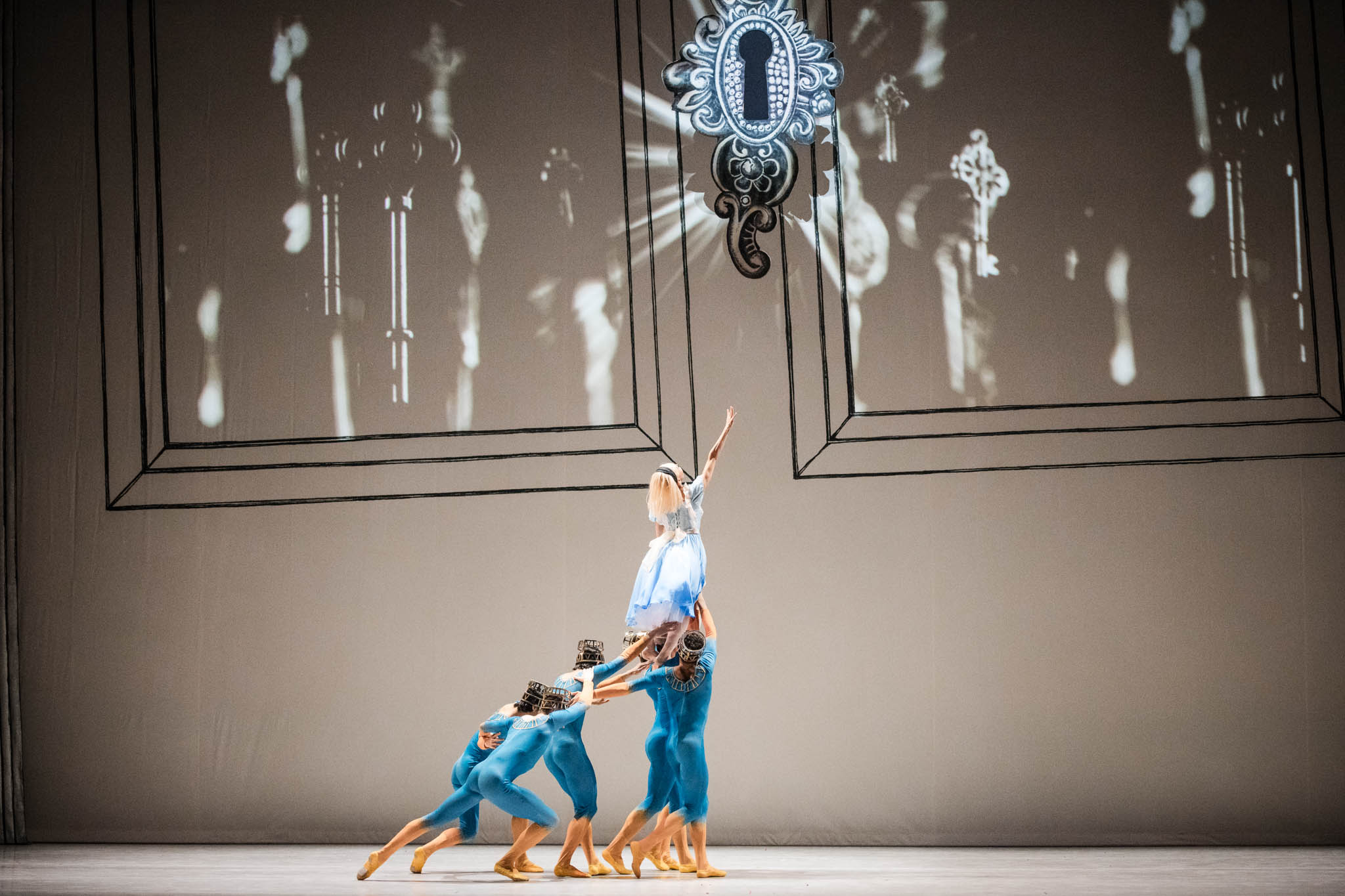
Tindall didn’t linger on the introduction but quickly brought us the White Rabbit (Shi Jean Kim), bounding in with a frisky wiggle. Then the tree split in two and the stage was flooded with a blue-and-black kaleidoscope and projections that showed the feeling of falling (instead of literally having Alice tumble around). The “Eat Me / Drink Me” antechamber Alice landed in was an Edward Gorey pen-and-ink masterpiece, where digital effects and shadow-play achieved a believably unbelievable “growing and shrinking.” The team kept the “time” theme cooking with an 18-member ensemble in teal and filigreed gold that moved Alice through a series of doors, their arms and legs cycling through sharp positions as if moving around the face of a clock.
And then we were off, hurtling through the familiar Lewis Carroll scenes: the Caucus Race (framed by Zentangle waves, punched up by Gene Krupa-style drums); the Caterpillar (backed by delicious-looking mushrooms, shifting into a moonlit dance with magical butterflies); the Duchess and the Cook (whomping and puffing to a quotation from Ravel’s La Valse, in a kitchen tucked into the back side of a giant invitation from the Queen of Hearts); Tweedledum and Tweedledee (their Jim Carrey physicality half-hilarious, half-sinister). A duet for Alice and the Caterpillar came a little bit out of nowhere, but who cares? A ballet needs some pas de deux, and these were an ecstatic few minutes. Act One culminated in a Tea Party—with Celtic pipes and drums and Aubin LeMarchand as a Dickensian Mad Hatter—that could have been, in my opinion, a little madder.