

Skip to Content
Culture

“Cat On A Hot Tin Roof” Didn’t Quite Reach A Fever Pitch

American Theatre Company’s production of the Tennessee Williams classic was full of strong scenes but lacked some urgency

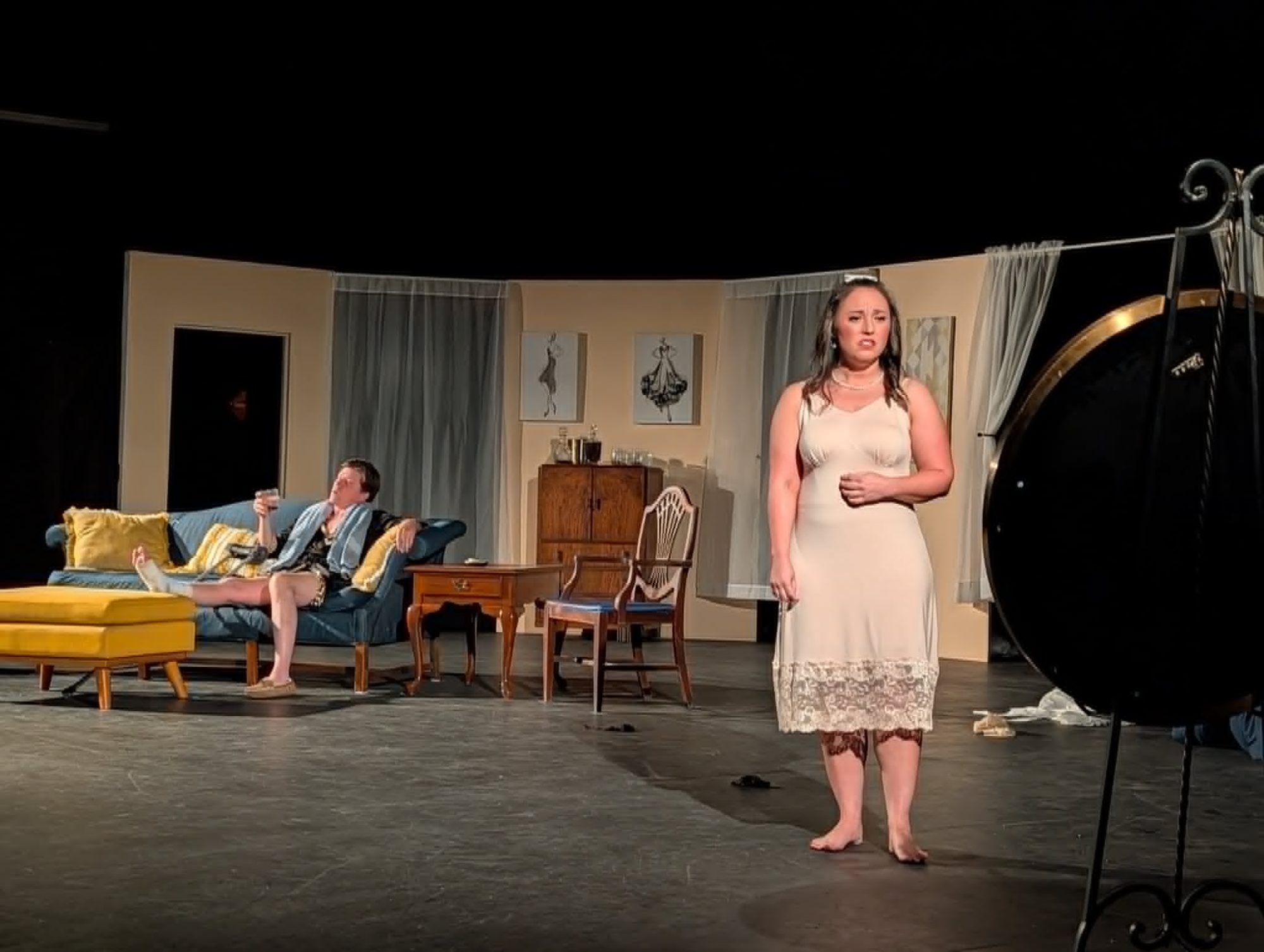
Maggie (Charmin Richardson) has a quiet moment to herself while her husband Brick (Butch Mahaney) drinks

|photo by April Skidgal

The Pickup's Culture coverage is brought to you by Tulsa Artists' Coalition Gallery, 40 Years of Empowering Tulsa Artists. Visit TAC Gallery to see American Highway Revisited by VC Torneden and Melinda Harvey Green, June 5 – 27, 2026.


American Theatre Company and B&Z Productions: Cat on a Hot Tin Roof
Tulsa Performing Arts Center, Norman Theatre
June 13, 2026

American Theatre Company has had a busy and unique season. After staging an original works competition and its 49th rendition of the holiday classic A Christmas Carol, the community theatre organization mounted a couple one-night-only productions out of its new home at WOMPA: Dear Jack, Dear Louise in the black box and Les Liaisons Dangereuses in the mixed-used outdoor space. For their season finale, ATC teamed up with B&Z Productions to bring the 1955 play Cat on a Hot Tin Roof to the Tulsa Performing Arts Center. 

Tennessee Williams’ Pulitzer Prize-winning drama takes place during a single evening in Mississippi, where the Pollitt family gathers to celebrate patriarch Big Daddy’s 65th birthday. In attendance are his wife Big Mama, their sons Brick and Gooper with their wives Maggie “the Cat” and Mae, and Mae and Gooper's five kids. Add in a roaming reverend, the family doctor harboring horrible news, a maid, and a butler, and the Pollitts’ vast 28,000 acre plantation feels claustrophobic, the perfect pressure cooker to crack the family mendacity (a word I learned in this very production!)  

In her directorial debut, Ya Mi Vang staged the play in the new-to-me Norman Theatre. Even though this is one of the Tulsa Performing Arts Center’s two black box spaces, it felt like I was seeing a production in a “found space.” Chairs formed three rows on the floor and the ceiling was stripped of the usual stage lights. Vang found ways to make both the room and the story feel enveloping with two light stands at the front corners of the stage, a classic living room set with high walls, and some banging costumes (*cough cough* Maggie’s dress). Even with a few modern furnishings mixed with the antiques on the set, I found myself sucked into the Pollitt family drama.

Williams does not make the actors’ jobs easy, giving them pages-long monologues laced with subtext. For example, the first act is essentially a 50-minute monologue from Maggie, who talks to, at, and about her husband, Brick. Brick spends the scene disengaged, cradling a glass of whiskey as he props up his broken leg on a coffee table. He injects a comment on occasion, as do nosy Mae and Big Mama when they pop in and out of their bedroom, but the scene is essentially Maggie talking. For the audience and the actor alike, a scene like this can be an exciting challenge or a daunting task. 

Charmin Richardson tackled this difficult role with tenacity. Keeping up with Maggie’s rapid-fire word vomit left her catching her breath on occasion, but she always found a way to reinvigorate her performance with strong vocal inflection and by finding interesting ways to share the different sides to this multifaceted character. Her big personality moments were endearing and the quiet moments to herself were stirring. I found myself keying in on every word she said. 

Butch Mahaney as Brick | photo by April Skidgal

A handful of episodes radiated with the tension that Williams threads throughout his script. In act two, Big Mama and Big Daddy have a heated conversation away from the rest of the family, which ends with Big Daddy telling his wife he never loved her. Andrew Pearson and Julie McAllan’s high energy and precise characterizations during this dialogue made for an absolutely devastating moment that left me grieving a couple I had just met. 

In the following scene, Big Daddy aggressively confronts Brick about his drinking, a topic that comes up several times during the play. Here, Big Daddy takes it a step further and asks whether Brick was in love with Skipper, Brick’s best friend. Exposing the nerve of this gay subtext results in a tug of war between the two personalities to peel the truth out of Brick—Pearson working himself up so much that his already belabored physicality fell apart, while Butch Mahaney’s Brick grew more defiant and deflective the more intoxicated he became throughout the scene. Watching him snap as Big Daddy whittled down his resolve was fascinating; by this point in a play that’s all about the lies we tell ourselves and others, I too was dying to know the truth. 

Big Daddy (Andrew Pearson) and Big Mama (Julie McAllan) get into an argument | photo by April Skidgal

Despite the strong emotional arcs from the actors that created good tension in specific scenes, American Theatre Company’s overall production lacked the urgency you’d expect for a play about secret-keeping. I think you can attribute this to two factors, the first being the gay subtext behind Brick’s secret. While Williams keeps it ambiguous in the script, Mahaney’s Brick was firm and honest when explaining the situation to Big Daddy, saying his feelings for Skipper were platonic, implying that the mendacity causing him to drink stemmed from the knowledge of Skipper’s romantic feelings.

Within this approach, Brick’s heavy drinking doesn’t come as a compulsion to suppress; rather, it’s due to apathy caused by grief. Without that undercurrent of tension, Mahaney’s acting choices struck a humorous note, especially in the final scene of the play, an emotional confrontation involving the whole family. His was a good performance with strong comedic timing, but it worked against the conflict and drama building in the scene as a whole.

The second factor involved the tactics Williams employs to create the play’s about-to-explode hothouse atmosphere—like placing Maggie and Brick in a room that anyone can enter at any time; arguments interrupted by loud kids, fireworks, and telephone calls; and physical restrictions like a broken leg. But in this production, these elements kneecapped the energy instead of helping build it. Strategically layering them, along with guiding actors to have sharper and quicker reactions to them, could’ve helped strengthen the overall tension. 

As the heat of Tulsa summer starts to build, it was good to see this classic onstage, and to see why it continues to justify its classic status. Williams’ script taps into a rare universal experience—everyone can relate to keeping a secret from friends or family. Even though this production didn’t quite hit a fever pitch, it had characters who drew me into their worlds, making it difficult to not get wrapped up in the messy dynamics and myriad secrets hidden behind the Pollitt family walls.  

If you liked this story, please share it! Your referrals help The Pickup reach new readers, and they'll be able to read a few articles for free before they encounter our paywall.

Stay in touch

Sign up for our free newsletter

More from The Pickup

Kevin Nealon Healed My Live Comedy Trauma

The SNL legend played it straight in a perfect stand-up set at Tulsa's Loony Bin

June 17, 2026

The Best Tulsa Events: June 17-23

The Silkroad Ensemble, Tulsa Juneteenth, Graveyard Shift Slumber Party and more!

June 16, 2026

Riding The Intergenerational Sludge Wave With Chat Pile And Acid Bath

A night of crust, death, doom, and camaraderie at The Criterion

June 12, 2026

Tulsa’s Self-Appointed Graffiti Critic Isn’t Divulging His Criteria

What did Trueson Daugherty learn by going viral for critiquing his neighborhood graffiti?

June 10, 2026

“Fun Home” Wrecked Me In The Best Way

Theatre Tulsa’s latest collaboration series project with Eclipse Theatre Collective stages the Tony Award-winning musical for Pride Month

See all posts