


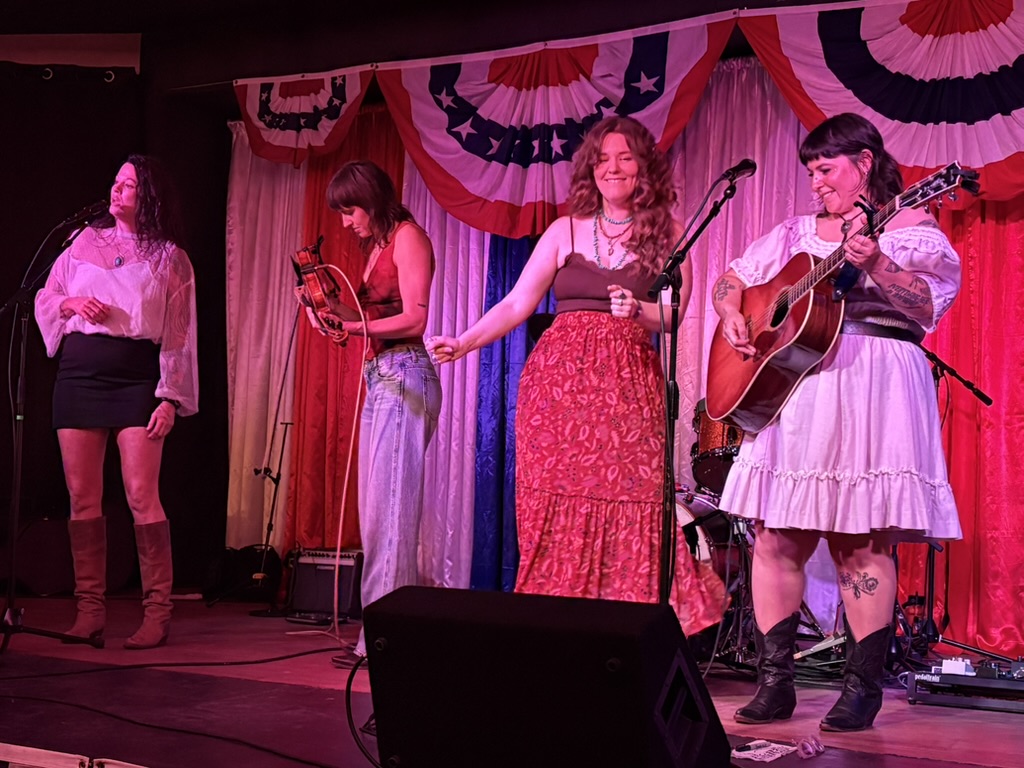
Kalyn Fay Album Release Show
VFW Post 577
April 24, 2026
Tulsa’s music scene has all the requisite features: local venues that support live and original music, studios that bring expertise and innovation to sound engineering, and a creative history that hums alongside our town’s complicated broader story. But where Memphis has Elvis, and Austin has Willie Nelson, one persona or genre doesn’t make Tulsa’s contribution to American music immediately recognizable, despite the list of icons, from Bob Wills to Leon Russell, who have thrived here.
Tulsa’s vibe is more communitarian; you have to be there. The release show for Kalyn Fay’s third album ᎠᏫᏒᏅ (“Garden”) was certainly a celebration of Fay’s latest project, their first in seven years. But it was also that kind of party that starts on time, where the cool people actually talk to you, and the hugs with friends last a little longer. Fay is, after all, the best hugger in Tvlse.
I can’t remember another time when a new album has led me to feel so thankful to the artist for their generosity, but that’s exactly how I feel now after having listened obsessively to ᎠᏫᏒᏅ every day since its April 3rd release. Supported by fellowships from the Native Arts and Cultures Foundation and the First Peoples Fund, Fay’s superb accomplishment brings a distinct and cohesive point of view steeped in themes of family and community, a sustaining rootedness here in the Cherokee Nation.
Fans of Fay’s first two albums, Good Company (2019) and Bible Belt (2016), are already familiar with the local and country references of Fay’s sound, but ᎠᏫᏒᏅ moves it all forward, both in its more expansive and layered instrumentation and its more introspective approach to lyricism, in both English and Cherokee languages. On this album, produced by Scott Bell, the rougher edges and deeper resonances of Fay’s delivery are more successfully balanced with supporting orchestral tracks featuring cello, saxophone, and clarinet along with the bedrock nuts and bolts of the band. (You may notice a similarity to the Canadian alt country singer Kathleen Edwards in Fay’s alto voice.)
In songs such as the opening track “More,” Fay uses second person to speak not to a specific individual of the songwriter’s imagination but to a collective, inviting listeners into a shared space of commiseration about the exhausting pressures of hustle culture: “wonder if you feel it too,” the song asks. But beyond simply voicing a call-in to community, this album is soul stirring in its pairing of sound and image. My favorite of the ten songs, “Grandmother,” begins with a simple cadence of guitar strumming but gradually layers in orchestral accompaniment underneath lyrics about connecting to this loved one through the leaves, cedar and oaks, the sun, and the breezes of this land, “caught up in a feeling not a song.” I’m reminded in this performance of why music is so powerful; songs are the vehicle for accessing a deeper well of emotion.