
The Pickup's Culture coverage is presented by Tulsa Artists' Coalition Gallery, 40 Years of Empowering Tulsa Artists. Visit TAC Gallery's 5x5 Show and Sale, running from May 1-May 16.
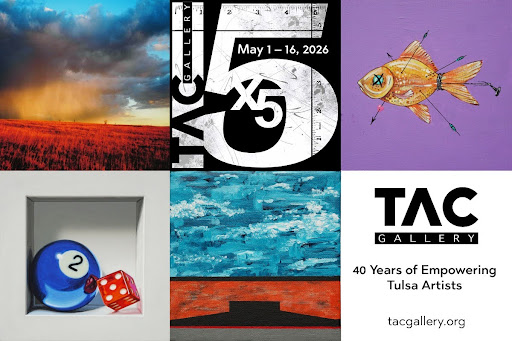
“I’m Good. How Are You?” by Zach Litwack
Belafonte
Through May 15, 2026
Aggressive politeness, relentless optimism, the constant presentation of okay-ness: toxic positivity is the American way of life, where the price of getting along is the cold-metal clink of one reality distortion coin after another into the “it’s all fine” machine. The mechanics—and the costs—of these social expectations are the subject of Zach Litwack’s I’m Good. How Are You?, a potent little show that stopped me in my tracks.
Like his exhibit Phantom Limb at Liggett Studio three years ago, Litwack’s new body of work, supported by the Artists Creative Fund, takes a single concept and allows it to filter through every element in the show. Arranged on two sides of Belafonte’s one-room space, his hand-built, hand-collaged pieces are both subtle and confrontational, starting with their Soviet propaganda-inspired color palette and blocky shapes that push out from the wall like a comic book speech bubble. Litwack is a filmmaker as well as a visual artist, and his storytelling here feels effortlessly cinematic, dropping the viewer into close-up worlds that churn with unsettling currents below the surface.
The jaunty vibe you see at first glance—high-contrast design, dancing couples, big cut-outs of people’s profiles facing each other as if in conversation—gets sharper and darker the closer you get to each piece. But Litwack’s touch stays light as little gestures of obedience to positivity slowly take shape as control mechanisms for much bigger forces.
Next to those jitterbugging couples, we see the pre-set dance moves through which they telegraph spontaneity. Under the rote dialogue—“Hi, how are you? I’m good, how are you?”—we see the real conversations playing out in those people’s heads, from which little buttons poke out on black stalks like typewriter keys. (Just press one for your pre-programmed response!) Those silent dialogues are brutally funny and uncomfortable one-shots that render a whole toxic relationship—with its deeper infrastructure of aggressions, fears, projections, and protections—in a few agonizing lines.