
Tulsa Symphony Orchestra: Bach, Fung, Tchaikovsky
Lorton Performance Center
September 14, 2025
TSO’s first concert of the year promised to be a banger. For something familiar, there would be Bach and Tchaikovsky, performed by the orchestra’s lush string section, and for something new, a violin concerto by Vivian Fung, which I was hopeful about because I knew the violin soloists would deliver.
The concert took place at TU’s Lorton Performance Center, which I love a lot more than the TPAC. The chairs are more comfortable, you have not one but two center aisles (why oh why does the TPAC have no center aisle? The fire marshal must have done math gymnastics real hard to get his exit plan approved), and the Lorton’s ceiling glows a dreamy sunset blue during the show, like you’re in a woodland bower. I was at peace just sitting there while the musicians warmed up.
The elegant guest conductor, David Lockington, introduced each of the three pieces. His commentary was informative, but he did a bit of surmising that this audience member could have done without. He said Bach’s Third Brandenburg Concerto had a lot of threes in it—three notes in a pattern, motives played three times, three different instruments playing the same tune, etc., which showed Bach’s genius. But frankly, saying a piece of classical music has a lot of threes is like saying a cake has a lot of sugar. Lasagna has a lot of noodles. A tree has a lot of leaves. You get the picture.
He went on to say (this is where I raised my eyebrows to what I’m sure was a level visible from the stage) that these threes represent the Holy Trinity, something Bach never said, wrote, or implied about this piece. Please, sir, if you can’t present evidence for your whimsical theories, stick to technical analysis.
All was forgiven when TSO began the Bach, featuring a pared-down chamber orchestra. A good dose of acoustic strings can truly soothe this savage beast. I forgot all about the Holy Trinity and bopped along with the repeated threes, letting the familiar melodies wash over me. The second movement, a harpsichord cadenza, was a pleasure. Harpsichordist Lyndon Meyer absolutely tore it up, playing an improvisational solo that went from tame to wild, scales ripping up and down, arpeggios swelling, all on the most delicate of keyboard instruments.
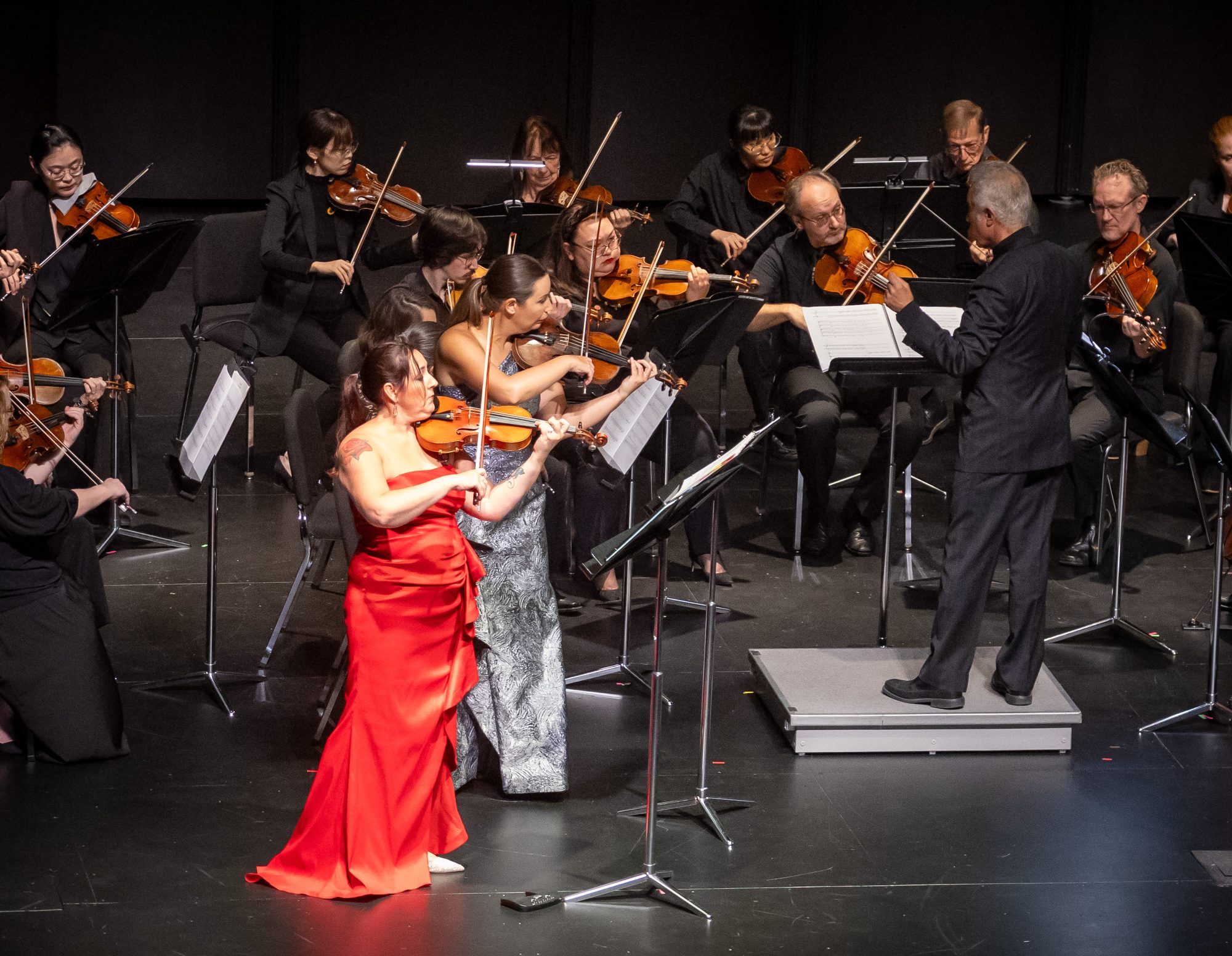
I settled in for Vivian Fung’s Concerto for Two Violins and String Orchestra, composed in 2018, as the full string orchestra filed onto the stage. Unfamiliar with Fung, a Canadian composer who is (hold onto your hat) still alive (I love the TSO’s programming of works by living, female, and non-white composers), I researched the piece before the concert. The recording did not impress me much, so I was skeptical, but the visual of seeing it played and the strength of the TSO soloists made me love it. The violin soloists, Ronnamarie Jensen and Jennifer Sherman, were stunning in their virtuosity and sensitivity, giving this contemporary piece classical gravitas. (They also looked fabulous in their sparkly gowns. Kudos, ladies.) Being a contemporary piece, it was full of changing rhythms and harmonic dissonances, but the plaintive melodies and back-and-forth between the soloists and the orchestra made it very listenable.