

Dombrance
Cain’s Ballroom
March 9, 2024
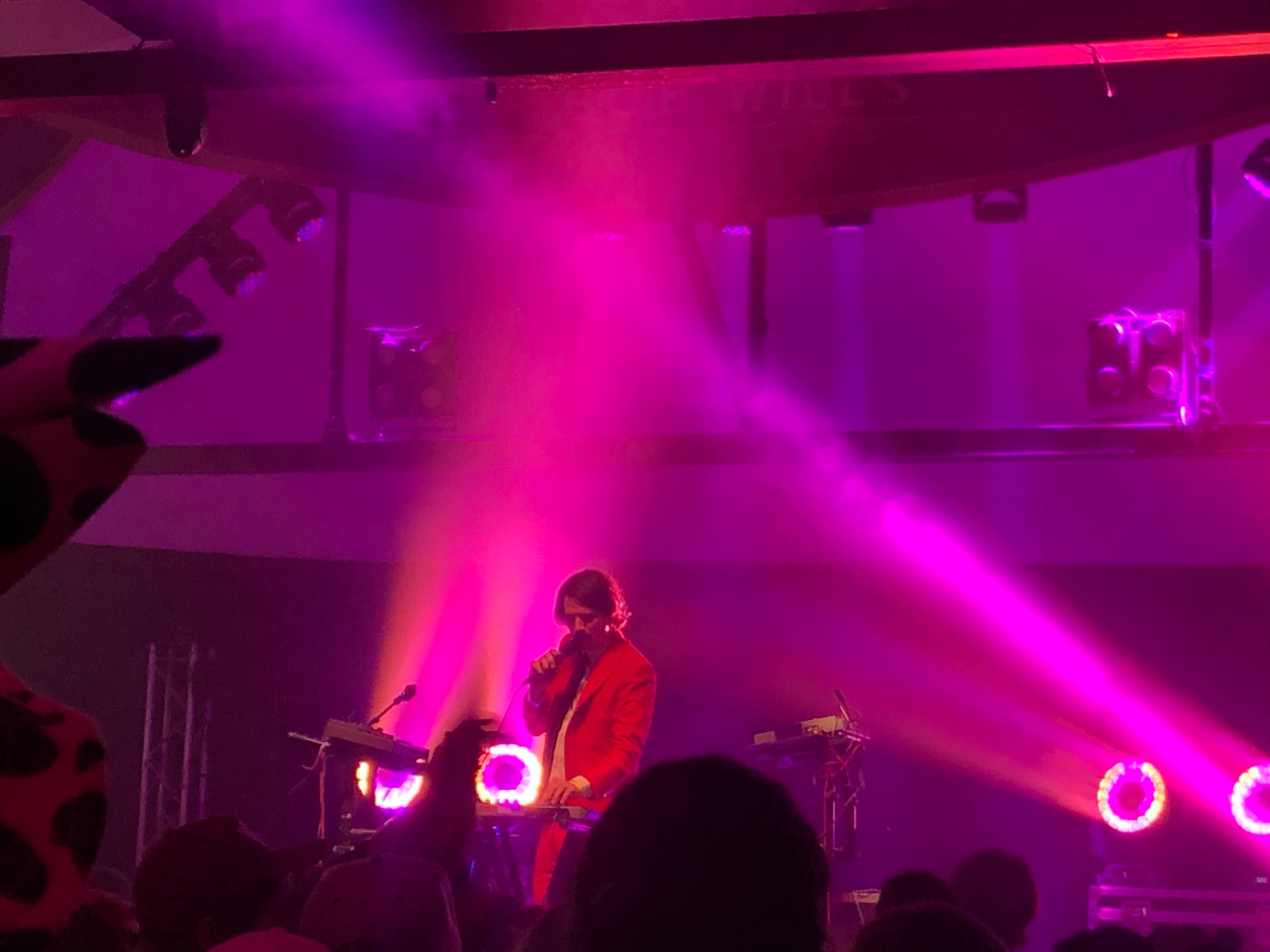
The character of Dombrance—with his red suit, black tie, distinctive mustache, and high-energy beats—was well-received, and deservingly so, at Cain’s. Dombrance’s persona is a slightly aloof French DJ, a man of few words (“My name is Dom-brahnce! I come from Frahnce!”) who comes to work on the people in need of dance. In this he gives a fascinating physical performance, navigating his cul-de-sac of keyboards like a nuclear plant worker desperately trying to avert a meltdown, holding an arpeggiator with one hand while stretching to reach another keyboard across the way to create his feverishly danceable music. In so doing, he cartoonishly parodies a world in collapse.
Collapse of meaning, collapse of ideas, collapse of community: these have all been hallmarks of the past century, a fact which Dombrance lampoons with little mercy or distinction. As he worked his keyboards and the crowd, the video screens to either side of him played his trademark video content: For every one of his songs using the names of well-known figures (for example, the song “Sarkozy” goes, “Sarkozy/Sarkozy/Nicolas Sarkozy/Sarkozy”), a cartoon video of that famous figure played.
Dombrance skewed his performance towards his American audience, playing songs based on what are surely two of America’s least controversial figures: Barack Obama and Kanye West. (Yes, the lyrics are also just their names.) These are songs from his 2021 EP, Make America Dance Again, which includes songs based on Joe Biden, Alexandria Ocasio-Cortez and Donald Trump as well. As a singer of politics, Dombrance seems to skate the middle line, choosing neither left, nor right, but only dance.