


Planetarium Mobilis
Living Arts of Tulsa
August 15, 2026
Solaris
Circle Cinema
August 18, 2026
What with the Glenpool refinery explosion, the heat-stricken trees prematurely shedding leaves, Scott Taylor prowling northwest Arkansas, and the thought of the Cry Baby Cry sculpture baking in some warehouse at a taxpayer-funded $2500 a month, it seems like a good time to leave the planet for a sec. In spirit, anyway.
You might not think The Pickup has the budget for this, but I went to outer space twice this week. The first trip happened at Living Arts, where Austin-based duo Highway Lights presented their new ambient-music-and-film pop-up Planetarium Mobilis on Saturday night. The second came via Tulsa Global Alliance, which brought Andrei Tarkovsky’s film Solaris (1972) to Circle Cinema on Tuesday, in honor of Tulsa’s sister city Zelenograd.
Total time: four hours and change. Total cost: around $30. Getting a taste of interstellar travel while also experiencing air conditioning felt like a win.
Sure, things got a little hairy on planet Solaris, with its seething sentient ocean, ambient paranoia, and themes like what my cinephile seatmate jauntily called “the prison of my own nostalgia.” But the crowd gathered in the Circle’s big theater (some veteran Solarists, some first-timers) seemed cozy enough, as we tried not to munch our popcorn too loudly during the gorgeous silences that make space feel so intimate in Tarkovsky’s film.
Introductory remarks by Tulsa Global Alliance’s Bob Lieser were both economical and eloquent, punctuating an overview of Tarkovsky’s career and influence with details about locations and methods that genuinely improved my experience of the film. Quality AV, thoughtful presentation, and a roomful of hyperfocused participants made this screening feel intentional, like something held in common with care.
It’s not uncommon to get that sort of experience at Circle, but this one really hit as a ride that we all took together—including several of those in the know who ducked out during the film’s famous five-minute-long driving sequence (shot in Tokyo, Lieser told us) to stock up on snacks and drinks for the journey to come. TGA representatives said they thought this might be the first-ever screening of a Tarkovsky film in Tulsa. I hope it’s the first of many.

Solaris is a far cry from the good space vibes of last spring’s Artemis II mission and Project Hail Mary—less “amaze amaze amaze!” and more “utter existential crisis.” I think there’s as much fun to be had imagining bad shit in other worlds as there is standing in rapturous awe of them, so I’m agnostic on tone when it comes to outer-space-related material: give me all of it. An event description like the one for Planetarium Mobilis—“astral projection meets sacred minimalism in this meditation on the universe”—hits several of my main aesthetic pleasure buttons, so I was eager to see what the event would deliver with its promised live ambient music, space-themed video installation, and invitation to lounge in an immersive art experience.
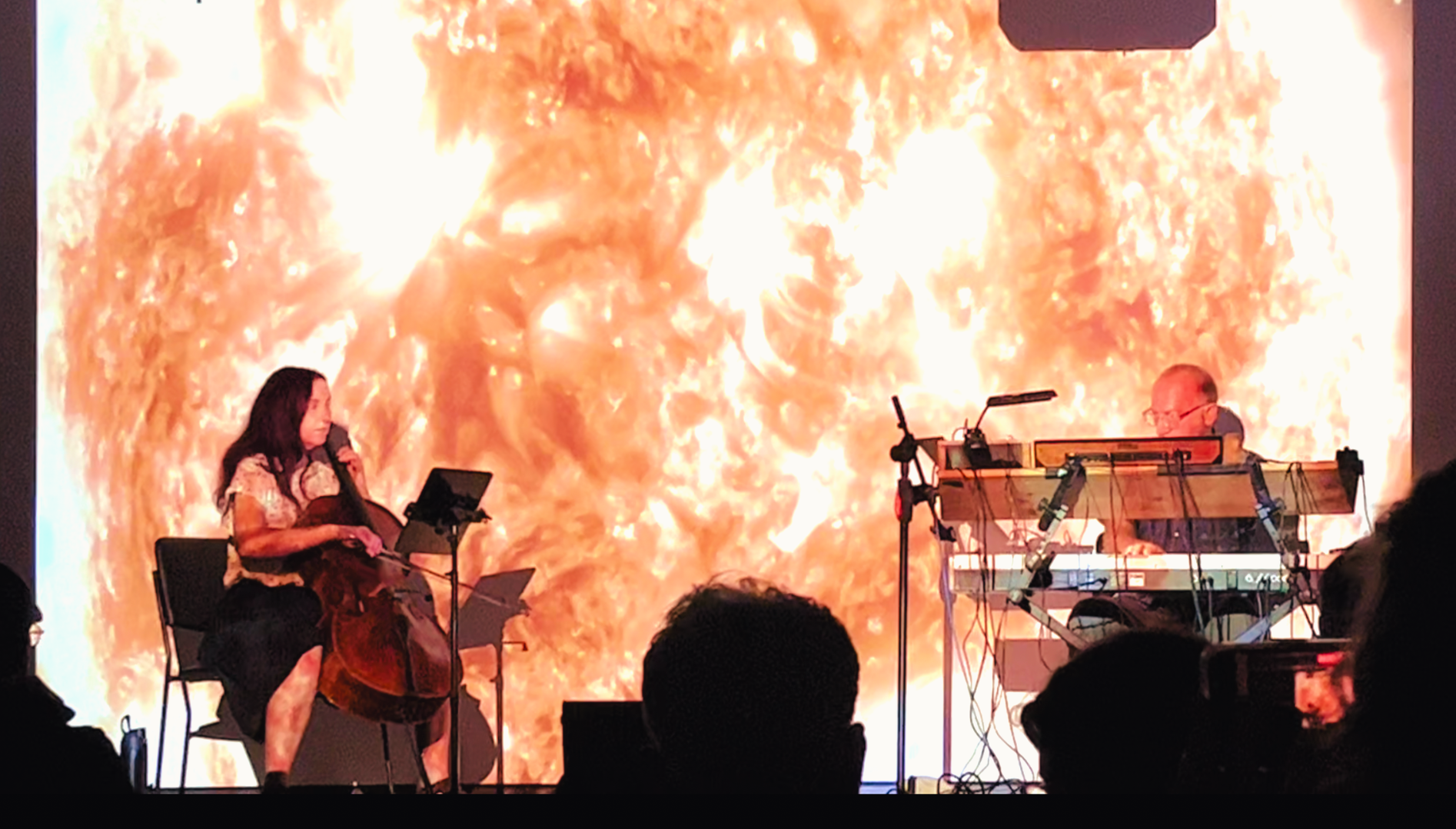
Musicians Justin Sherburn (pianist, composer) and Sara Nelson (cellist) created Planetarium Mobilis as a ready-to-travel pop-up show based on their new album Power of a Planet, a follow-up to their first record, the eclipse-inspired A Space of Partial Illumination. The new work ranges through the rings and moons of Saturn, merging Sherburn’s synthesizers with Nelson’s assured strings into an hour-long expanse of swirling sound, backed by a video remix of NASA imagery by filmmaker Anlo Sepulveda.
The husband-and-wife musical team (who also do live film scoring as Montopolis) worked effortlessly together across all frequencies, with the tactile friction of her cello giving weight and texture to his electronic riffs and drones. On a large screen behind them, bright spangles pulsed out of dark matter like pop rocks. Giant multicolored moon bodies (slightly distorted, as in a map projection, into the shape of dragon eggs) emerged at one side, floated across the musicians’ faces, and disappeared on the other, giving an impression of slow orbit.
In one exceptional sequence, a sun moved closer and closer to us, its golden plasma sparkling like a topaz, until the whole screen and both musicians’ forms were subsumed in what looked like the innards of a juicy tangerine. A culminating image set a shape like a mirror within Saturn itself: a strong, explicitly metaphorical moment in an otherwise mostly open-ended flow that gave my mind plenty of room to meander.
After a while, I found myself thinking of Sherburn and Nelson's sonic adventures in terminology from the visuals—a nebula-esque arpeggio, a crescendo expanding like a corona. Elegant cello motifs intermingled with synthy beats and subtle swells. Suggestions of other space-themed compositions (a hint of Eno, a glimmer of Zimmer, a Gustav Holst-ian chord progression) set this one within a long lineage of cosmic music, just as the visuals brought an artistic interpretation of the familiar planetarium show. At the end, Sherburn let loose with a driving rhythm on the keyboard that made for a powerful climax.
For a meditation on such a mighty planet, though, and despite the beauty of the music and the visuals, the hour felt a little thin. The environment really matters in a “let’s take a vibey trip” show like this; where there’s no narrative to hold a room together, audience/performer connection happens at the level of shared experience, and every detail matters. A great ride to space needs a ship well-suited to the voyage. The spare gray box of Living Arts wasn’t quite up to the task.
Venue staff told me they tested out the advertised “lounging with yoga mats and pillows” before the event and determined that lying on the concrete floor wouldn’t be comfortable, so they set up chairs in front of the gallery stage instead. I appreciate the test run, but as an equal opportunity floor-enjoyer, I would have preferred to make that decision myself; it would have been nice to at least get the option of getting horizontal. Barring that, a different arrangement of seats—in arcs, maybe, instead of rows—would have created a space more conducive to meditation.
As it was, the setup prepped us more for a straight-up performance than for an immersive experience. (At the start of the show, as venue staff cut all the house lights at Sherburn’s request, he good-humoredly said “now it’s immersive!”) The visuals, likewise, were less “installation” than “projection on a screen,” and there was something hanging in front of the projector that cast a big black shadow across the top of the video.
Planetarium Mobilis didn't quite get to the "transcendent backyard sleepover" level of magic it could have reached in another setting. But the fundamental elements are there for a beautiful immersive experience as it travels to other places on our own terrestrial plane.


