



The Pickup is an independent media company doing culture journalism for curious Oklahomans. We write stories for real people, not AI scrapers or search engines. Become a paying subscriber today to read all of our articles, get bonus newsletters and more.
Little Shop of Productions: The Seagull
Theatre Tulsa Studios
November 16, 2025
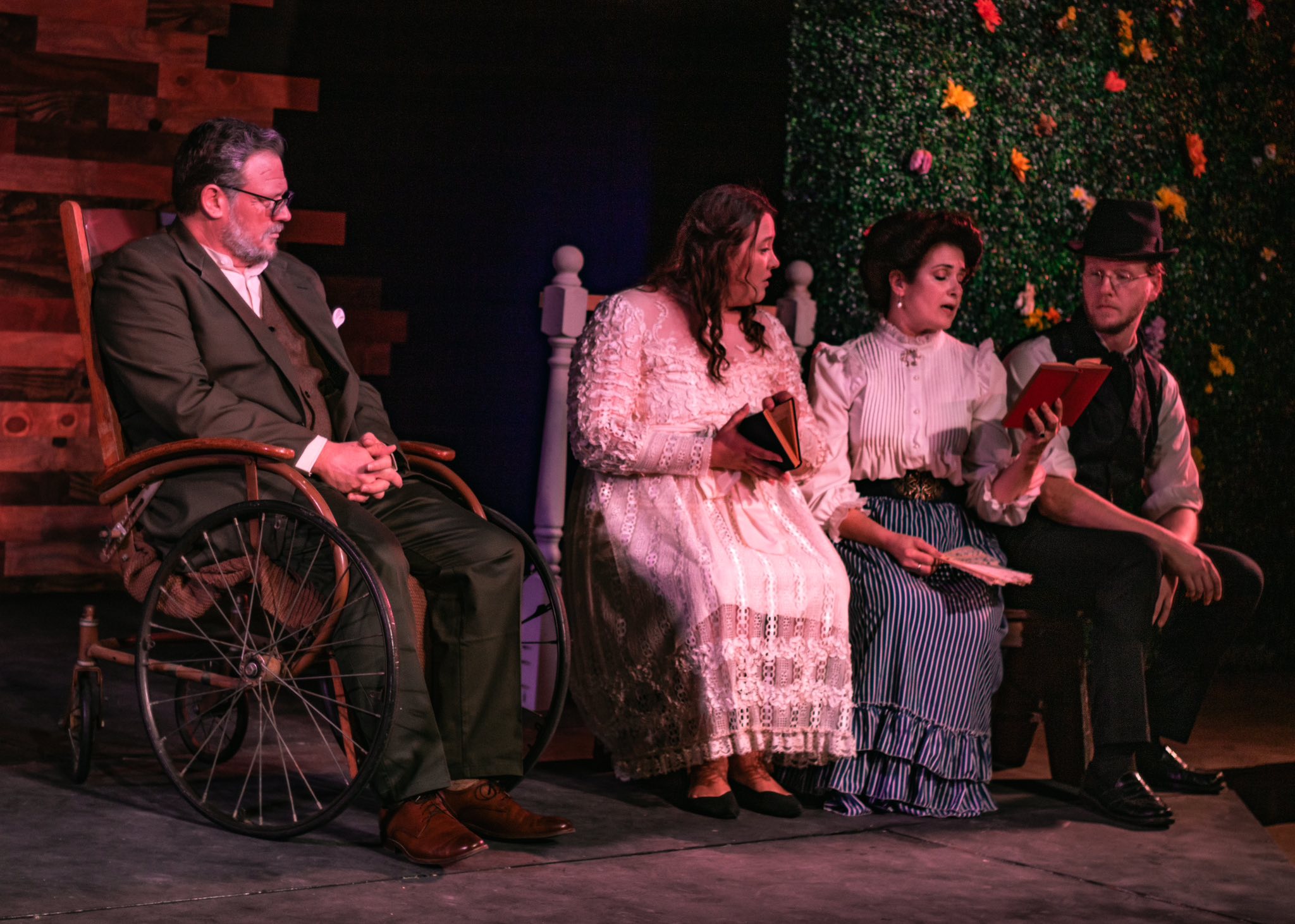
The former Family Dollar at 55th and Peoria—now Theatre Tulsa Studios—has become the site of some of the most adventurous, accessible, unexpected theatre happening in the city. I love that Tulsa’s longest-established theatre company has repurposed this late-capitalism-coded space into a mecca for immersive performance and DIY productions; unlike a lot of other nontraditional venues, this one has a great parking lot. One of Tulsa’s newest theatre groups, Little Shop of Productions, took over the venue recently for a repurposing of its own: a one-weekend-only production of Anton Chekov’s 1896 play The Seagull that sent a gust of something bright and fresh through the city’s theatre scene.
The Seagull is one of the first truly modern plays, full of meta references, self-aware moments, and character-driven debates about the various approaches to art that the play’s own structure explores. “Life must be represented not as it is, but as it ought to be; as it appears in dreams,” says the play’s Konstantin, an aspiring writer making a go at creating a new form of theatre—like Chekov himself did as he pushed away from 19th-century melodrama and into a psychological mode that would influence 20th-century theatre from Beckett to the originators of Method acting and beyond.
The Seagull takes place on the family estate of Irina Arkadina, a famous and famously stingy actress, a bit past her prime, who’s still swimming in the glory of the theatrical world that Konstantin, her son, now attempts to revolutionize. At the play’s heart is an ever-shifting love quadrangle: Irina loves Trigorin, a well-known writer; the passionate but mild-mannered Konstantin loves Nina, a self-effacing would-be actress from the neighboring estate; Nina loves Konstantin but admires and runs away with Trigorin, who eventually destroys her; and Konstantin and Irina are enmeshed in a way that Freud would have appreciated. Everyone’s dreams are as high-flying and precarious as the seagull—first soaring, then shot down—that gives the play its central metaphor.
Instead of a driving plot, The Seagull rides on an impressionistic wave of themes: thwarted dreams, freedom and boredom, unrequited love. The same set of people in the household come and go, some escaping for a time before returning to the estate’s entrapment, others only ever dreaming of something different. Chekov walks a quintessentially Russian line between tragedy and comedy, one that these actors clearly enjoyed playing around—particularly Jacob Ide as Peter Sorin, Irina’s brother, Ryan T. Devlin as the country doctor Eugene Dorn, and Rebecca Gray as Masha, the daughter of the estate’s manager, who got some of the show’s biggest laughs with her pinched, wan, snuff-huffing ways and lines like “I dress in black to match my life.”