

Published in 2013 by This Land Press, edited by Jeff Martin, and lauded by The Paris Review as “the literary equivalent of a high-wire act,” Imaginary Oklahoma is a collection of flash fiction stories about Oklahoma by writers who may or may not have ever been here. In 46 stories to commemorate the 46th state, some of today's most important writers, each paired with an artist, provide their take on "the Oklahoma of the imagination." We're proud to bring some of these stories to The Pickup—some with This Land Press’ accompanying podcast episodes—to help you dream your own Oklahoma dreams.
Washing the dishes after dinner, I couldn’t stop thinking about the Whale of Catoosa, which I read about on the Internet. It’s a big, not-quite-life-size, cartoonish blue whale set at the edge of a shallow body of water, as if it had come up to visit. I read that a man made the whale for his wife to commemorate the anniversary of their marriage. Then I read that this was not quite the truth. The whale was constructed sometime in the 1970s. Then, since its builder’s death, the residents of Catoosa, Oklahoma have maintained it, or his family has, and it has become some kind of roadside attraction, something people stop for a few minutes to see.
It’s hardly worth thinking about, but staring at a picture of the whale—it wears a little baseball cap and smiles—I think of questions: How does this whale, which could be based on a kindergartner’s drawings or something weird locked deep in the inner imagination of a quiet adult, like Mount Rushmore, speak about love? How did she—the man’s wife—know what it meant? What was the secret between them about whales? And is that why the citizens of Catoosa maintain it—in tribute to, if not in search of, that secret? Or is that too serious a question for such a silly and almost perverted thing?
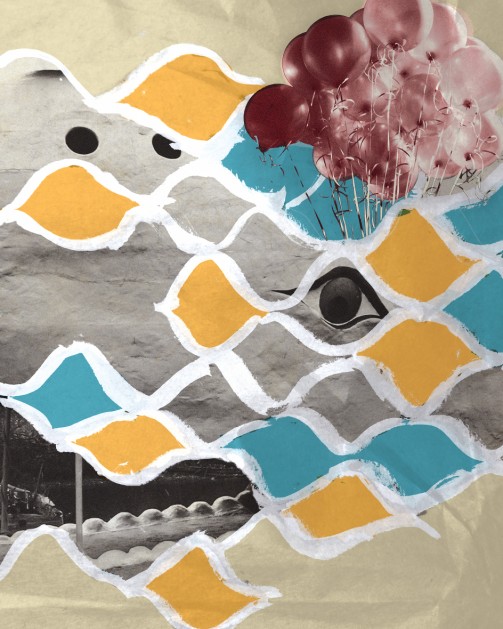
And why did the balloon someone bought for my son’s birthday last week, now only about two-thirds full of helium, venture on its own through two rooms when we weren’t looking such that I found it waiting above my daughter’s changing table? Is it too much to eat an entire cantaloupe? What, finally, will result from the whale’s eternal happiness? It seems to me that its smile gives something to the world while it takes something else away. Plants do this too, in a way that is helpful to humans. Are joy and irony always at war, and what happens when they strike a balance? I learn that, in fact, the whale was built by the man as part of a water slide park. Its fins are actually slides.
Could my wife have been happier? Could I? Will my daughter and son? If that balloon is a symbol, whatever it represents might not be worth understanding. And yet isn’t this what it’s like most days, such that the real questions can never get asked?