


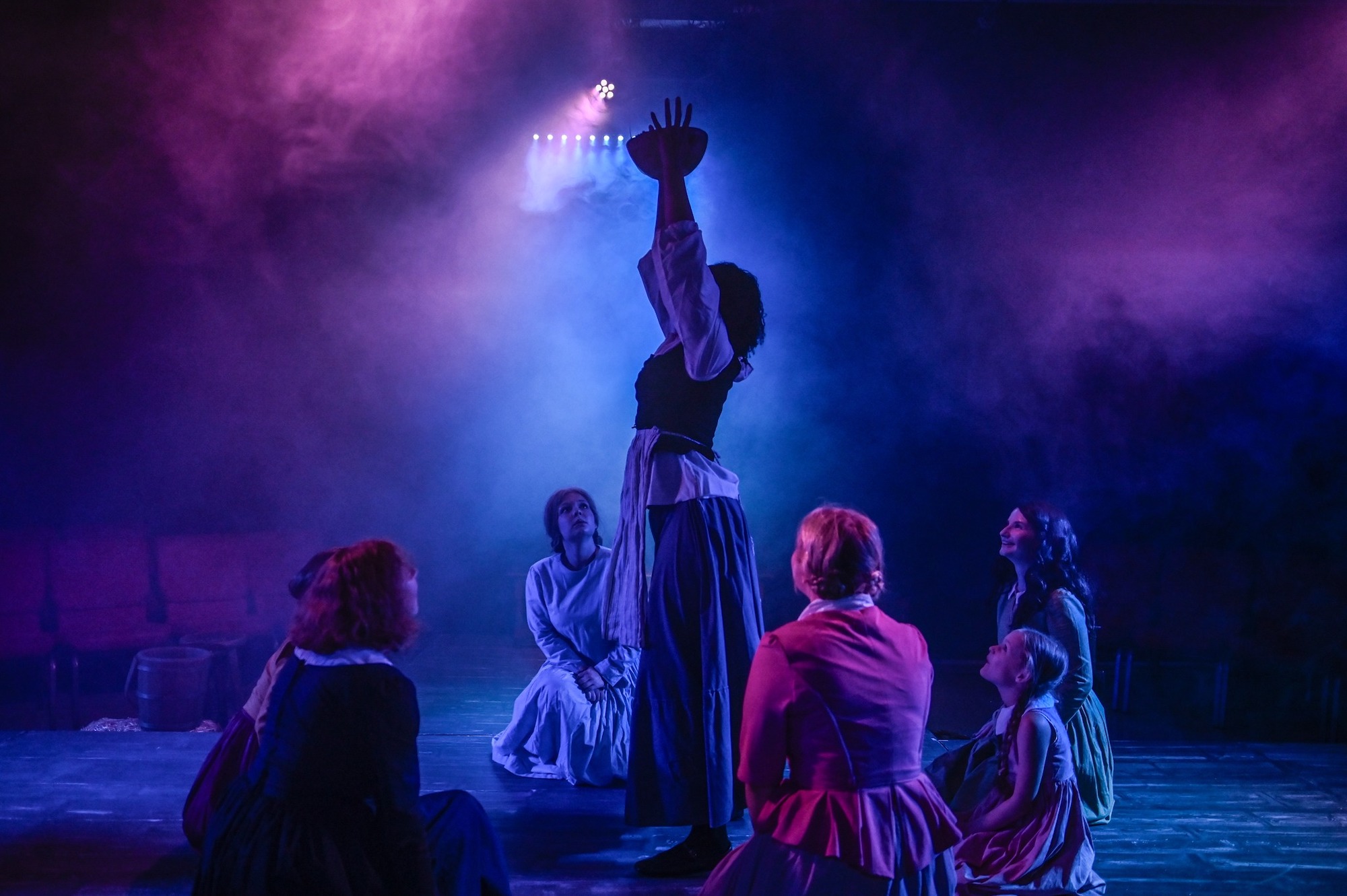
Theatre Tulsa: The Crucible
Theatre Tulsa Studios
August 17, 2025
I saw The Crucible for the first time when I was 11, at what would become my future high school. I went with my grandma, who taught math there and liked to support her students. From the moment in Act One when Tituba entered the stage and began performing her ritual for the girls, I was hooked; I’d never felt that much fear in my life watching a live production. My grandma, on the other hand, fell asleep. I feel like this is the biggest challenge when staging Arthur Miller’s infamous play, one that Theatre Tulsa faces in its current production (up through August 24): It’s easy for the plot to come across as procedural until the truly tense moments.
No matter how tricky it might be, staging The Crucible now makes sense. With a well-received adaptation (John Proctor is the Villain by Kimberly Belflower) about to end its Broadway run, a big comeback for witches lately in popular culture, and an ongoing spot in the high school literary canon, it’s an easy sell. It’s also a timely one, just as it was in 1953 when it premiered as an allegorical commentary on McCarthyism.
For those of us who did not read the play in high school, The Crucible is a partially fictional account of the Salem Witch Trials. The story follows inhabitants of Salem, Massachusetts in 1692 after 17-year-old Abigail Williams and her friends falsely accuse women of being witches. But Abigail has a motive. After having an affair with farmer John Proctor, she has it out for his wife, Elizabeth, in hopes getting rid of her will allow her and John to be together.
While the text’s main plotline is quite salacious, the play largely examines morality’s tie to integrity and the way guilt can manifest if one partakes in deception. Miller incorporates these themes into every character’s story, politically and socially, whether that’s about who actually owns a plot of trees or what one’s true “thrifty business” is in Barbados. Because of that, every character has a clear motivation and reason for being exactly where they are. When done well, it’s fascinating to see how their stories intertwine.
In Theatre Tulsa’s production—which marks the directorial debut for Mandy Gross and Lisa Hunter—many actors find humanity in Miller’s somewhat antiquated dialogue. Don Amon is delightfully haughty as Judge Danforth, while Sarah Schudt’s doe-eyed, anxious Mary Warren (one of the accusers) is sympathetic. Sebastian Paden’s earnest and grounded Reverend John Hale is a perfect foil to Ben Morgan’s pompous and flittering Reverend Parris. Jasmine C. Perry is engrossing as Tituba; her playfulness is captivating and her fear is raw. And I have to mention Michael Reed, a young actor who stepped in at the last minute to play 70-year-old Francis Nurse and looked so convincingly frail that I thought he was going to fall over.