


Barron Ryan's "There Arises Light (in the Darkness)"
September 29, 2023
Guthrie Green
Tulsa pianist Barron Ryan’s work, indeed his general vibe as a performer, has typically been draped in cool, from his online tagline of “Classic Meets Cool” and his bowtied collaboration with his pianist father, Ryan & Ryan, to the pop-classical Suite Thing which comprises the first half of his 2021 album First of Its Kind. That album was the first of his four to feature original compositions longer than songs, and it revealed him to be a highly competent composer as well as a talented performer. And while Suite Thing worked as an impressive and flavorful piece of genre-mixing pop-adjacent work, it was with his “Magic City” Sonata that Ryan showed his chops as a classical composer—abandoning cool entirely and tapping into strong human emotion—and hinted at further classical ambitions.
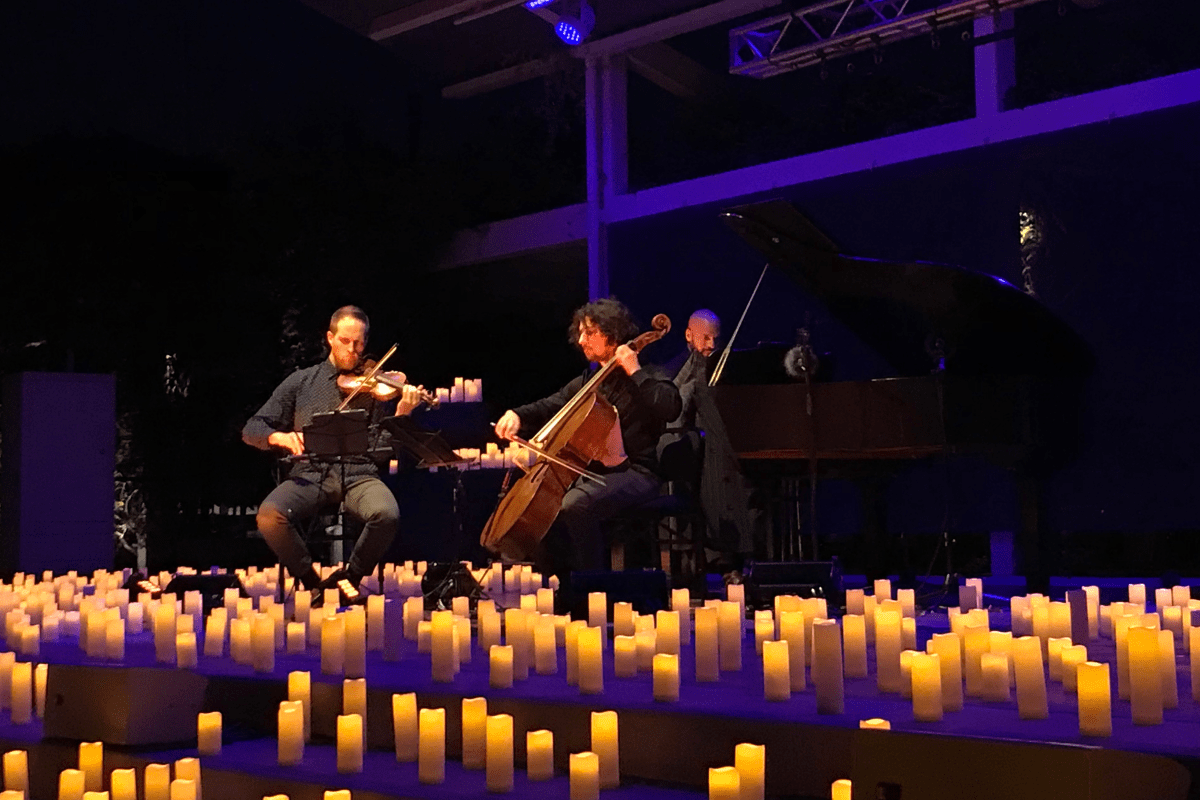
Those ambitions arrived bearing proof—and surprising teeth—last Friday night, when a packed and enthusiastic crowd at Guthrie Green watched Ryan premiere his new composition, “There Arises Light (in the Darkness),” a memorial piece for the Tulsa Race Massacre, commissioned by Chamber Music Tulsa. Two thousand battery-powered candles surrounded Ryan and his string section—Alex Cox (violin) and Christopher Whitley (cello) of the Thalea String Quartet—as the sun went down.
The trio set the theme with several opening pieces by other composers. First came the brooding, mournful Trio élégiaque No. 1 in G Minor by Rachmaninoff and the horrifying and deeply Catholic Libera Me from Fauré’s Requiem (“Deliver me, Lord, from death eternal,” the original text reads). Then came Ryan’s adaptation of Gounod’s version of Bach’s Ave Maria, and finally, a version of Chopin’s Polonaise Héroïque—adapted by, he noted from the podium, the winner of the 1975 Chopin competition in Warsaw, Poland: his own father, Donald Ryan.
Those opening pieces set the tone for a night that sought to funnel Tulsa’s hideous past through the lens of Ryan’s cheerful cool. “Despite the evil in our past, Tulsa has persisted,” he said during the intermission. “We have striven to find light arising from the darkness of 1921. Indeed, we now enjoy this beautiful setting, near the very ground which saw unspeakable horror one hundred and two years ago. I wanted to represent the hope with which we act in pursuit of a better tomorrow.”
The work succeeds at this aim. I write that in the present tense, with the hope and the assumption that “There Arises Light (in the Darkness)” will live on into the future. Like the works the trio performed to open the night, this 40-minute piece is mournful, powerful, quietly devastating, often optimistic, technically impressive, and rhythmically complex—often all in the same phrase. Dreamlike whole tones wander through the valleys, cascading against Ryan’s versatile arpeggios as the strings sing out hopeful melodies in the upper register.
In “There Arises Light (in the Darkness),” the horrors of 1921 are not only keenly felt, but also, as in any good piece of art, they are transformed. The initially confounding final section gallivants like a parlor dance in a time-lapsed video, with glory and tragedy each arriving and dissolving at the other’s approach, a dream of the future in which horror and grief are subsumed into each other in the service of living fully. A final dirge laments the loss before a triumphant staccato finale, after which the crowd stood and cheered and yelled bravo, and rightfully so. Ryan has created a mature and potent work, one sure to be associated with the history of Tulsa, from the horror of its past to the bright hope of its future, for a long time. Pretty cool.