



Published in 2013 by This Land Press, edited by Jeff Martin, and lauded by The Paris Review as “the literary equivalent of a high-wire act,” Imaginary Oklahoma is a collection of flash fiction stories about Oklahoma by writers who may or may not have ever been here. In 46 stories to commemorate the 46th state, some of today's most important writers, each paired with an artist, provide their take on "the Oklahoma of the imagination."
We're proud to bring some of these stories to The Pickup—some with This Land Press’ accompanying podcast episodes—to help you dream your own Oklahoma dreams.
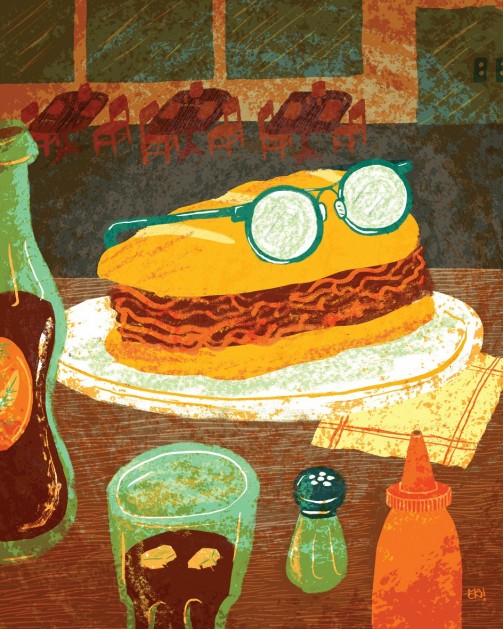
W.G. Sebald had a more complicated life than most readers realize. He spent the summer of 1985 in Oklahoma City, where he ate, every noon, at a modest café that I recently visited. I ordered a tongue with horseradish sauce sandwich also called, on the menu, a “Sebald sandwich.” My waitress brought me an indiscriminate platter of leftover sandwiches: “I’ll give you this whole tray for ten bucks,” she said. I stared at the unimpressive array; I was chagrined to see that the sandwiches were on bagels, not regular bread. I told the waitress, in a tone whose uncharitableness now gives me shame to remember, “I don’t want these tawdry leftovers. I want a freshly-made Sebald sandwich.” From among the debris on the platter, the waitress fished out a pale approximation of a Sebald sandwich and handed it to me. I repeated my insulting demand: “I don’t want an ersatz version on a skimpy bagel. I ordered a normal Sebald sandwich.” After great delay, and a series of further miscommunications and disappointments, which it would be tedious to describe, I received my long-awaited Sebald sandwich. Upon finishing it, I told the harried, grumpy waitress, “Sebald was a theater person. Theater people like to eat at overpriced cafeterias. Theater people glorify these watering holes, which then become tourist attractions, like Sardi’s. I distrust any restaurant that becomes a cult locale.” The waitress was grumpy, but she was also talented and beautiful. She looked exactly like a young Roberta Flack, famous for “Killing Me Softly.”
