


Editor's Note: This story was originally published in This Land, Vol. 3 Issue 2. Jan. 15, 2012.
TO THE FIRST ‘POWER’
I remember the tension, the edge-of-the-seat nervousness. I remember wondering which would explode first—the lungs of the pumped-up, corn-fed man before me, or the hot water bottle containing his gale force exhalations? But I don’t remember anything about Jesus.
I must have been in the fourth or possibly fifth grade the first time I encountered the Power Team. It was the mid-to-late 1980s. The death rattle of the Cold War was just beginning to register, however softly it may have been. Growing up in a mostly religion-free household, my mother a reformed Catholic and my father a hybrid agnostic/ secular humanist, I honestly wasn’t aware of anything going on in the Christian world. However, the same could not be said for many of my classmates. From appearances on Christian television, mentions at various church services, and a good amount of word-of-mouth circulation in the fundamentalist community, the exploits of the Power Team were all the rage.
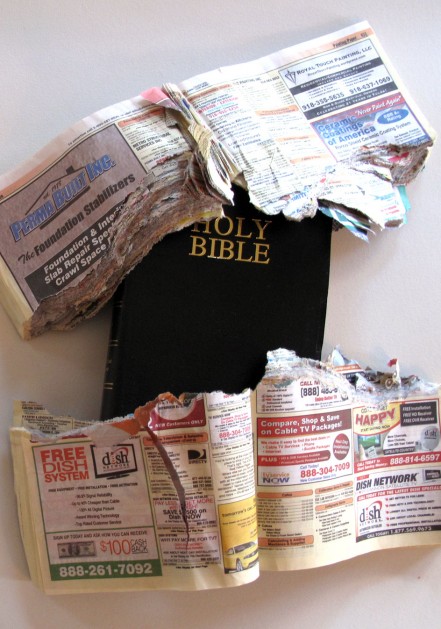
When the assembly was announced, the rumors began to swirl. One boy in my homeroom class told me that the guys in the Power Team could tear phonebooks in half “with their bare hands.” Phonebooks? I wasn’t exactly the tallest kid, and the memory of having to use a phonebook as a makeshift booster seat was still quite clear. This was not an insignificant object. There was also talk of bending pieces of rebar and crushing stacks of bricks, but for some reason the phonebook gimmick piqued my interest.
Formed in the late 1970s by Oral Roberts University graduate John Jacobs, the Power Team mixed one part Rambo, one part Ron Popeil, and a splash of Mr. Roberts himself to form a fresh, testosterone-filled cocktail of American evangelism. The idea began in Tulsa, when Jacobs, still enrolled at ORU, attended a martial arts event. The presence and charisma of one karate expert caught Jacobs’ eye. “I noticed that Christians weren’t the only ones who watched him,” says Jacobs, recounting the moment in a 1988 interview with People. “I liked that. I had gotten tired of those all-Christian events, and I wanted to bring the sinners in.” It worked. According to the Power Team’s website, the group reaches “nearly one million youth annually” and have performed at “over 30,000 school assemblies in their 30 year history.”
I don’t remember the music that introduced the Power Team on that day in the gymnasium, but a popular and often-used piece in their repertoire is the theme music from Rocky. That sounds about right. The nation’s moviegoers were at the height of the “Action Hero” phase that lasted throughout most of the ’80s. Stallone, Schwarzenegger, Willis ... these weren’t actors, they were human personifications of Reaganomics. Did John McClane call on the government for help when Hans Gruber and his group of terrorists took over Nakatomi Tower? Nope. He just pulled himself up by his bootstraps (actually, he wasn’t wearing shoes) and took care of the job himself.
Due to the separation of church and state, and the fact that this was a public school, no talk of religion or anything related to Christianity were allowed in the presentation. In fact, on the same website that boasts such a large impact and wide reach, there isn’t a single mention of God, Jesus, or anything that might lead one to believe that the Power Team is a faith-based organization. From what I remember, the basic outline of our presentation was much more in line with McGruff the Crime Dog—a competing school assembly attraction at the time—than John the Baptist. Don’t do drugs, stay away from alcohol, basically don’t get into trouble. That was the message. According to their standard boilerplate, “Power Team Members are mandated to be steroid-free; being randomly drug-tested by an independent agency according to stringent Olympic standards.”