


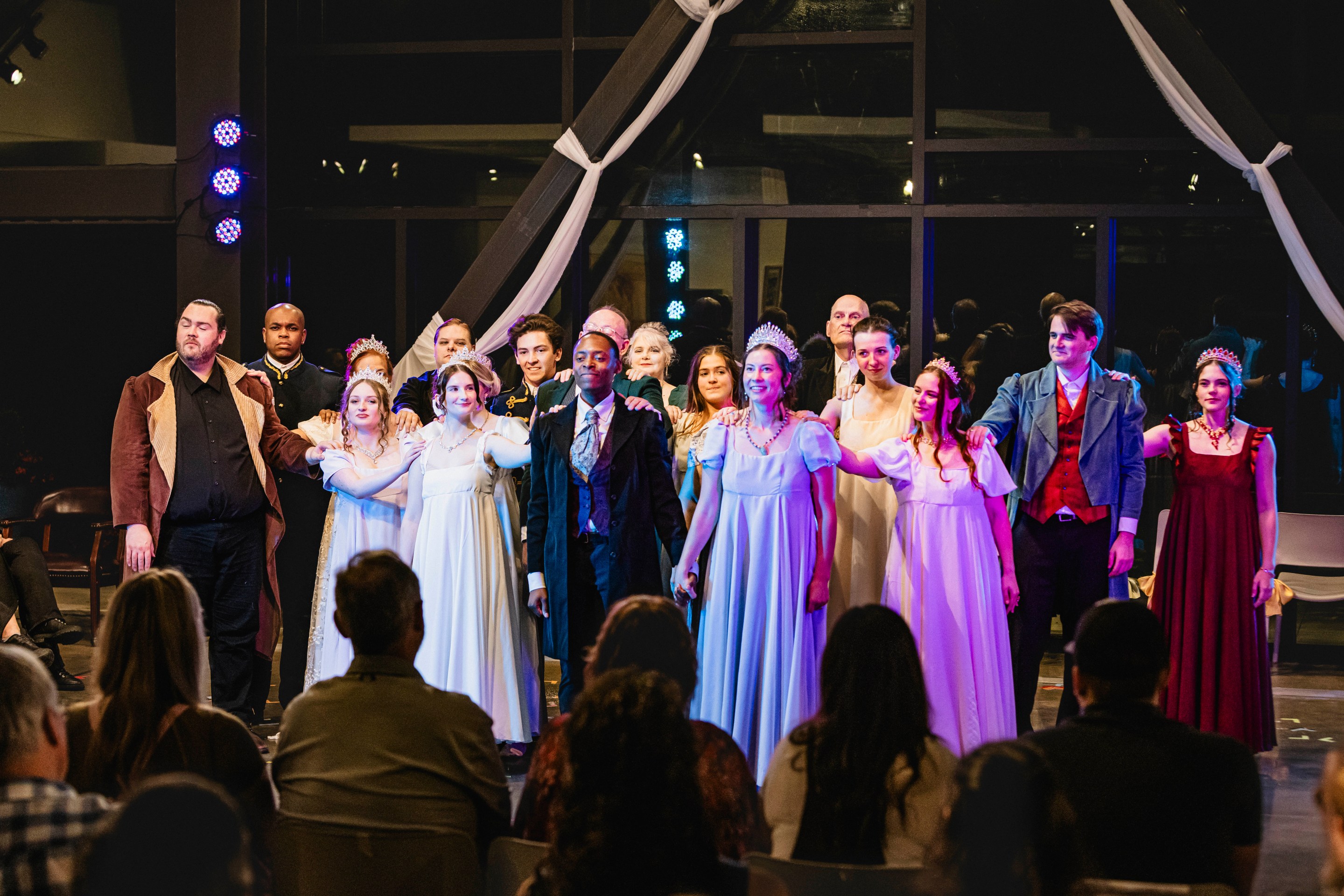
Pembroke Players: Pride & Prejudice
101 Archer
June 1, 2024
I couldn’t have been more charmed by an invitation if Mr. Darcy had delivered it to me himself. The handwritten, wax-sealed envelopes on the ticket table at last weekend’s run of Pembroke Players’ Pride & Prejudice might have looked, at first glance, like just an endearing on-brand vehicle to get the show’s program into our hands (the brand being Jane Austen). But like many other elements of this production, that simple, winsome, accessible gesture proved to be a genuine call into a world. ”You are cordially invited to Netherfield Park,” the envelopes said—and they meant it.
In its first season as a theatre company, Pembroke Players has delivered some of the most innovative productions in the city, all using source material so familiar that your eyes might skate right across it if not for founder and director Cody McCoy’s singular vision. With an approach that reminds me of Twyla Tharp’s observation that “before you can think out of the box, you have to start with a box,” the company invites us not so much to see classic plays and literature differently, but to experience more of what’s inside them to begin with.
In this Pride & Prejudice, what could have been just a fan-service rendering of the story became a fantasia—one that illuminated facets of the original that even the most diehard Austen lovers might not have considered. McCoy (a prolific local actor, educator, and graduate of the now stupidly dismantled University of Tulsa theatre department) has been thinking about this adaptation for 13 years. That slow burn of development resulted in a production that was fully articulated on every scale, from its period costumes, sound design, and well-paced script (all created by McCoy) to its confident use of space, which placed the audience whimsically and movingly inside the novel’s dramas and dreams.
101 Archer’s first floor gallery itself was the set. We sat on three sides of an open space, with performers, furniture, and even a piano moving in and out through the crowd. With its support beams lightly draped in white tulle, the gallery’s giant wall of windows provided both backdrop and vista, a barrier that was also an opening onto a wider world. Performers sometimes stood (and even danced) outside, looking in on the action from the garden as we looked out. The audience surrounded the actors, but with their entrances and exits and subtle engagement with us, it felt like we were the ones in the middle of the story.