


Published in 2013 by This Land Press, edited by Jeff Martin, and lauded by The Paris Review as “the literary equivalent of a high-wire act,” Imaginary Oklahoma is a collection of flash fiction stories about Oklahoma by writers who may or may not have ever been here. In 46 stories to commemorate the 46th state, some of today's most important writers, each paired with an artist, provide their take on "the Oklahoma of the imagination."
We're proud to bring some of these stories to The Pickup—some with This Land Press’ accompanying podcast episodes—to help you dream your own Oklahoma dreams.
In the beginning there was dust: an ocean of it. The dust lacked form, lacked life. This grieved God, who then cried amidst the dust until there was mud below, and mud above: a wobbling firmament of mud. God brooded over that mud, breathed over it, and then mud became man.
Some time passed. Men-from-mud began to misbehave. Egregiously. Feeling the pain of his hands’ work, God grieved. It was a larger grief than that first one, the one that poured form into dust. This grief was shaped by the recollection of specific evils, harm that his creation had worked upon each other and the terrible knowledge that it would continue. This grief was not of the nutritive sort. And God knew it. God cried for his creation that would not be able to withstand his sorrow. The lives that those lives might have engendered, if given more time—he lamented for them, too. He cried because sorrow was so often a lop-sided engagement: people rarely grieve together for the same reasons at the same time and with the exact same measure of sorrow. Sorrow is unique, and therefore, misunderstood.
Which is why God had sent a series of preemptive rescues: flotation device experts offering in-home inspections at absolutely no charge to all who said yes. Samples large and small: butterfly wings, life jackets, neon colored foam noodles. Then came the flotilla of canoes, life rafts, inflatable porpoises, and plastic crocodiles—also free.
But it had been hotter than blazes, the heat searing the color out of grass, wood, air. The heat turned streets to rivers of tar. It had been so hot that no one could take seriously these gifts of air corralled in tensile materials approved for water sports and nautical adventures everywhere. These offerings seemed like jokes in poor taste: especially the admonition, repent! How insulting—the implication that a sudden climactic change might have anything, anything at all do to with them. This is what provoked homeowners and renters young and old to draw their blinds, bolt their doors, roll plugs of cotton into their ears.
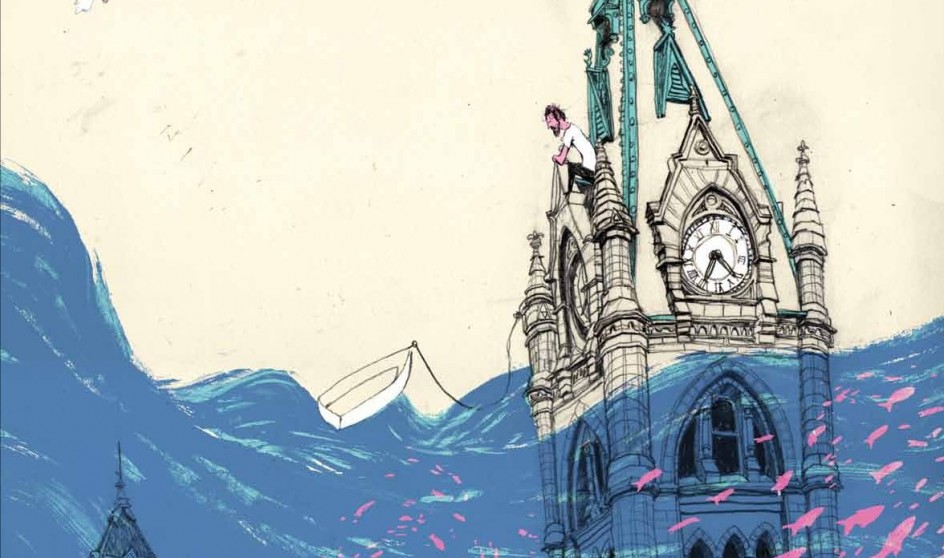
At the sound of such unified refusal, such willed rejection, God’s sorrow increased exponentially. Neither casements of sky nor wellsprings of deep could contain it. From above and below water rose and fell. God, as he had in the beginning, hovered and brooded over the dark and roiling waters. Days passed. Near Day 27 God brooded his way toward regret. The floodwaters receded. On Day 33 God remembered something—another incidence of human harm done purely for recreational purposes, and then he felt sorrow. The floodwaters rose. That’s how Godly sorrow works: it ebbs and flows. It’s like the breath of the breath of life. There. And then, at times, less there. It’s enough to fool the uninitiated.
Which is the reason for the rainbow: a reminder for those who would doubt the potency of sorrow. A promise that should God become grieved in the heart at some later date, he’d not resort to tears. Other reminders: in low places, flats and sinks, places like Uzbekistan or, say, Oklahoma, God’s tears dried to salt. Thirst. Dust. From time to time people dig in such places and find evidence of life before the big sorrow: elongated fishes and fronds of plants stretched by the pressure of so much water. They hold these items in their hands, speak of them with wonder and awe.