

May Yang: Wordplay
Liggett Studio
February 7-27, 2025
Looking for a word in May Yang’s “Wordplay” is like looking for life in a forest. It’s not in any one thing you can see, exactly, but it’s there—a hidden force that drives everything visible. In this robust and subtle solo show, a word becomes a situation, an environment, almost a dance.
For Yang, who grew up as a first-generation Asian American in Oklahoma, making art out of words is a personal matter. She writes in her artist statement that she “encountered cultural contrasts and communication barriers within my own family, further amplified by language differences. My frustrations fueled my artistic journey, and art became my method for processing and reconciling these intercultural challenges.”
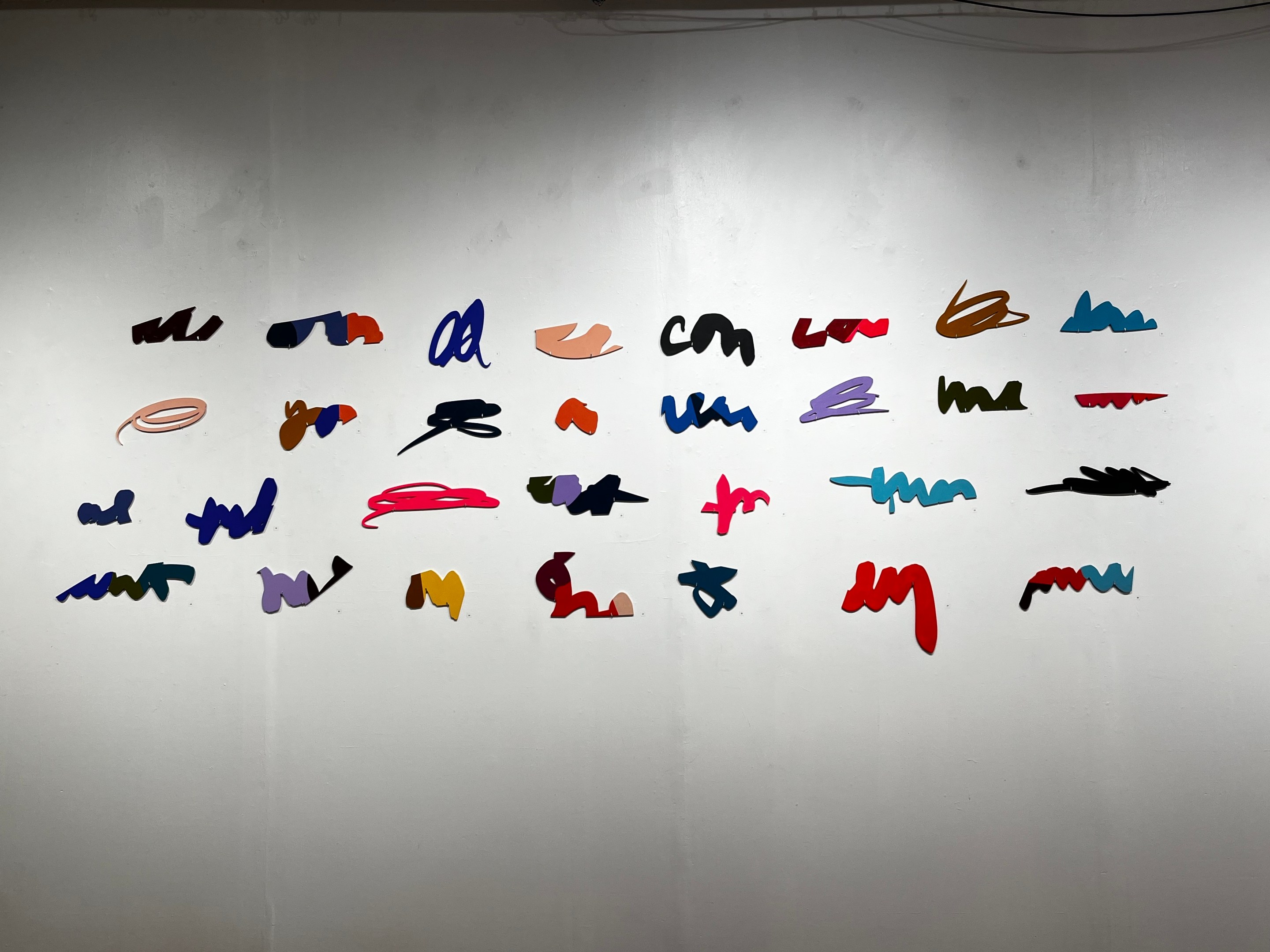
All of the works in “Wordplay” start with a source word, which Yang (a printmaker who runs Flash Flood Print Studios in Kendall Whittier) then begins to play with in ways that range from typography to laser cutting. She writes the word, draws it digitally, morphs and expands it, traces it onto fibreboard, cuts it, paints it, layers it with other cut and painted shapes. By the time a piece is finished, the source word itself is so abstracted and obscured as to be nearly lost. It’s no longer a standalone thing but a catalyzing event that creates an interplay of meaning-making forms—which reveals much more about the word itself than a literal representation would. We never know what her source words are for each piece, nor do we need to. What we see is what they are.
As she takes them from sound-signs to digital images to 3-D objects, Yang’s words become more complex as they move further into the tangible world. Let loose from the literal, speaking, writing and listening become kinetic, embodied experiences, rather than intellectual or verbal ones. These pieces—which she calls “relief paintings”—invite you to get close, look into layers, process surprises in depth and perspective, notice connection points and divergences and overlaps. To me, they’re about relationships.
The whole show unfolds like a train of thought expressed not verbally but physically. “Wordplay” starts to the right of the gallery door with a small box filled with unpainted fibreboard shapes, almost like a children’s puzzle. Next to it, the only flat painting in the exhibit (The Tide Will Turn) sets up another stage in Yang’s own development; her flat paintings, she told me, “always wanted to be dimensional.” I can almost feel the phrasing of the painting’s title here, the rhythm of a wave in the stroke of pink and the shifts between dark and bright. Beside this piece hangs After Image, which seems to take elements from its 2-D neighbor and pop them off each other—and we’re off and running as Yang states her new process with authority.