


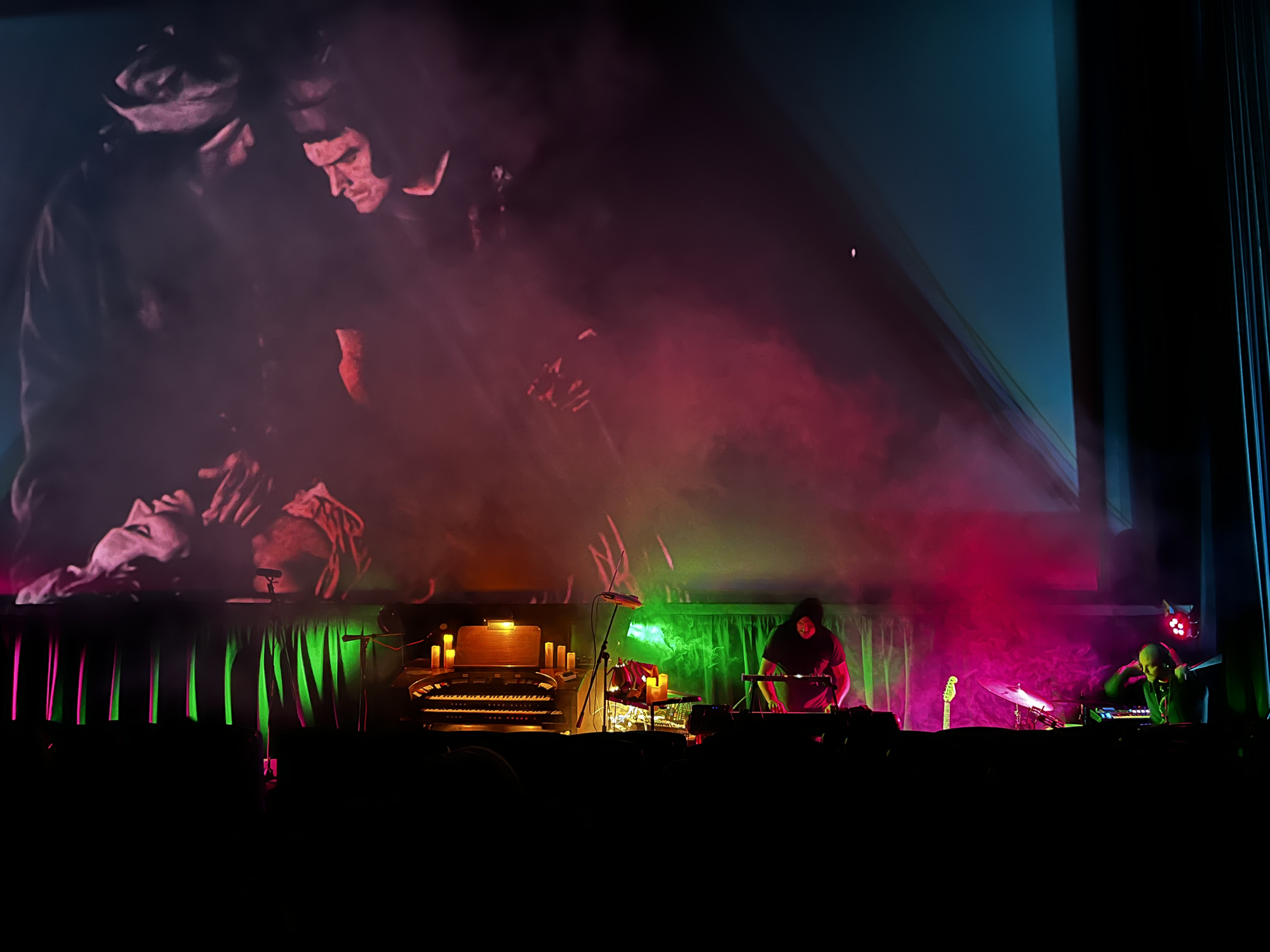
"Häxan: Witchcraft Through the Ages" with live score by Dustin Edward Howard
Circle Cinema
December 20, 2025
If you’ve never seen a guy in a black hooded cape play a theremin with laser gloves, surrounded by candles and smoke machines, while a live-action Satan flicks his tongue at you on a giant screen, you’re going to want to get yourself to Circle Cinema’s Häxan: Witchcraft Through the Ages on the next winter solstice. This was my second year celebrating the darkest night with Häxan, and it’ll be a tradition for me as long as Circle keeps it going.
You might think that Halloween is the proper time for a film about witchcraft, but Dustin Edward Howard’s annual one-night-only event—a screening of this Swedish docu-horror classic, originally released in 1922, for which he creates a live score on the spot—calls up the real spooks: the destructive forces of patriarchy. My year in cultural events started and ended with art about witches, from January's incendiary Allison Ward-curated group exhibit Waking the Witch at Living Arts to this film’s reflection on the fact that very little has changed in a hundred (a hundred thousand?) years. These events made pretty good bookends for a year that saw plenty of mass hysteria and misogynist bullshit thrown down under the cloak of law and order.
There’s some discourse in cinephile circles around the various versions of Häxan—like, that the 1922 silent original is the only version you should ever see, and that coals should be forever heaped onto the 1968 edit with narration by William Burroughs (the one shown at Circle). But I don’t really give a shit about discourse right now. It’s the end of a hellish year and I came out for synthesizers and subversive witchy business and a laconic monologue by the author of Naked Lunch, and that’s exactly what I got.
The film (a tight 77 minutes in this version, as opposed to the original’s nearly two hours) was and continues to be revolutionary. As Howard wrote in the lead-up to the show, Häxan is “an attempt to explain witch hunts using proto-psychiatry, not a celebration of witchcraft. [Director Benjamin Christensen] spent two years researching medieval manuscripts for accuracy. The film was meant to criticize persecution and superstition…. Think of it as a 1920s TED Talk with themes of how misunderstanding shaped history and insane visuals.”