


Skip to Content
Reviews

In “Dinkum Hokum” And “STATE OF THE UNION,” Living Arts Responds To A Weird Time

The dual exhibition from Austin Gober and Val Esparza offers new ways of thinking about familiar objects

“STATE OF THE UNION,” Val Esparza.

On September 10, 2025, Charlie Kirk was killed by a gunshot to the neck the same day that a student in Evergreen, Colorado—just outside of Denver—walked into a high school and shot multiple students before shooting themselves. This, the day before the 24th anniversary of 9/11, made for a potent environment in which to enter Living Arts’ latest double exhibition: Val Esparza’s “STATE OF THE UNION” and Austin Gober’s “Dinkum Hokum.” Both exhibitions have plenty to say to our current moment in American history, and they do so quite successfully. 

In Austin Gober’s “Dinkum Hokum,” a host of ordinary objects are disrupted and torn into shreds. Gober, a BFA grad from the Kansas City Art Institute, has a style that could be described as “MS Paint on LSD,” wherein bold, sharp, recognizable lines run over, through, and around melting, pixelated grotesques that stand in for figures. 

“Dinkum Hokum,” Austin Gober.

Gober is no realist, though in “Dissociating in the Living Room,” he proves that he could be. In that acrylic, a green chair is vivisected into three quadrants, each smaller than the other, until a tiny piece remains in the center. Gober’s balancing act of verisimilitude and abstraction is at its most perfect here. Modernity’s collapse of meaning finds a physical avatar in this chair, whose reality is pushed inward until it splits. 

“Dinkum Hokum,” Austin Gober.

Instead of using realism, with its pitfalls of ease and specificity, Gober reaches for the feelings of things, the disturbances inherent in matter. In “The Same Cat Twice While Hating the President,” cats are burst open into recognizable yet disturbingly blown-out ultraviolet renderings; in “Deb,” a series of black and white bars stands in for the features of a woman’s face—even with this constraint, Gober is able to make her age and aspect clear and recognizable. 

“Dinkum Hokum,” Austin Gober.

This is Gober’s great strength, finding the normality inside the disturbance. In a moment like ours, when everything is digitized, picked apart, and left behind for the next viral moment, Gober’s subjects act like a buffer between digital delirium and physical reality—and a reminder of how easy it is to confuse the two. His work reminds me of another Gober, the great American sculptor Robert Gober, whose statues of normal objects in confounding positions can make the easiest concept seem baffling, and vice-versa. 

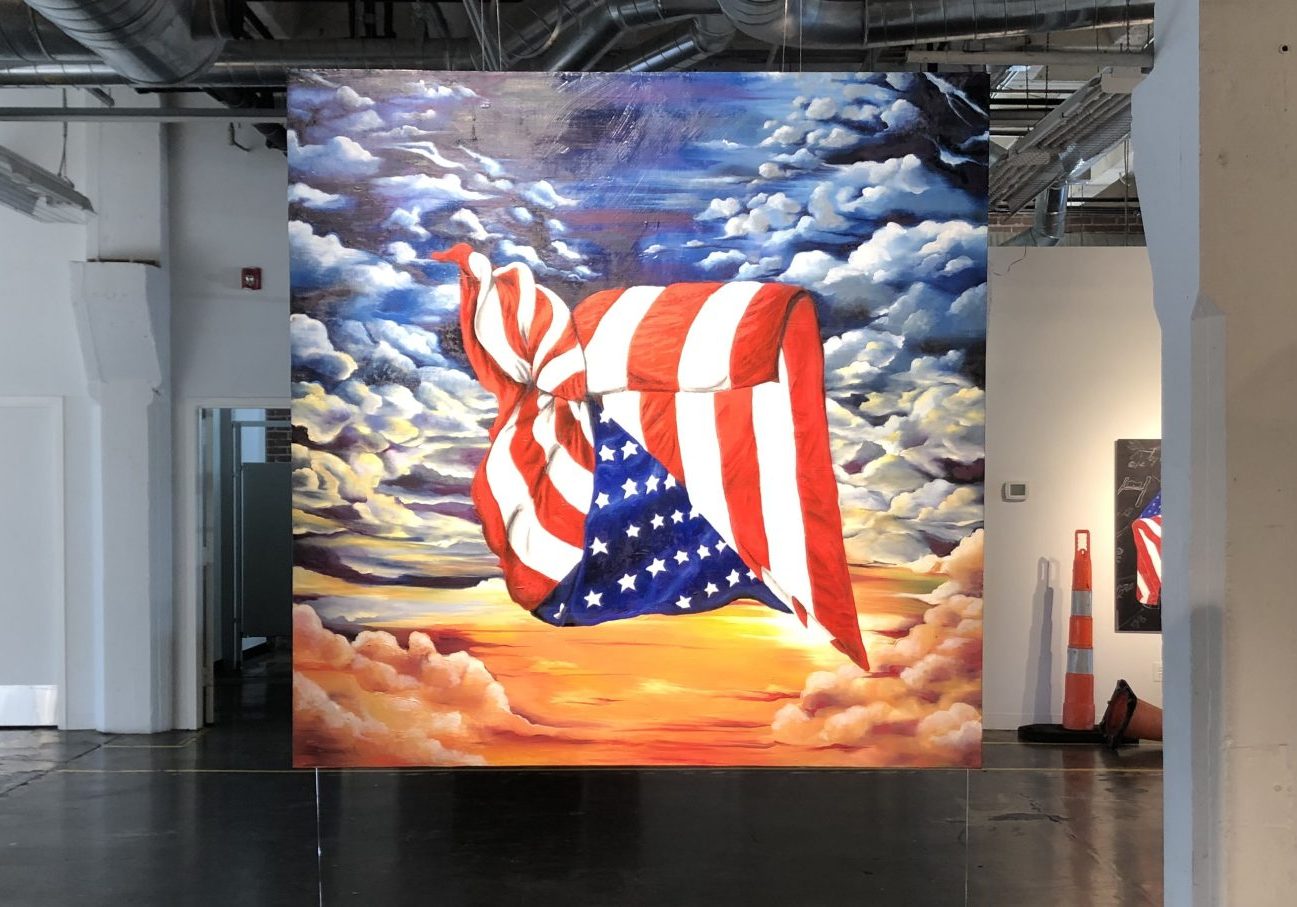
On the other side of Living Arts, Val Esparza’s “State of the Union” similarly takes a familiar object, the American flag, and distorts it into many different shapes. In the central piece of the show, titled “Pride,” Old Glory is wrapped up into what might be a fist. It’s as good of a thesis statement for the show as exists among the pieces, which run the flag through a variety of scenarios and treatments meant to complicate the feelings associated with the flag. 

"STATE OF THE UNION," Val Esparza.

Esparza’s paintings of the flag twist and tear at its fabric; one painting, “Deception Disinformation Denial,” offers the viewer a chance to take a staple gun and press a real staple onto the painting.  Esparza’s political inclinations are crystal-clear here: for this Mexican-American artist, the implications of the flag are not so much patriotic as patriarchal, worthy of questioning and even derision and destruction. In an America in which free speech is under direct and consistent threat, it’s nice to see someone taking that right seriously.  

The show also contains Esparza’s photography, all containing the American flag. While the paintings suggest a point of view, these photos are stripped of Esparza’s visual sardonicism, which must be supplied via the title. Photos like “Coney Vibin’,” “American Dream,” and “Florida Man,” which are essentially photos of the flag in different locations, hint at a position on the flag in these settings, but do not fully explore it. The photography ends up being less compelling than the paintings; ultimately, Esparza’s willingness to destroy and disrupt the image of the flag hits harder than his desire to simply capture and display it. 

"STATE OF THE UNION," Val Esparza.

While Esparza’s political ambition is one of his strengths, it’s one of his limitations too. “Thoughts and Prayers,” a flag twisting to a mass of fabric at its end, suggests an association with mass and school shootings, but does little more to tempt that association. Like a word that, when repeated, loses its sense of being a word, the American flag displayed over and over starts to seem like less of a commentary and more of a technical practice: here are so many ways of painting an American flag. And since the artistic liberties Esparza takes with the flag are so tame, the titles of the paintings become the only method by which he can transmit his icon-bending agenda. In a word, aesthetically, I wish he’d go farther. 

"STATE OF THE UNION," Val Esparza.

That said, the concept of Esparza’s exhibition contains a power that goes beyond artistic accomplishment. The willingness to wrangle the sacred symbol of the nation into new shapes takes a specific kind of courage, one to be applauded. It’s rare to see artists take actual risks like this, and it’s important to celebrate them when they do. 

Digital dissociation and nationalistic idiocy are two of the most important undercurrents in American society today; it’s exciting to see artists take on both with such vigor. This is a Living Arts show that’s well worth seeing. Not everything will land. Not everything is perfect. That’s the price we pay for living in a free society. 

If you liked this story, please share it! Your referrals help The Pickup reach new readers, and they'll be able to read a few articles for free before they encounter our paywall.

Stay in touch

Sign up for our free newsletter

More from The Pickup

Samantha Fulnecky and Christian DEI

On college campuses and American victimhood

In ‘Monument Eternal,’ The Mountain Isn’t The Whole Story

Le’Andra LeSeur’s show at the TAF Flagship considers the weight of history, embodied resistance, and the texture of being present

December 4, 2025

Crawl To The Year’s Finish Line With These December Art Shows

What even is reality?? Ask a Tulsa artist this holiday season

December 3, 2025

Tulsa Picks: The Week’s Best Tulsa Events, December 3-December 9

First Friday, The Nutcracker, a concert at Tyler Thrasher's Materia shop, and insane amounts of Yuletide cheer

December 2, 2025
See all posts