


Riffraff Tulsa: “Saint Joan”
The Studio
March 23, 2025
After a remarkable debut last fall with Karel Capek’s R.U.R., adapted for modern audiences by Executive Artistic Director Meagan Mulgrew, Riffraff Tulsa ended its inaugural season with another classic, George Bernard Shaw’s 1923 play Saint Joan, which the playwright’s biographer dubbed “a tragedy without villains.” Written three years after Joan of Arc’s canonization, the play, which Mulgrew condensed, opens in the midst of the third stage of the Hundred Years War, after Joan receives her first divine vision. In six scenes and an epilogue, Shaw covers Joan’s rise, fall, and legacy and the slew of historical events that happened in between: the nine-day siege of Orléans, the coronation of Charles VII of France, the unsuccessful siege of Paris, and Joan’s capture, trial, and burning at the stake. Historically, this all takes place in the span of three years; on stage it takes about two hours and 20 minutes, with intermission.
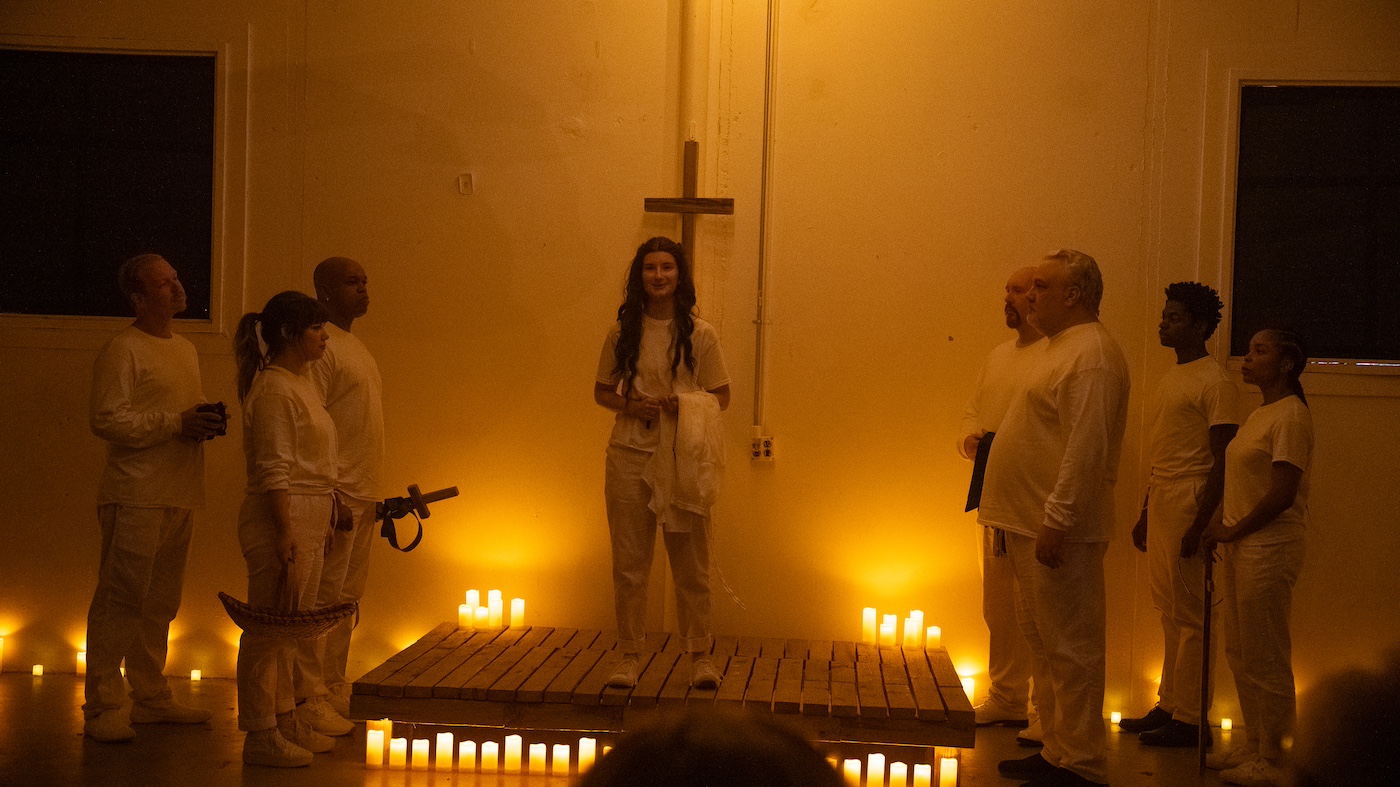
Mulgrew, who directed both of the company’s productions this season, brought many elements that I loved about R.U.R. to Saint Joan: tight ensembles, choreographed transitions, and unconventional theatre spaces that become immersive storytelling sanctuaries. With the guidance of production designer Brittany Campbell, The Studio in Kendall Whittier transformed into a simple, adaptable backdrop that evoked the pre-industrial aesthetic of 15th century feudal Europe. A wood altar lit by flickering (battery-operated) candles and a single string of fairy lights created an intimate space for 45 attendees and elevated the dramatics. The actors moved four small wood benches, a table and a creaky wood throne into different configurations scene by scene. Costuming took a similarly minimalist route: a uniform base of white adorned with accessories and props that allowed the ensemble to switch between characters. It’s proof that you really don’t need much to create an effective, cohesive design.
Prudence Lloyd tackled the titular character, performing a grounded yet resolved Joan who confidently balanced the gaggle of historical figures she encountered on her quest to conquer Orléans and beyond. The remaining seven members of the cast collectively handled the remaining 17 characters that made up the ensemble (in the original play, there are 23). As an actor, I’d like to emphasize this is no easy task. Oftentimes, we are cast as a specific “type” of character, either because we’ve played that kind of role so long it feels familiar, or because our likeness to that “type” tends to bring forward an honest performance. Playing against type is hard; playing two, three, four different characters in one show—the task Mulgrew gave her actors—is more challenging still.
In a play where language shapes the characters and their motivations, certain performances popped; I especially loved Thomas Hunt’s domineering Baudricourt and Andrew Smith’s hilariously insistent Courcelles. Ashe Baileigh had the delicious task of playing four separate characters and found different physicality and postures for them all, switching effortlessly from scene to scene. It was a joy to watch Josiah Parks saunter between the introspective yet firm Earl of Warwick and the willowy, flighty Charles VII. The captivating Rachel Brown played both French soldier Dunois and English chaplain John de Stogumber, placing her on literally both sides of the war. In one scene she’d appear as Joan’s supporter, a hardened military officer who comes to trust in the young woman’s ability to deliver miracles; in the next, she became Joan’s biggest adversary, leading the charge for her excommunication and burning. Brown captured these characters’ distinct motivations while driving home impassioned speeches that made me listen.