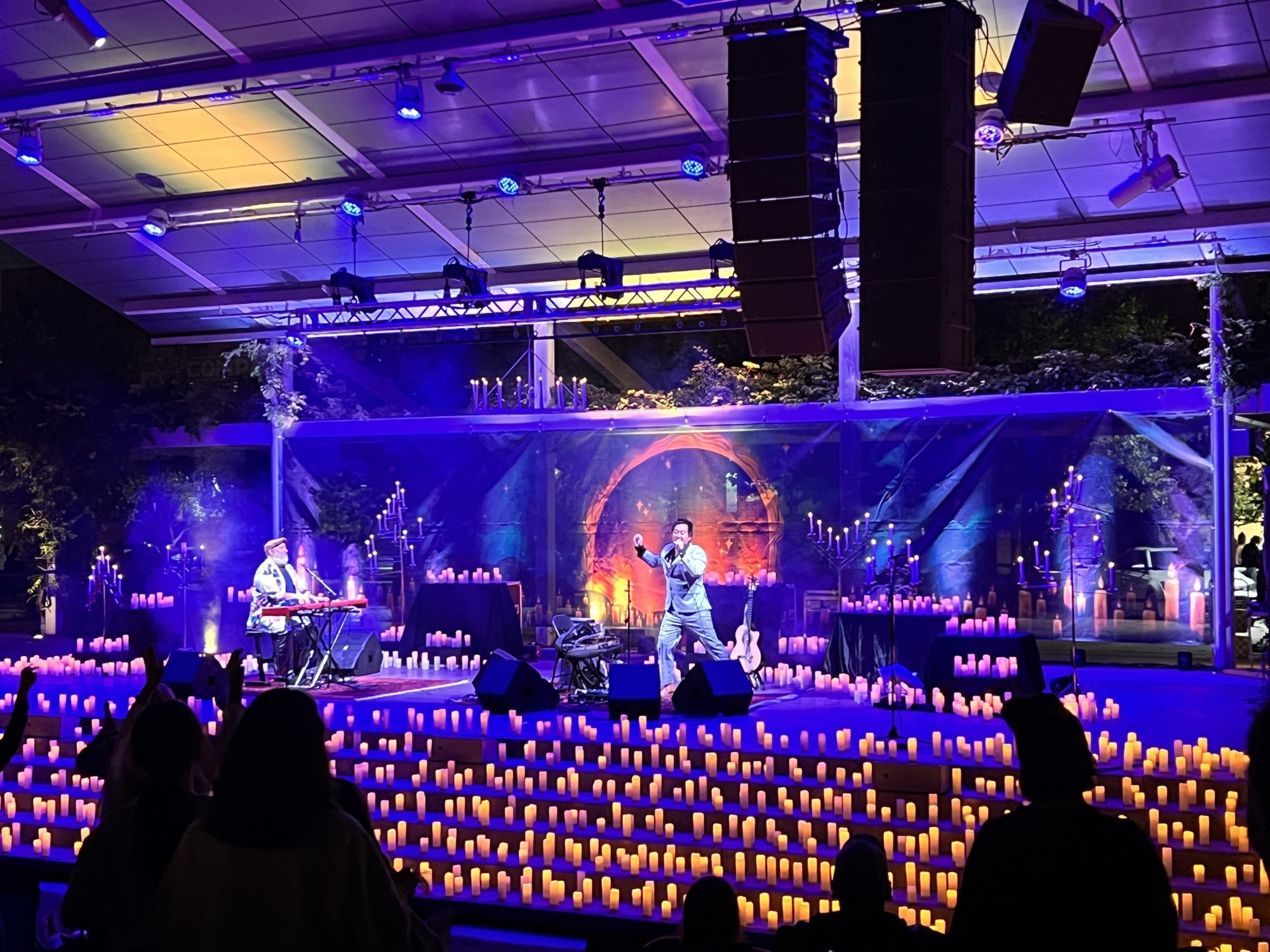


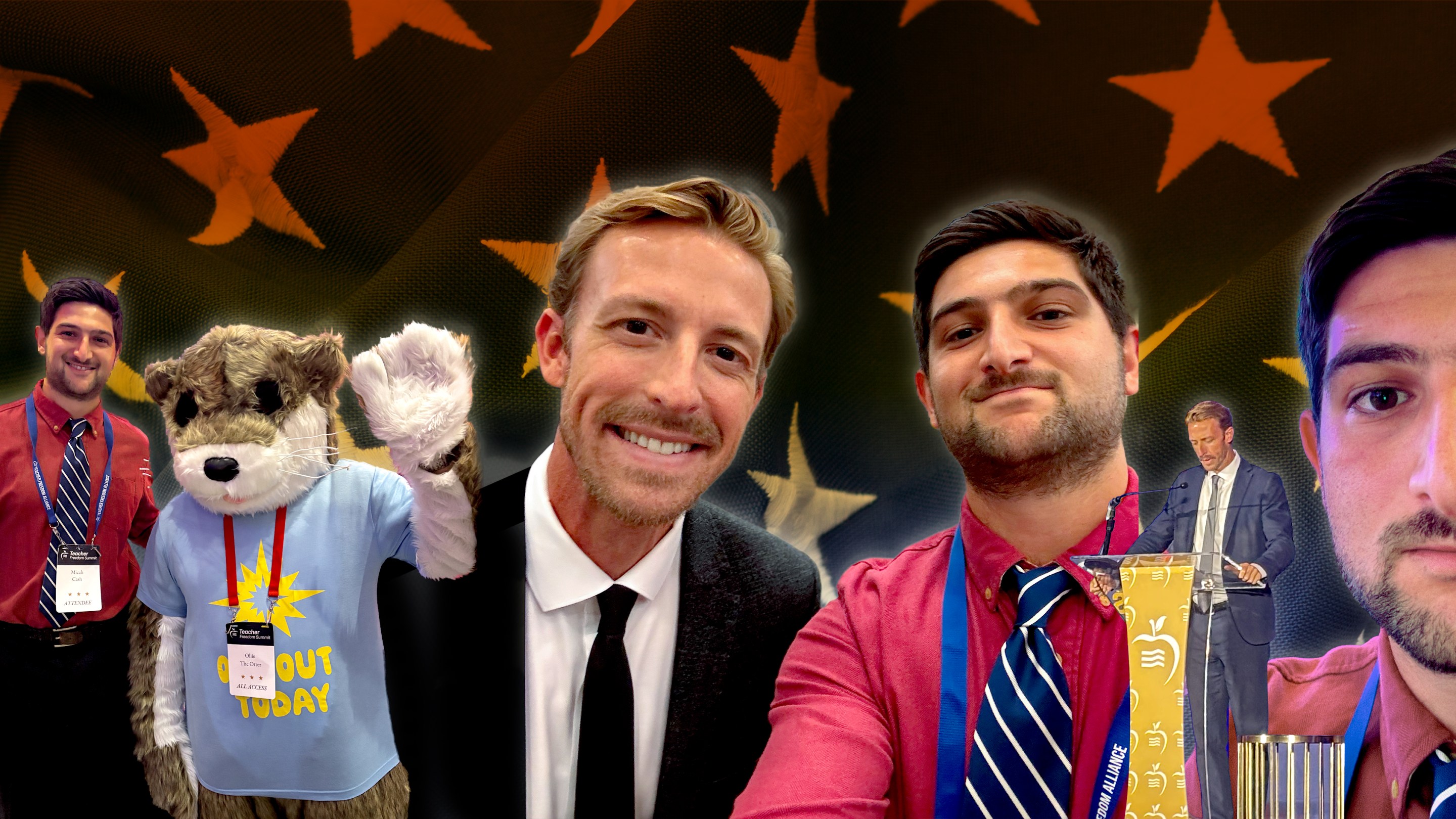

Paul Everts teaches music outside Sacramento. Short and solidly built with a shaped grey beard, it’s easy to imagine him and his vibrant baritone conducting a high school band, which he did with success at California public schools since, as he says, “nineteen hundred and eighty-nine.” In 2021, Paul’s school began receiving complaints from students.
The first incident, in his telling, alleged Mr. Everts declared his proud Christian faith and love of Jesus in class. The second alleged he told one or more of his students that he loved them. In meetings with school administrators and union representatives, Paul freely admitted to all of it. The union decided not to defend Paul in the ensuing disciplinary hearing, so he defended himself, telling the principal and school board to make sure he was on the record before he delivered the line he repeated to me as he tightened his starred-and-striped tie: “I love God, I love my wife Diana, and I resign.”
I met Paul by the Moms for Liberty booth at the opening exhibition of the Teacher Freedom summit. Hosted in July at the Sheraton Dallas, the summit is the annual conference of the Teacher Freedom Alliance, founded with $2.5 million in contributions in 2024 and headed by Ryan Walters, the firebrand former Oklahoma State Superintendent of Public Instruction. When he announced his resignation from public office and new role as TFA’s CEO on Fox News last September, Walters stated the organization’s objectives plainly: “We will build an army of teachers to defeat the teachers’ unions once and for all.”1
I began teaching in fall 2024, two months after Walters issued an order for all Oklahoma public school classrooms grades five through twelve to keep a Bible and a copy of the Ten Commandments on display. At the time Tulsa Public Schools was a frequent target of Walters’ scrutiny for legitimate concerns over student outcomes and a case of executive-level embezzlement. But he also fashioned himself into the state’s leading culture warrior, leaning fully into a modern political style of meme authoritarianism. He campaigned on hoaxes, picked fights with the media, threatened to decertify Tulsa Public Schools, and called out specific teachers for their “woke ideology.”
One public school, Ellen Ochoa Elementary, received bomb threats for days after Walters retweeted Libs of TikTok. Hundreds of LGBTQ+ and civil rights groups called for his removal after the death of Nex Benedict, a gender-nonbinary student at Owasso High School. Even some Oklahoma House Republicans tried to start impeachment proceedings against him.
Walters’ years-long reign over the state’s education system was often rumored to be an audition for a job within the Trump administration. When I told friends I was moving back home to Tulsa from New York City to teach, their first question, no matter where they lived, was about Walters.
Yet the mundane truth, as I’d soon discover in my classroom, was that Walters’ pronouncements were not binding. The Oklahoma Department of Education was hardly going to send inspectors into every classroom in the state. And while administrators and parents had to deal with a whiplash of rhetoric and regulations, in my experience, Walters’ presence in the classroom was that of a phantom.
So when he suddenly exited the spotlight last year—weeks after an investigation into how the television in his office came about screening nude scenes from the 1985 Jackie Chan movie The Protector during a school board meeting—I was curious about his mysterious new landing spot. My colleagues and I had never heard of this teacher’s advocacy group. News reports at the time focused on Walters’ scandal-plagued tenure and the fallout with his former friend and boss, Governor Kevin Stitt, while details about the organization were scarce. NonDoc called it a “nebulous education reform nonprofit.” What exactly was this anti-union that so resembled a union? I decided to check it out myself.
Teacher Freedom Alliance (TFA2) was free to join, and I was soon added to its discussion forum hosted on a platform called Circle. The group chat was sporadic: many of the posts were from staffers promoting webinars or Walters’ press appearances. A few super-posters promoted their YouTube channels and lamented any whiff of wokeness in their school, state, or nation. Occasionally I heard from users without profile pictures sharing stories like Paul Everts’: deeply personal accounts of being fired, bullied, or otherwise mistreated for their political and religious beliefs. Walters himself posted an introductory message, making a point to respond to each enthusiastic commenter. But besides embedding within a community of aggrieved teachers with conservative leanings, I was no closer to discovering what the organization actually did, nor understanding its scale of influence within the American education system.
I reached out to their communications department with more questions. Was TFA an affinity group, or did my membership qualify me for other benefits, like liability insurance or bargaining for pay? Could they connect me to other members within Oklahoma? And how much were they paying their new CEO? Their response was politely evasive. While TFA was not a bargaining unit, they did offer what they called excellent liability insurance to teachers who could prove they’d quit their union. They also offered a variety of resources, ranging from opt-out instructions to PragerU curriculum videos. As for connecting with other members, had I tried introducing myself in the chatrooms? I’d reached a dead end.
A few months later, I received an email about the 2026 Teacher Freedom Summit in Dallas. My editor and I realized it was the perfect opportunity to meet the “army of teachers” Walters was leading into battle. But first, I had to be accepted.
The online application asked for confirmation that I work in public education. It also required I submit a link to my social media accounts. I only have Facebook, and even there I’m not active, but to be safe I scrubbed my profile of anything potentially compromising: college op-eds arguing for gun control and pictures betraying my years in California and New York among the coastal elite. Next I was to answer a series of short-answer questions about my “philosophy” of teaching and my interest in the summit. Most concerning was a series of terms and conditions, including one stating that any disruptive conduct and/or statements contrary to the values and mission of the Teacher Freedom Alliance were grounds for immediate expulsion, as well as financial penalties and prosecution to the fullest extent of the law.
The application should have been a hint of what awaited me at the summit: internal strategizing on how to take down the unions, AI-generated prayer requests, direct access to Walters himself, and a convocation of teachers more bizarre and humane than I could have imagined. But the email said spots were going fast. I signed everything, wrote a few answers that were truthful, though carefully calibrated to my audience, and put in my credit card information. I was accepted within the week.
And then for nearly six months I wondered about that “army of teachers.” Who were they, and what did they want to see in their classrooms? Were they zealots like Walters? Or just teachers like me, treading water in the face of insurmountable challenges, trying to be a little bit better every day? And what about Walters himself? Is he still measuring success by whether or not he goes viral? And what’s his big plan for taking down the teachers' unions, anyway?
"Sam from the Midwest sent an AI-generated list of prayers for the conference ahead that included '4. Prayer for Technical Excellence and Peace Amid Challenges: Lord, we ask for Your hand over every detail of the event’s logistics and technology.'"
That’s how I found myself heading south on US-75 on a Tuesday in July, stuck in World Cup semifinal traffic just past Stringtown rather than enjoying one of the last weeks of my summer break. If the Teacher Freedom Alliance meant to raise an army, it was my mission to don a helmet and report from the front.
***
On the way from my hotel room to the summit’s opening session, I meet Leely and her mother Pam. Leely attended last year’s summit in Washington, D.C., and teaches eighth grade at a Christian charter school in North Carolina. She previously taught in Florida public schools but left because of the pay and, as she put it, the woke agenda. At her new Christian charter school, she can negotiate her salary. Pam is not a teacher, but decided to join her daughter and make a road trip of it. There are police and prohibited-items signs in patriotic colors at the top and bottom of the long escalator. Pam glances, bemused, at the metal detectors and bag checks at the entry checkpoint. There is “way more security than last year,” Leely observes.
We enter the ballroom, where rows of conference tables face a stage with flags and a lectern in front of TFA’s guiding values: “developing free, moral, upright citizens.” Flashing lights sweep the stage from overhead and floor beams project “America’s 250th” on the cutaway walls. Multiple camera stands and a large production booth in the back house monitors, speakers, and guys with earpieces. They’re pumping in cold air and macho country music.
I find Paul Everts at a table near the front, and he introduces me to his friend Priscilla, who also has a YouTube channel. She grabs his shoulders for the chorus of “Party in the USA.” Their energy is infectious. The music gets even louder—Springsteen—and there is Ryan Walters, bounding to the lectern. He is slim with slick-backed hair, a dark gray suit, and light gray tie. A hush goes over the crowd. He has the glow of a cable television celebrity, but here he is in the flesh. This is what people came to see.
His introductory remarks are inoffensive. “We’re getting back to the basics in education,” Walters says. “What does it mean to be an American? What does it mean to be a valuable member of our society?” Walters encourages us to share content from the conference on X, spelling out the designated hashtags.
According to the official agenda—a robust booklet handed to me at check-in along with my unlaminated nametag and a clear bag of TFA-branded goodies—the summit lasts from Tuesday afternoon until Thursday at noon. The schedule is grueling, crammed with programming. It provides us eight hours for sleep each night, and, in classic teacher fashion, exactly 30 minutes for lunch. Each day consists of two main components: general sessions with featured speakers, and breakout sessions with themed panels. Each evening we’ll be treated to dinner with more speakers. To my surprise, tonight’s headliner is Linda McMahon, the U.S. Secretary of Education.
Upon closer inspection, I see the agenda is split between explicitly political content and standard educational topics, weighted towards the former, along with a sprinkle of religious references. Both mornings begin with an optional seven o’clock prayer and worship session in the ballroom. The promotional materials promised 400 teachers. By my count, at least 200 have shown up for the first session. Many of my early acquaintances were repeat attendees; the first summit was held in 2023, with Walters as the keynote speaker. But throughout the conference, I found that even among a self-selecting group of teachers, attendees ranged from skeptical observers to single-issue networkers to the hardcore phalanx of culture warriors that Walters advertised.
The opening speaker was James Lindsay, a conservative social media personality. After a few awkward jokes about the World Cup, he addressed one of the biggest bogeymen in all of conservative education: Critical Marxist Theory.
If you didn’t know better, you might think you’d wandered into the wrong conference as Lindsay gave an adequate if rudimentary explanation of how the Frankfurt School’s critique of capitalist reproduction made its way into American public school classrooms. Instead, Lindsay said, we should be teaching our young people to be proud of their community, their history, their country, and the normative standards of family and citizenship. Over the next 45 minutes, he outlined a can-do patriotism that acknowledges our country’s faults while appreciating its inherent tendency to overcome them.
"It occurred to me that none of the opening session’s three speakers were teachers, nor were any of them employed in formal education. Instead we’d heard from a Twitter pundit, a motivational speaker, and a licensed real estate agent."
In Lindsay’s telling, the ghost of Theodor Adorno is haunting schools throughout the country, training young people to be constantly critical and whine about microaggressions. He finished on an optimistic note, something about gratitude and teaching civics. There was scattered applause, and we were quickly on to the next speaker, Ken Pope from the Victims of Communism Memorial Foundation, who wove a web of conspiracy from TikTok to the Red-Green alliance as he encouraged us to “depoliticize the classroom.”
In advance of the summit, a dedicated thread in the chatroom had filled with reply-all responses, each carrying a distinct undertone of desperation. Sam from the Midwest sent an AI-generated list of prayers for the conference ahead that included “4. Prayer for Technical Excellence and Peace Amid Challenges: Lord, we ask for Your hand over every detail of the event’s logistics and technology.” For a conference full of Boomer teachers, we’d need divine intervention to deliver us from technical difficulties.
Paul, Priscilla, and I were joined at our table by Nona and Linroy Kilgore. The Kilgores shared not only a name and sensibility with a famous Vonnegut character, but a frizzled hairstyle matching the late author of Slaughterhouse-Five. I was familiar with Nona from Circle, where she was prone to post Bible verses at random intervals, sometimes multiple in rapid succession like the poster-in-chief himself. A representative post from the day before the conference was the full verse from Isaiah rendered in her house style: “no weapon that is fashioned against you shall succeed,” with the subject line “God is Faithful! Thank YOU, LORD!!”
I was excited to meet the star of my parasocial lurking in person. Nona was born in Armenia under Soviet rule, and she still lived there in 2008 when she met her husband Linroy, who had fled the U.S. the morning after Obama won. With Linroy running English-language schools and Nona teaching music, they lived in Armenia, Turkey, Kuwait, and even China. When I asked what it was like to teach in China, Nona told me that there, at least, she was allowed to call it a Christmas concert. The couple moved back to Texas when Trump won for the second time, and last year Nona was officially naturalized as an American citizen.
Ken Pope displayed a PowerPoint slide with side-by-side pictures of Boris Yeltsin perusing the cornucopia of a Clear Lake, Texas, grocery store and a contemporaneous Soviet store with empty shelves and rotting meat. Nona leaned over to me and said, “That’s what it was like.” As Pope drew a line from Yeltsin’s famous visit to Zohran Mamdani, Nona’s eyes welled, and she whispered in my ear with increasing agitation about the ideological tests she passed in her childhood, the thin soup her mother made every night, and the impossible dream of America.
I decided to take Lindsay’s advice and put aside my relentlessly critical worldview. For the next two and a half days, I’d try to be like Nona and so many other devoted teachers spending one of their last weeks of summer earnestly searching for answers to what has gone so horribly wrong in our education system. And how, God willing, we might just fix it.
***
At the happy hour “networking reception,” my fellow educators and I are seated by state. While a few—California, Virginia, Texas, Florida—occupy multiple tables, I have to search for Oklahoma, which was relegated to sharing a table with other states.3 Over beer, wine, and cheese cubes I meet an AP U.S. History teacher in Colorado alarmed by the rise of “commies” in her state, then an elementary school math teacher in the suburbs of Atlanta, where everyone on the school board is a “wackjob.”
Also at my table are Jonathan, from Texans for Fiscal Responsibility; Chase, from the Herzog Foundation;4 Tov, a first grade teacher in California; plus my buddies Leely and Pam and a young Teacher Freedom Alliance staffer. At one point, Tov says the problem with first graders is you can’t fight back against them, except for the time he headbutted one of them. All in good fun, of course. Soon Chase is handing a despondent-looking Jonathan a flyer advertising his Christian education podcast and telling him about his dream of one day holding the title of “visiting scholar” at a think tank. Leely and Pam, meanwhile, are smiling and nodding as Tov shares tales of the raccoons he feeds and nurtures against the wishes of his neighborhood association.
I ask the staffer how she got into this line of work. She told me she went to a community college outside Sacramento, got a job at the Freedom Foundation working on projects related to California public sector unions, and eventually moved over to TFA. She didn’t strike me as an ideologue. I wondered how many of TFA’s staff had ever worked in a classroom. It occurred to me that none of the opening session’s three speakers were teachers, nor were any of them employed in formal education. Instead we’d heard from a Twitter pundit, a motivational speaker, and a licensed real estate agent.
In fact, despite what was suggested on the application, most of the people I’d met so far worked in either religious charter schools or the conservative policy blob. There were many public school teachers at the summit, but my informal survey suggested that TFA’s inroads at public schools were shallower than advertised, and that the “high-profile” attendees were dominated by those who had already “opted out,” not just from the union but from public education as a whole.
By the time I escape Tov and his raccoons, my new friends are scrambling for seating. Nona and Paul’s table is already full, so I take my seat next to Leely with a sigh of relief, only for Tov to plop down next to me and turn his wide eyes straight for the bottle of Cabernet. There was barely a moment to meet the rest of the table when a guy from Tennessee—who had been nursing a bourbon at happy hour—got up to lead us in a prayer about the battle between good and evil.
Then Walters returned to introduce Aaron Withe, the CEO of the Freedom Foundation, who gave the clearest answer I’ve gotten to date about what the Freedom Foundation and TFA actually do. In lieu of a positive vision for the future of education, Withe, in his British accent, spelled out a singular objective: the negation of America’s teachers’ unions.5
According to Withe, the Freedom Foundation has, first, helped over 280,000 workers opt out of their unions, including a significant number of public school teachers. Second—and this was the point that multiple speakers throughout the conference seemed especially excited about—they make red tape for unions. “I’ve got some of my lawyers here,” Withe said. “And all they do every day is sue unions full-time.” Finally, TFA lobbies for legislation targeting public unions, such as Arkansas’s ban on automatic dues deduction and Florida’s recertification law.6
Toward these ends, TFA has its foundational lore. The origin story, repeated throughout the conference, goes like this: Jimmy Carter created the Department of Education in 1979 as a reward for the political loyalty of union leaders, including Walter Mondale’s brother, a higher-up with the NEA. Ever since, the department has been a one-stop shop for union interests, giving them immense power over classrooms and a platform to push radical left-wing politics. Meanwhile, the quality of the education system has steadily deteriorated. TFA exists to directly combat the power of unions by organizing ordinary teachers to take back control of their own classrooms.
By Withe’s account, the movement is growing. In less than two years, TFA has amassed over 16,000 members. Withe closed with an odd joke about how his wife didn’t usually attend these “rubber chicken dinners,” but as a public school teacher, she was proud to be here tonight. As if on cue, a fleet of hotel staffers began passing out warmed plates of chicken and carrots. Tov asked our server if they had steak, but she shook her head, and he settled for a refill of Cabernet.
Weary and hungry from the travel day and five hours of programming, I struggled to cut into my rubber chicken. But just as my spirits were flagging, U.S. Secretary of Education Linda McMahon walked onto the stage. “She looks fantastic,” Pam said as I poured her a glass of Chardonnay, and indeed McMahon, 77, radiated health and competence in a white pantsuit.
The longtime wrestling executive holds thin credentials for the nation's top education job.7 But given the nature of her appointment, perhaps a background in business administration is more apt. McMahon sat for a chat with her deputy chief of staff Lindsay Burke, a longtime researcher at the Heritage Foundation who authored Project 2025’s chapter on education. Burke was “writing papers about abolishing the Department of Education before it was cool,” as Walters put it. McMahon, whose kayfabe past includes getting stunnered by Stone Cold Steve Austin, was installed by President Trump for one final mission: the closure of the Department of Education, pursuant to Executive Order 14242.
The fireside chat format consisted of Burke lobbing softballs to her boss, who responded with telegenic charm. She told us of the president’s embarrassment over America’s declining test scores, and an Education Department that has spent $2 trillion over almost 50 years with nothing to show for it. She detailed their progress in securing inter-agency agreements to improve “operational efficiencies.”8 Workforce programs could be handled by the Labor Department, student loans9 by the Treasury Department, and so on. She closed with a list of solutions that were by now becoming familiar: civics contests, school choice tax credits, and above all, listening to teachers.10
It was past eight o’clock when McMahon finished. Applause was decent, and an attempt at a standing ovation fell flat. Tov helped himself to one more generous pour of red as Walters introduced the next speaker: David Barton, an author and activist committed to an explicitly Christian interpretation of the nation’s founding. Everyone else seemed to know this guy—Walters himself was visibly more fired up about his presence than McMahon’s—but I was beginning to feel woozy from the strangely enlarged chicken breast, unnaturally cold air, and neon stage lighting. I ducked out the back doors to find the exhibition hall nearly empty, stray pamphlets strewn on tables.
A thin, bald man introduced himself by the dessert table. With soft-spoken confidence, Jack told me he wasn’t a teacher but a builder of schools. He’d run a charter school in Baltimore with outstanding results. The conservative education movement has always backed charter schools; many of the Freedom Foundation’s largest donors are charter advocates. Jack got involved with TFA through the charter school policy world, and attended last year’s summit. He came back this year because “too many people know the legacy system is broken, but too few are building serious alternatives.” He wanted to spend time with people who are actually trying to build. When he heard I was an Oklahoman, he couldn’t believe I hadn’t met “Ryan”—he was happy to make the introduction.
Jack’s schools are nontraditional in many ways, though deeply traditional in one: boys only. They have “no rules,” only guidelines and expectations (I didn’t press him on the difference), no homework, and two hours of athletics or outdoor time to start every school day. His students learn Latin and complete open-ended, long-term, interdisciplinary projects. Teachers are expected to work more like holistic education guides and though class time ranges from individual tutoring to peer-led symposiums, it was never one teacher lecturing at a whiteboard. “The biggest problem in public education,” he wrote to me after the summit, “is not only ideology or bureaucracy. It is that too many schools are no longer organized around formation, mastery, and real human responsibility.”
The clearest sign that Jack was in touch with realities on the ground was when he asked me how I could tell if my students were taking THC gummies during the school day. We agreed that while instinct took you far, in the end there was no way to know. His tone was different from what I’d heard the first day of the conference. He was asking out of empathy, not fear. Finally, I’d found someone with a positive vision for education: “smaller, higher-trust schools with clear culture, adult authority, academic accountability, and differentiated pathways.”
A staffer made the rounds to tell people that the movie would be starting. The final agenda item of the night was a screening of the three-hour director’s cut of Reagan, the 2024 film starring Dennis Quaid, filmed in Oklahoma.
Jack said that Kindergarten Cop was a better use of my time. Then he saw Walters, interrupted his conversation, and introduced me. Walters is taller than I expect. He has sharp angles to his face, a long nose, and intense eyes that are constantly scanning the room for the next person to talk to. I tell him I teach in Tulsa Public Schools, that I’m here at this conference because of him. He is gracious and happy to meet a fellow Oklahoman. After a short exchange, we plan to talk more tomorrow. Jack and I split and after about 30 minutes of Reagan conducting tense negotiations in Geneva, I decide I’ve seen enough. Kindergarten Cop isn’t available on demand, but Caddyshack is on cable. I doze off around midnight, with 15 hours of programming awaiting me tomorrow.
***
The second morning’s opening speaker, Rick Green, continued yesterday’s drone of vague patriotism (“One prayer a day keeps the communism away”), and I began to wonder if anyone at all would talk about teaching. But things turned around with Jedd Hafer, an emotional intelligence expert employed by Scott Ervin, better known as “The Kid Whisperer.” When I saw “behavioral management” on the schedule, I’d expected a primer on draconian discipline. Instead, over the course of his charismatic presentation, Hafer walked us through a series of eminently reasonable strategies for de-escalating common classroom disruptions. The key, apparently, is to be “calm, strict, and loving all at once.” In practice, this meant avoiding arguments with preventative signals, communicating solely in facts rather than statements of value, and constantly noticing positive behavior to reinforce good habits. While the statistics (95% reductions in disruptive behavior at large city schools!) seemed too good to be true, Hafer kept my colleagues more engaged than any of the previous speakers. He ended to a rousing ovation.
Just as we were getting some actual professional development, the political rhetoric resumed. A Freedom Foundation staffer named Maxford Nelsen emerged to lecture us on “Janus Rights and Union Dues.” I knew we were in for a doozy when Aaron Withe himself appeared at the table next to me, followed by a procession of staffers delivering him three separate drinks (iced latte, green juice, Liquid Death) and a large Driscoll’s container of washed berries, which he deleted with relish over the course of the presentation.
Nelsen has the name and self-presentation of a conservative intellectual. He opened with two quotes on progress: the one about the arc of the moral universe bending toward justice, which was popularized by Martin Luther King Jr. (and worn out by Obamacore liberalism) but actually came from Unitarian minister and abolitionist Theodore Parker; and the other by C.S. Lewis, roughly paraphrased: “If you’re going down the wrong path, true progress is turning around.”
Having established his scholarly bona fides, Nelsen presented on a single slide three photos: a group of Hispanic men holding guns and drugs, the OPEC logo, and a group of striking teachers. He asked the room what they have in common. After 10 seconds, my aversion to awkward silences overtook my reluctance to draw attention to myself, and I raised my hand: “They’re cartels.” Nelsen was impressed: “You must teach economics.”11 Direct recognition from the stage—what a rush!
Eleanor, an English teacher in Beaverton, Oregon, sitting next to me, acknowledged my triumph with a nod. Over the next half hour, Nelsen endeavored to present a history of the American labor movement. Just like the critical theory primer from yesterday, if you only looked at the PowerPoint slides, you might think we were engaged in a very different conference. The ballroom was beginning to function like a casino, warping time and attention via sensory overload: huge, sterile chandeliers built into the geometric ceiling panels, main lights dimmed all the way, a single spotlight focused on the stage, the soporific drone of industrial air conditioning, branded holograms on the walls lit up in neon red and blue. The same patriotic songs cycle between speakers and there is no sunlight, no soft seating, no children.
The feeling of disorientation intensified as the bespectacled right-winger told us of the Great Railroad Strike of 1877 and the equally important but often forgotten Homestead Strike of 1892, both featuring violent, state-sponsored repression of workers in critical industries. The point of Nelsen’s ridiculous cartel graphic was that until the early 1900s, it was common for the U.S. to treat unions as illegal criminal conspiracies. But after years of violent struggle between working people on one side and capital and state on the other, in 1914, the Clayton Act exempted labor unions from antitrust laws under the theory that “the labor of a human being is not a commodity or article of commerce,” a view further codified in the 1935 National Labor Relations Act.12
Nelsen’s history toggled from alternative back to mainstream with the 2018 Supreme Court case Janus v. AFSCME, a ruling so important to the Teacher Freedom Alliance that it became featured on countless buttons, stickers, and pamphlets, repeated often without context like a slogan or a psalm. The 5-4 decision held that non-union government employees cannot be required to pay union dues as a condition of their employment. It was this ruling that allowed the Freedom Foundation to launch OptOutToday.com, a handy way for state and municipal workers across the country to take back the union dues being siphoned from their paycheck while continuing to be subject to employment conditions negotiated by the union. So far, over 280,000 have done so per Aaron Withe, who in my periphery had finished all three of his drinks and was fixedly turning each plump berry between his thumb and index finger before popping it into his mouth.
From gender unicorn diagrams distributed to elementary school teachers in Montana to official union social media accounts posting iconography for May Day rallies in Chicago, Nelsen gleefully projected the union agitprop on the big screen, and Eleanor was disturbed to see what her dues were supporting. As the detailed account of recent union excesses continued unabated, Eleanor and I got to talking. Was Nelsen’s story connecting with her?
The unions have done a good job bargaining for pay increases, she said, especially as her high-performing district in the Portland suburbs becomes more and more unaffordable. But her conscience was shocked by the political activism of national organizations like the NEA. Liability insurance, legal representation, bargaining for cost of living adjustments to pay scales—for all of these things she was thankful. And yet, the unions were “crazy.” “That’s the bargain,” she said.
"I was running on a few hours of sleep and hadn’t left the labyrinthine confines of the Sheraton Hotel & Event Center since my arrival the day before. I decide to skip the next breakout session and regroup before the afternoon marathon. Walking to lunch in the midday Dallas heat, I receive a text: 'This is Ryan Walters.'"
Two slides of Nelsen’s presentation got to the core of the entire summit. The first was titled “What Changes When You Cancel Union Membership?” In the “keep” column: salary/raises, health insurance, retirement benefits, working conditions, and anything else provided for in the collective bargaining agreement. In the “lose” column: attendance, participation, and voting in union meetings.
The next slide quotes American Federation of Teachers President Randi Weingarten, to Nelsen’s credit, directly: “Public employees who benefit from a collective bargaining agreement but choose not to join the union can opt to be ‘free riders’ and not contribute anything for the benefits they receive, while the union must still represent them.”
Exclusive representation13 rights are a monopolistic advantage, then, but also a collective responsibility. Strikingly, while Nelsen went on to lambast the unions’ support of drag queens and gender unicorns, their creative use of dues to fund campaign contributions, and their disastrous COVID-era policies, his “keep” column can only be read as an endorsement of their views on salary/raises, health insurance, retirement benefits, working conditions, and more. Later in the day I sent pictures of the slides to a fellow Tulsa Public Schools teacher, who summed up the situation: “Two sets of people agreeing on the existence of the free rider problem, just disagreeing on whether it’s a good thing.”
In any other context, the various interest groups at the Teacher Freedom Summit would be staunchly anti-free riders. But in the context of public schools, a movement that traditionally vilified free riders has landed, after decades of losses to the organizational, legal, and financial sophistication of the unions, on a ruthlessly logical argument: it’s much easier to encourage people to quit their union when you implicitly acknowledge that they will continue to reap all the advantages of membership without any of the costs, except perhaps some awkward conversations in the teacher’s lounge. Nelsen’s presentation ended with tepid applause.
***
Before the breakout sessions, I talk to Walters again. I approach him this time, catching him looking at his phone as an aide whispers in his ear. He says he remembers me from yesterday, though his tone indicates otherwise. I ask him why he decided to work for TFA rather than continue in public office.
“Every fight in education is national,” he says. “[TFA] reached out to me and said we’re trying to get more involved in the national fight, like Turning Point USA, trying to coordinate effort and strategy. Because we were able to do a lot in Oklahoma, but I mean literally, we would do something and there would be four million dollars in ads on TV against us the next day. Now we’ve got a counterweight to all the nonsense going on, and at the same time playing some offense.”
He wants to continue the conversation, he says, but he has to run. Handlers in black TFA polos hover nearby, carrying energy drinks. He has me put my number in his phone, and I assume it’s a convenient way of getting rid of me. I was running on a few hours of sleep and hadn’t left the labyrinthine confines of the Sheraton Hotel & Event Center since my arrival the day before. I decide to skip the next breakout session and regroup before the afternoon marathon. Walking to lunch in the midday Dallas heat, I receive a text: “This is Ryan Walters.”
***
After lunch the breakout sessions continued. From a litany of options,14 I chose “Barely Reading to Bookworm: Why Schools Should Teach Whole Books” and “Classroom to the Capital.” The two sessions encapsulated the summit’s dichotomy: earnest, heterodox ideas about classroom teaching on one end; ideological warfare on the other.
The “Whole Books” session was led by Beanie Geoghegan, a parent and advocate who headed yet another education nonprofit with “Freedom” in the name. I already knew something about the creeping replacement of whole books with excerpts in American classrooms.15 Amid wider fears over growing illiteracy, I’ve spoken with several English teachers who continue to teach whole books despite their district’s preferred curriculum or state test format, out of a belief in the value of grappling with complete works of literature. Often, these teachers must create curriculum and purchase class sets on their own time and expense, and some, as dramatized by Kansas teacher Peter Shull in his excellent novel Why Teach?, have even been reprimanded by superiors for the crime of reading Othello or The Grapes of Wrath in their entirety.
Along with maybe two dozen other teachers, I listened to Beanie extol the virtues of whole books and lead a broader discussion of the challenges facing parents and educators seeking to instill in their children the habit of reading for leisure. She spoke of books not just as tools of curriculum but as maps for making meaning in the world. It was an inspiring and productive session, and it didn’t hurt that I won the raffle. Two weeks after the conference I received my prize, a pack of brand-new patriotic classroom books including Thomas Paine’s Common Sense and Narrative of the Life of Frederick Douglass, along with a handwritten note from Beanie.
From there I hightailed it across the event center to the state legislators panel, where I hoped for an inside view of TFA’s political agenda. While the legislators got ready, I introduced myself to the woman sitting next to me, who seemed friendlier than the rest of the crowd, which included Chase the wannabe scholar from happy hour, and a man with a crew cut who’d held his palms an inch from his face throughout morning prayer, reading them like the divine word. James Lindsay was flanked by done-up women gossiping about their campaigns for school board, and a few of the most eager beavers I’d noticed throughout the conference sat front and center, necks craning and eyes bulging as if to get even closer to the action.
Bethann was from the Dallas area and had taught in K-12 public schools for 15 years. She asked me, her head slightly cocked, “What do you think of all this?” “Very interesting,” I muttered, then a noncommittal “This is my first time, I’m learning a lot,” wary of getting kicked out for violating the summit’s draconian terms and conditions. Bethann smirked, and then told me something incredible. She lived nearby, saw an ad on Facebook, and had come to the summit thinking it was a standard teaching conference. She quickly realized the summit was something else entirely.
“They say they want to keep politics out of schools, but they seem so focused on politics,” she said. "I’m a Republican, but ... all this stuff about prayers in the classroom? I don’t know.” Here was my perfect subject. Instead of the predetermined likemindedness of most attendees, Bethann came in as a neutral observer. I was eager to talk more, but moderator Rusty Brown tapped the mic and, after a few jokes that landed in silence, began introducing our panel.
First on the state legislators panel was Oklahoma State Senator David Bullard, who taught U.S. history for 15 years at Denison High School, just across the Lake Texoma border from the Southeastern Oklahoma district he now represents.16 Next up was Tim Jones, former Speaker of the Missouri House,17 who gave the first of many long-winded answers, weaving from Grover Norquist to term limits before landing with a genteel smile: “Every day I feel like we're fighting a multi-front war against the media, against the left, against all sorts of deranged individuals on all sides of the political spectrum.” Then came Andrew McVey, President of Texans for Fiscal Responsibility, who, to his credit, acknowledged that he had no business alongside the legislators on the panel, and barely spoke for the rest of the session.
The highlight of my day running into @SpeakerTimJones @Freedom4Teachrs #TFS2026! pic.twitter.com/jBbEoDEJ4J
— Chase Spears (@DrChaseSpears) July 15, 2026
And finally there was Gabe Woolley, a former Tulsa Public Schools and Tulsa Honor Academy teacher elected as a state representative for Broken Arrow in 2024. The night before, Walters told me I needed to meet Woolley. I hadn’t seen him or his prominent neck tattoo18 around the summit, but I had read up on his eventful campaign. Woolley grabbed headlines for his crusade against child protective services over the treatment of his nephew, and for opposing adoption rights for homosexual couples despite his self-identification as a “former member of the LGBTQ community”19 who, in his words, struggles with same-sex attraction.
After former Speaker Jones kicked things off with a nearly 10-minute comment about his personal history with movement conservatism, name-dropping Missouri politicians I’m quite certain no one in the room had heard of, Senator Bullard shared the first of several revealing anecdotes, lamenting the “monopoly” the Oklahoma Education Association20 had over teachers in small districts like his home in Durant. He said he goes to church with some of these rural OEA members, strong Christians with a biblical worldview, and though he tries to show them the agenda of socialism and rainbows, they stay, because the union “takes credit for pay raises they had nothing to do with.”
Woolley told roughly the same story: in Oklahoma, where for years we have offered some of the lowest teacher pay in the country, pay raises come from the legislature in spite of the unions, not because of them, no matter what the union’s messaging suggests. While Bullard supports Professional Oklahoma Educators as a rival union to undermine the dominance of OEA, Woolley wants to take on the unions directly. Last term, he explained, he tried to introduce a bill that would tangle the unions in red tape, which he summarized as “basically trying to make their life miserable.” Both legislators’ pride in confronting the unions offers context for their repeated insistence that when teacher pay came up for debate later in the session, no one from the union ever visited their offices.
Eventually the bad jokes and arcane discussion got to be too much for Bethann, who shot me a look before standing up and marching out the back door. We corresponded by email afterward. “I came to the summit because I thought it was going to be an empowering experience about teaching, helping us learn new skills and strategies in the ever-changing world,” she said. “I realized it wasn't what I expected when security was more like TSA. They talked a lot about the Bible. Overall, I thought it was too politically charged. There was a lack of knowledge about what’s happening in the real world of education.” In her view, what was really wrong with education? “The biggest problem in public education is politicians not listening to the people in the classrooms,” she said, a sentiment that was also expressed by Linda McMahon, though otherwise absent from the summit.
"In my first year teaching, one of my best students fell asleep during first hour. When I took him aside after class, he told me his family had held an emergency meeting the night before. They made a plan for what to do if ICE came in the middle of the night and took his parents away. He’d stayed up all night going over the plan in his head. As the eldest, he would be in charge."
Fifteen minutes over time, Bullard gave a closing statement. In his eight-year tenure, he said, Oklahoma has passed three teacher pay raises, including the largest two in history, and increased spending on public schools by $1.5 billion. Education, he said, takes up 52% of Oklahoma’s budget.21 “And yet, when I go to my schools, what’s the first thing that they tell me? ‘You are starving us.’ Right now, the people who claim to love education the most are the ones touting their state ranking 50th in education.”22
The issue, according to Bullard, is the emotional response. “They say things like, ‘Well, I feel like you’re underfunding us.’ You know, I told my daughters, we don’t feel our way through life, we think our way through it. Liberals have a tendency to use their emotions to determine how to proceed. Conservatives use logic, facts, and understanding to decide how they act.... Remember, when God sent his son, he made him both a carpenter and a teacher. The greatest profession ever created is now being spoiled and destroyed by the socialists, and they will not think and reason and talk—they don’t want to have an honest discussion about the problems in education.”
Over and over, speakers returned to this line about the importance of facts and logic over feelings and emotions. Here is a fact: on the “Classroom to the Capitol” panel, all four of the panelists as well as the moderator were white men from Texas, Oklahoma, and Missouri. Here is another fact: Oklahoma legislators are in session for four months a year, four days a week, and are paid a salary of $47,500, an amount that Oklahoma teachers don’t make until their 10th year. And one more: in my first year teaching, one of my best students fell asleep during first hour. When I took him aside after class, he told me his family had held an emergency meeting the night before. They made a plan for what to do if ICE came in the middle of the night and took his parents away. He’d stayed up all night going over the plan in his head. As the eldest, he would be in charge.23
***
For the evening’s keynote speech and Teacher of the Year celebration, we are invited to embrace the patriotic theme. Looking at my freshly trimmed face in the hotel mirror I’m unsettled by how well the conservative teacher uniform—red oxford, striped blue-and-white tie with my least baggy chinos—suits me.
Walking into the ballroom, Leely and Pam wave me over to their table, but I’m not willing to risk another dinner of raccoons and red wine with Tov, so I make a beeline for the open seat next to Jack, front and center. After a few minutes of table talk, Jack leans over to me: “I think this guy next to me is crazy. You know, Robert Altman could make a great movie about this conference.”
The first speaker was Mike Morath, the Commissioner of the Texas Education Agency, their equivalent to state superintendent. With affable authority, Morath laid out the major reforms undertaken during his tenure, most notably his success getting the Bible into schools as, in his framing, a necessary component of historical and cultural literacy. While many national news stories about Texas’s new curriculum focused on the Bible, when Morath put the full list on the projector screen, biblical stories were interspersed with the poems of Langston Hughes, the anti-censorship letters of Kurt Vonnegut, and the testimony of Primo Levi and Elie Wiesel. Any choice of canon will have omissions and oddities, but Texas’s list, specific choices aside, was focused on reading whole books (on paper, even!).
Even more interesting to many of the teachers in the room were his slides on pay. High-performing teachers in Texas are eligible for bonuses, based on a formula that weighs year-over-year improvement over absolute metrics while taking into account the unique characteristics of each district. More innovative still is their plan to provide large stipends for experienced teachers to move to lower-performing or understaffed districts. One billboard for a rural school district reads “Be the $100K+ Teacher.”24 More than anything about curriculum or gender politics, performance-based pay is the third rail for major teachers' unions, along with the taboo that bad teachers sometimes need to be fired. Morath closed on Houston—a district taken over by the state after five straight years of failing grades, now his proof of concept, the "most exciting and significant increase in closing the achievement gap that has ever happened in the United States."25
What Morath represented was a substantive, serious conservative agenda for education. Teachers and unions may disagree with that agenda, but they should not dismiss it as radicalism.
As Walters thanked Morath, I wondered what Morath thought of Walters. The modern right is a pretty big tent, but here was a serious public servant shaking hands with a man whose tenure could be summarized as a series of culture war stunts mixed with unenforceable policy designed specifically to catch the attention of Donald Trump. And right on cue, Erika Donalds took the stage in a red power suit.
A star of the school choice movement, Donalds told us about her child’s teachers crying to her about Common Core, her son’s transfer to a Classic Christian charter school, her experiences being bullied by a school board she depicted as cartoonishly corrupt.26 Ten minutes in, Jack tapped me on the shoulder. “I gotta run, having dinner with some friends from Dallas,” he said, and disappeared. Next to Jack’s untouched bone-in breast and possibly crazy seatmate, I listened to Donalds, who’d never taught, tell me what we really need to fix education in this country is for every parent and teacher to become their own “edupreneur,” a term so sinister I’m loath to type it.
At my first union meeting, my building rep, a veteran of the armed forces and a long-tenured teacher with a ponytail, said something that has stuck with me: the whole education system, he told us, runs on our free labor. The best teachers, then, are the ones doing the most free labor. The union’s solution is to organize, politic, and collectively bargain for better working conditions, higher pay, and more. Here, Donalds was presenting us with a different solution: opt out of the union, leave the public schools entirely, start your own school that is also a business, and get yourself paid what you deserve. A chicken in every pot and a school for every child and parent.
"I asked [Walters]: did he miss teaching? He seemed touched by the question. Yes, he said, and for the first time, I could tell he meant it. Did he think he’d go back one day? Yes, he said after a pause, but now it was stoic and unconvincing."
By thinking of ourselves not merely as educators but as “founders,” she said, we can live our dreams and make more money than we did in the classroom. This was teaching as an extension of hustle culture. Soon we could have a world where all teachers operate with businesslike efficiency: lesson planning, advocating, emailing, and professionally developing until we collapse, ready to wake up and do it all again.
Outside the ballroom after dinner, I asked Eleanor, the English teacher from Oregon, what she thought. She told me she’d looked up Donalds during the speech and found multiple allegations of self-dealing related to her charter school business.27 She didn’t want to start her own school, she said. She loved teaching. What she wanted was relief from ever-growing class sizes that put 45 students in her room, and ever-changing district requirements that made her, after 20 years of experience, teach new courses every year.
***
After dessert, people begin slipping out in droves. At nine o’clock, they finally open the doors to the after-party-slash-Teacher-of-the-Year awards. The wonkier crowd seemed more interested in the tea and coffee bar outside than the actual ball inside the ballroom. Others retired to their rooms. I join a dozen or so people trying on the patriotic paraphernalia scattered across the cocktail tables surrounding the empty dance floor. Cashing in my drink ticket behind a guy mansplaining an old fashioned to a female attendee, I’m briefly cornered by Jack’s crazy neighbor from dinner, who tells me about his quest to get Paris Hilton and Logan Paul to sponsor his charter school. I wander back to the grand hall, where there are far more people, and find Walters standing alone, again on his phone.
I asked him about TFA’s stance on teacher pay, and he told me a story. Early in his tenure, he said, it was time to negotiate the new contract, and he was prepared to offer the unions a $6,000 raise, more than generous in his view. Before he could even bring it to the table, they decided they would ask for $10,000. If he’d offered 10, they’d have asked for 15.
His point was that they didn’t want an agreement, they wanted a fight. He may be right, not about the details of that case, but about the union doing its job and bargaining for the best possible deal for its members. But if so, he is surely guilty of the same sin. The summit had constantly framed its purpose in terms of war; I lost count of how many times I heard people talk of foot soldiers, front lines, revolutionaries, the battle of good against evil. Walters himself, in both of our conversations, focused on the tactics of his adversaries, whether it be the ACLU or the teachers' unions. I kept asking for his vision for the organization, but all he could give me was attack ads.
I managed one more question. The most incongruous fact about Walters is that he was a beloved teacher at McAlester Public Schools for 12 years. He was even named District Teacher of the Year. Former students say he was scrupulous about treating all political viewpoints equally in his classroom; a gay student cited him as an accepting mentor.28 So I asked him: did he miss teaching? He seemed touched by the question. Yes, he said, and for the first time, I could tell he meant it. Did he think he’d go back one day? Yes, he said after a pause, but now it was stoic and unconvincing.
Back in the ballroom, Christian country star Coffey Anderson and his band are playing patriotic standards from the summit’s playlist: “God Bless the U.S.A.” and “Courtesy of the Red White and Blue.” The party officially starts when Walters introduces a rousing rendition of our national anthem. The remaining teachers crowd around the band in a semicircle, hands on our hearts as we belt the words. Aaron Withe, James Lindsay, and others are joined by their wives and children. Walters, who filed for divorce from his wife of 15 years in May, stands alone during the anthem, a general separated from his army. When the anthem ends he walks back to the grand hall, where one person after another approaches him to smile for a photo.
The party itself was underwhelming, to say the least. Teachers are a constitutionally lame crowd to begin with, and this was a self-selecting subset of good Christians and fiscally responsible citizens. The dance floor was mostly septuagenarians spinning to “Wagon Wheel.” Priscilla was holding court by the photo booth, decked out in sparkling star-shaped glasses and red white and blue boas, posing like an influencer. A group of younger staffers circled around a cocktail table appeared to be having a good time, but they weren’t interested in talking to me. If they kept to themselves, I guess, it was easier to pretend they were off the clock. Nobody could figure out if you were allowed to purchase your own drinks from the bar after you’d used your drink ticket.29 I talked to Leely and Pam, who seemed amused by the whole thing, content to be dressed up and sipping their wine. Paul posted a message in Circle with the subject line “Time Goes By Too Fast!”: “I hope all went well at the party. I just needed to go to the room and collect my thoughts.” Even Tov was nowhere to be found.
By the time they presented the Teacher of the Year Award—$10,000 and a plaque—to Katie Hofsess, a special education teacher in Vancouver, Washington, there were maybe 50 of us left, a sparse crowd to celebrate the pomp of a giant check. The energy in the ballroom was low, and while a few of the Boomers on the dance floor were merry and flushed, other skittish stragglers looked around, dazed. But we were teachers, after all, and quite used to garish lighting and cheaply decorated auditoriums. I decided to check the hotel bars, in case the cool kids had moved elsewhere. But after one round with a few guys in patriotic button downs swapping war stories of woke colleagues, I’d heard enough. If there was a real after-party for conservative schoolmarms, I wasn’t invited. Back in bed by midnight; prayer and worship was once again scheduled for seven o’clock sharp.
***
Forgive me, reader, for I have slept through prayer and worship. Walking into the last day’s morning session around 7:45, I nod at other teachers with hungover stares and crusty eyes. Once more into the breach. It’s somehow even colder than before in the ballroom, and the fake chandeliers are turned up to maximum brightness. Attendees stretch the limits of the business casual dress code in jeans and athleisure. Suitcases peek out from under the banquet tables, adorned with our complimentary TFA bag tags.
The morning’s star speaker was Corey DeAngelis, a well-bronzed and -coiffed “school choice evangelist” and Heritage Foundation fellow, though his major credential is his 237,000 followers on X. “Thank you to Elon Musk for saving our republic,” he said before proceeding to talk mostly about his own posts on the platform as well as the migration of union leaders over to Bluesky, a fact offered as the clearest possible indictment of their fanatical wokeness. Jack, well-rested and chipper, took a seat next to me in the back corner, at a safe remove from the zealots. “You know about this guy’s background?” he asks. I don’t, and he looks both ways before telling me, with a good-natured smirk: “gay porn.”
DeAngelis was a natural performer, but his rah-rah, extremely online stump speech wasn’t striking a chord. The tables were less populated—some attendees had early flights, and others were sleeping in before the travel day. One sensed the crescendo had already come, and the final day’s events were just picking up the confetti.
In this spirit, Jack and I skip the meager breakout session offerings (“Constitutions,” “The Weaponization of Schools for a ‘Political Revolution,’” etc.) and talk for the next hour in the empty ballroom. We compare notes about AI and education. Jack went to the breakout session on the subject the day before, run by Moms for Liberty. “Beyond terrible,” he said. “These people are about to get hit by a tsunami they do not understand.”
We discuss the state of scholastic debate, the value of athletics, why boys have fallen so far behind their female classmates, the pitfalls of rote memorization, and the power of oral recitation. We have our disagreements, including his plan for me to move to Arizona to work at his school, but I sense that we are fundamentally in it together, and I realize that whether or not they came looking for it, what many teachers get from the summit is something the union might call solidarity.
After we returned home, I asked Jack for his parting thoughts. “The energy was real,” he wrote, “but the movement still needs more seriousness. It is one thing to criticize the system. It is another thing to build a school that families trust.”
The summit’s final talk was on the topic of burnout. Wellness expert Delia McCabe explained, on a biological level, why we all felt so tired all the time. As she flipped through slides on the relationship between stress and blood sugar levels, the mental health benefits of sunlight, and the deleterious effects of drinking coffee,30 those left in the room were rapt. Between the long hours, the maddening bureaucracy, the technological minefield of modern childhood, the shitty pay, and the shitty smells, wasn’t it nice to focus on ourselves for once, to practice some self-care, to support and center teachers for their own sake?
But the more I luxuriated in McCabe’s sympathetic voice, telling me that until my needs were provided for I couldn’t possibly be an effective educator, the more I saw the danger in this way of thinking. Of course it was good to drink more water during the day, and maintain a reasonable sleep schedule, and I wouldn’t say no to an actual window in my classroom. But more broadly, it is a failure—or blind spot—of the unions and the anti-unions alike to frame teachers as an interest group to be lobbied for, a standalone object of sympathy. No matter how you view them politically, it is undeniable that while the teachers' unions have power, the teachers themselves do not, and we will not get it as long as we view ourselves as distinct from the children, parents, and society that all share in suffering the failures of our education system. Maybe this holistic view is subversive. If that makes me a radical, so be it.
***
It is also worth naming what wasn’t discussed at the summit. Over three days of happy hours, rubber chicken dinners, and massive catered breakfasts of ham and egg sandwiches and soggy potatoes, there wasn’t a single mention of school lunch.31 In two years at a Title I school, I’ve never heard a student complain about Marxist indoctrination. Every day students go to bed hungry and wake up hungry, under-nourished by liquid-cheese nachos, still-frozen meat, and spoiled milk.
The more glaring omission was school shootings.32 At every public high school in Tulsa, students and their belongings are screened upon entry. In my school, administrators and teachers volunteer to wield metal detector wands every morning, giving up the half-hour before first period they could use for grading or lesson planning. No organization can claim to speak for teachers while ignoring the reality of school shootings.
In Walters’ closing remarks, he asked us to picture our students. He expressed his hope that the summit provided us with a knowledge of the challenges we face and “real, practical ways to deal with those issues.” Then he announced that we had achieved our goal of expanding the movement beyond this room: “Officially, this morning, we are trending on Twitter.” Walters gestured toward the big screen, but it was blank. Technical difficulties. After a long pause, there it was, on X’s trending topics: #TeacherFreedom and #TFS2026.33 Alone at the lectern, he smiled. On his own terms, the summit had been a success.
But virality has its limits as a political strategy. I came to the conference a curious skeptic, receptive to critiques of regulatory overreach, flattened expectations, and how my dues get spent. I suspect there are legions like me: union members but not loyalists, desperate for any challenge to the status quo that doesn’t add new layers of procedure. In nearly 30 hours of programming, no one made that argument. They were not trying to persuade. Walters spoke of his movement expanding. But first, it would have to escape the echo chamber of the Dallas Sheraton ballroom. Whatever army TFA had raised, it was too small to meet its opponents in the open field.
In the grand hall, they were already setting up for the next event: the national convention of Alpha Chi Omega. I found Paul by the grab-and-go lunch table. With his beard unkempt and his skin dry, he looked worse for the wear. Even his baritone was raspy. But his spirit was undeterred. Of the three summits he’d attended, he told me, this was easily the best. By noon the area was swarming with sorority girls, and the last teachers were heading out. For most of us, school started in a few weeks, and we each had our own battles to fight.
Footnotes
- Legally and financially, TFA is a subsidiary of the Freedom Foundation, a self-proclaimed “battle tank” funded by the Koch family and other conservative donors that lobbies against public sector unions, among other causes.Return to content at reference 1↩
- Most educators will associate this acronym with an organization coded on the polar opposite of the political spectrum: Teach for America.Return to content at reference 2↩
- To my knowledge, there was only one other teacher from Oklahoma at the conference.Return to content at reference 3↩
- A Missouri-based nonprofit with a mission to “catalyze and accelerate the development of quality Christ-centered K-12 education.”Return to content at reference 4↩
- Withe says that public sector unions are scamming millions of hardworking people into paying dues that fund subversive left-wing causes. Teachers' unions are especially critical to the union industrial complex, because they have the unique ability to indoctrinate the next generation. He makes the stakes explicit: “Now, I'm not going to stand here and ask you to go, like, to war. But I am going to ask you to show that same level of courage, and preserve our American way of life by fighting this cultural moment we find ourselves in.”Return to content at reference 5↩
- SB 256, which requires all public sector unions to hold recertification elections, has decertified more than 100 bargaining units of bus drivers, cafeteria workers, and municipal employees, and exactly zero teachers' unions.Return to content at reference 6↩
- McMahon met her husband and business partner Vince while still a student at New Bern Public High School in North Carolina. A degree in French from Eastern Carolina University was meant to prepare her for teaching, but except for one semester of student teaching, McMahon never worked in a classroom or school. When she was caught erroneously listing an education degree on a vetting document for the Connecticut State Board of Education, a spokesperson claimed it was an “honest mistake.” McMahon served on the Board for one year before resigning to run for Senate.Return to content at reference 7↩
- After immediately firing nearly 50% of the department’s workforce, creating widespread confusion and a backlog of critical functions like anti-discrimination cases, McMahon admitted in April 2026 testimony that her initial layoffs “went too far.”Return to content at reference 8↩
- “Honestly, if you borrow money, you should pay it back,” McMahon said.Return to content at reference 9↩
- Earlier in the day, McMahon hosted teacher roundtables with conference attendees, including Paul Everts. I did not receive an invite.Return to content at reference 10↩
- I don’t teach economics.Return to content at reference 11↩
- And here Nelsen stated a fact rarely mentioned: Even FDR, that great advocate for big government and workers’ rights, warned of the dangers of public sector unions. In this line of thinking, it’s one thing to collectively bargain (or even strike) against a private employer, but when the government sits on the other side of the table, it’s the people themselves whom the workers oppose.Return to content at reference 12↩
- In 1958, New York City mayor Robert F. Wagner issued Executive Order 49, better known as the “Little Wagner Act,” providing municipal workers unions with not only collective bargaining rights, but, crucially, exclusive right of representation. In other words, the union gets a seat at the table across from their bosses, and nobody else gets a seat. Nelsen draws the analogy to more traditional monopolies. PepsiCo or American Airlines may control an overwhelming share of the market for their product, giving them innumerable competitive advantages and pricing power, but at the end of the day, no one is forced to buy a soda or a plane ticket. Exclusive representation gives the unions what Nelsen calls a “super-monopoly”: under the Wagner Act, the union represents every worker in their sector, whether that worker is in the union or not. The ruling set the precedent for the massive growth of teachers' unions in the 1960s, which eventually led to Congress reestablishing the Department of Education at the behest of President Jimmy Carter in 1979. While Nelsen and the conservative education movement constantly reiterate the fact that the department was Carter’s gift to the teachers' unions, the reality at the time was more fractured. The NEA was strongly in favor of the move while the AFT (the nation’s second largest union) opposed it. In the House, one of the strongest objections to the bill was the prospect of mandated busing for integration. To win over the final votes, an amendment was added to ban racially motivated busing as well as a separate amendment permitting voluntary prayer.Reagan campaigned on abolishing the department, but as McMahon reminded us (with the cynicism of a schoolboy who finally accepts that some rules aren’t worth breaking), only Congress can do that. By his second term, Reagan was quietly approving increases in the department’s budget, gaining goodwill in Congress for other fights. The ‘90s were a brief period of relatively bipartisan tolerance for the department, before No Child Left Behind showed the liberals the double-edged sword of federal control, and Common Core inflamed conservative opposition (in Rick Perry’s infamous debate moment, Education was one of two Departments he actually remembered he sought to abolish), taking us pretty much to the intensely polarized present.Return to content at reference 13↩
- Including “Communism and Civics,” “The Classroom Revolution: How Marxism Captured American Education,” and the ominous one-word “Decertification.”Return to content at reference 14↩
- Data from Education Week found in 2023 that for grades 3-8 nationally, a quarter of ELA classrooms primarily read excerpts rather than complete works, and the number is almost surely higher now as many districts, including Tulsa Public Schools, use vendors such as HMH and McGraw Hill that are excerpt-based.Return to content at reference 15↩
- “I was what would be referred to as the black sheep of my teaching profession, because I've actually taught American history as it was originally intended, as a Christian nation...”Return to content at reference 16↩
- And, as he repeatedly plugged, current host of the evening drive on News Talk STL.Return to content at reference 17↩
- Upon further investigation, the tattoo appears to be a flower. Maybe a rose?Return to content at reference 18↩
- Nevertheless, Woolley won his race in a runoff over Dean Davis, another former teacher who was arrested for both DUI and public intoxication during his six years in office. Woolley was a rank and file member of TFA before he “felt the call,” living proof that the political aspirations of many in the room were a real possibility.Return to content at reference 19↩
- Oklahoma’s largest teacher’s union, a subset of the NEA.Return to content at reference 20↩
- Oklahoma teachers did get a raise in 2018, 2023, and earlier this year (none of these bills covered support staff such as librarians and counselors), and Bullard’s budget numbers are close enough; $6.03 billion of the state’s 2026 budget of $12.63 billion (48%) was set aside for education.Return to content at reference 21↩
- Bullard was probably referring to a WalletHub study from 2025 that was widely circulated. While the shoddy methodology of the study was heavily scrutinized, the ranking itself is in line with more respected sources. The 2026 version of WalletHub’s ranking put Oklahoma 48th.Return to content at reference 22↩
- Days after Trump’s inauguration, then-Superintendent Walters promised that Oklahoma would comply with federal immigration enforcement, including deportation of schoolchildren.Return to content at reference 23↩
- In Oklahoma, the highest possible teacher salary is $67,000, reserved for someone with a doctorate in their 35th year.Return to content at reference 24↩
- Houston Public Schools was the test case for Texas’s new policy that if a district receives a failing grade for five years straight, they will be “taken over” by the state. While giving up local control would cut against conservative talking points, Morath’s data showed a remarkable turnaround in basic proficiency since the state’s increased oversight in Houston.Return to content at reference 25↩
- Donalds, whose husband Bryon is the favorite to replace Ron DeSantis as Florida’s next governor, spent most of her career as an executive at a financial services company. After frequent appearances at school board meetings were fruitless, she ran herself, winning an insurgent campaign. A year before the end of her first and only term, she founded OptimaEd, a charter school management company.Return to content at reference 26↩
- Optima Foundation has been sued for contract violations and conflicts of interest. A Fort Myers Optima school enrolled hundreds of students but never opened, leaving parents “scrambling.” Byron Donalds failed to disclose his wife’s stake in the business to the Florida House Ethics Committee after he worked on legislation setting rules for charter schools in the state.Return to content at reference 27↩
- Other student testimonials claim they always knew of his conservative zeal.Return to content at reference 28↩
- The consensus was that you couldn’t, but that felt impossibly stupid.Return to content at reference 29↩
- Easily the least popular line of the entire summit.Return to content at reference 30↩
- According to a 2023 report, nearly 10 million school-age American children live in food-insecure households, and 1.54 million families go into debt to afford their school lunch. While districts with a high concentration of poverty such as Tulsa Public Schools qualify for free and reduced meal programs through the USDA, those meals too often lack basic quality control and nutritional value.Return to content at reference 31↩
- Since EdWeek began tracking in 2018, just before the Stoneman Douglass massacre in Parkland, FL, there have been 258 shooting incidents at K-12 schools in America, killing 159 and injuring 436 more. A generation of schoolchildren has grown up with active-shooter drills and well-founded fears of a gunman entering their classrooms.Return to content at reference 32↩
- I later discovered the Teacher Freedom Summit shared that hashtag with another summer conference in the Lone Star State: The Texas Furry Siesta.Return to content at reference 33↩
Editor's note: An earlier version of this story misstated Ellen Ochoa Elementary's school district. It's part of Union Public Schools, not Tulsa Public Schools.