


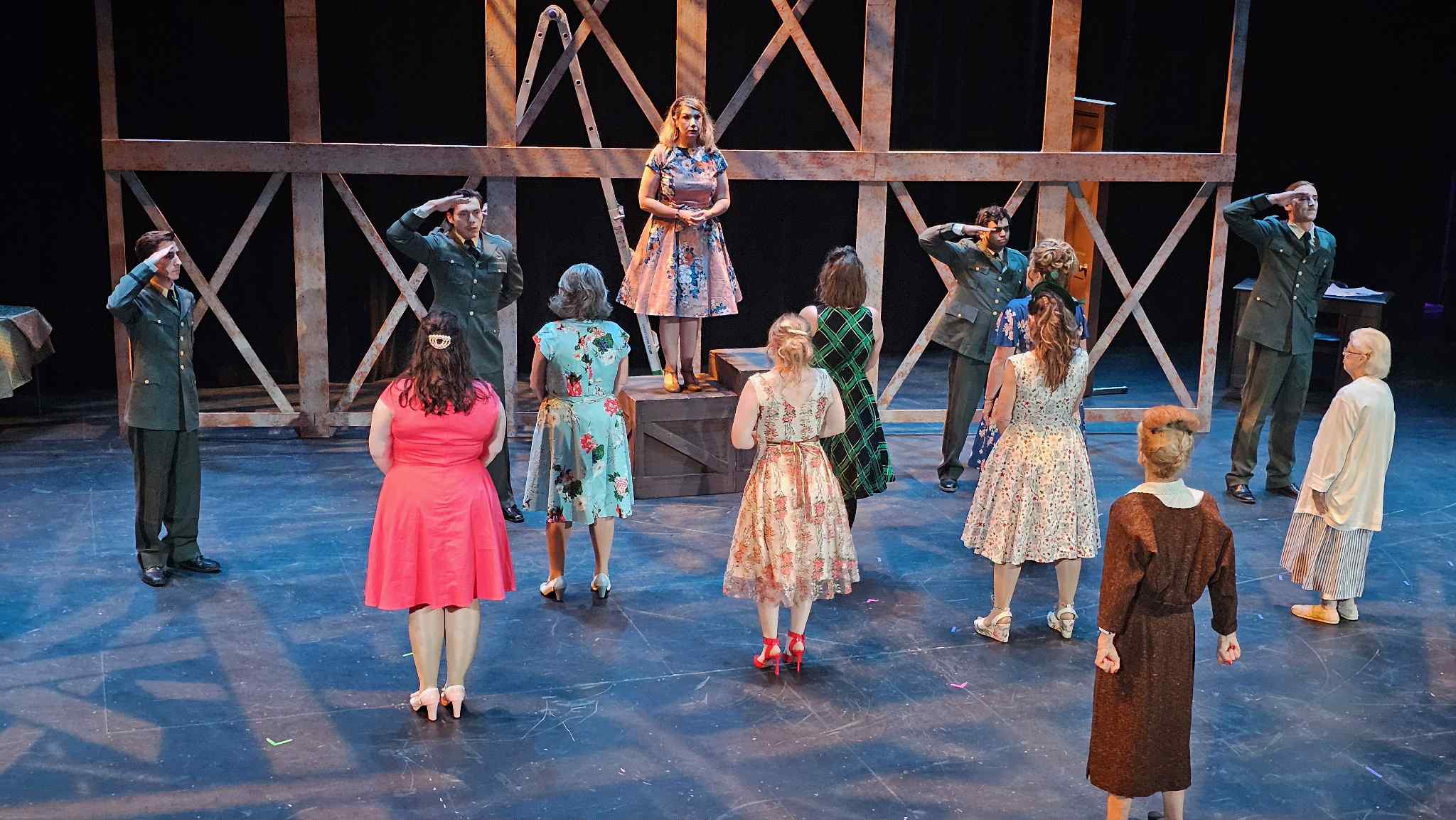
Pembroke Players: "Lysistrata"
Tulsa Performing Arts Center, Liddy Doenges Theatre
June 20, 2025
When lighting design, music choices, acting, directing, and a script come together in a play and work in cohesion, the final result can be magical. But it’s difficult and rare to achieve this—especially when the project is an adaptation of a play that’s almost 2,500 years old, when the adaptation is set in its own specific time and place, and when it’s trying to connect, through all those layers, to the present moment.
The marketing I saw online of Pembroke Players’ new version of Lysistrata promised an evening of female empowerment (complete with show merchandise with punny phrases like “Lysten to women”). The Ancient Greek satire, written by Aristophanes and performed for the first time in 411 BC, follows Athenian Lysistrata, who calls upon the women of Greece to take part in a sex strike, determined it will end the Peloponnesian War. The men, wrecked by lust, wander around in agony, and insanity ensues. (And yes, the strike works; by the end of the play, the warring powers sign a peace treaty.) It wouldn’t be a Pembroke production without a twist. For this one, dramaturg Meagan Mulgrew adapted the script to set it during the height of the Vietnam War, another moment in world history where military and gender tensions ran high, and public opposition to war and the draft had reached a fever pitch.
Presented on a weekend when the U.S. was literally bombing Iran, this Lysistrata had the advantage of timeliness. The audience seemed attentive and, in the lobby afterwards, invigorated. I came away with more mixed feelings.
Production-wise, Pembroke Players exceeded my expectations. The Liddy Doenges Theatre—whose lighting grid doesn’t give a crew much to work with—has never looked more professional, thanks to Mallory Lindsay’s excellent lighting design. With her use of color and the way she isolated parts of the stage, her work was of a caliber that I’d expect from a nationally-touring Broadway show. Paired with Rich Goss’ stripped-down but versatile set, that lighting design made the play’s different locations believable. Director Madalene Steichen found clever ways to use the whole space; scenes stayed tight and choreographed transitions flowed quickly.
The cast gave a wealth of rich performances. Davis Simpson (who played Cineseas, an Athenian general) projected the infectious energy and body contortions of a cartoon character. Tine Beyaert, Gayla Lindsay and Alyssa McCoy owned the stage with their powerful and confident performances as an ensemble of women who, though they don’t have husbands in the army, have personal reasons for joining the protest against the war. Jenny Guy was both funny and grounded as Lysistrata, keeping her reason for instigating and continuing the protest—the death of her brother—always at the forefront of her performance.
These production highlights reached a peak in a dynamic dinner party scene at the end of Act One, in which Lampito (Kathleen Hope) and Calonike (Kelli Lowe), two of the generals’ wives joining Lysistrata’s plan, attempt to convince their husbands to end the draft. Hope’s dynamic and billowing performance was constantly punctured by Lowe’s dry and witty humor that packed a punch to the heart. With their stage husbands, teddy bear John Orsulak and John “Top Gun” Lindsay, they created a synergistic magic that was both funny and devastating.