

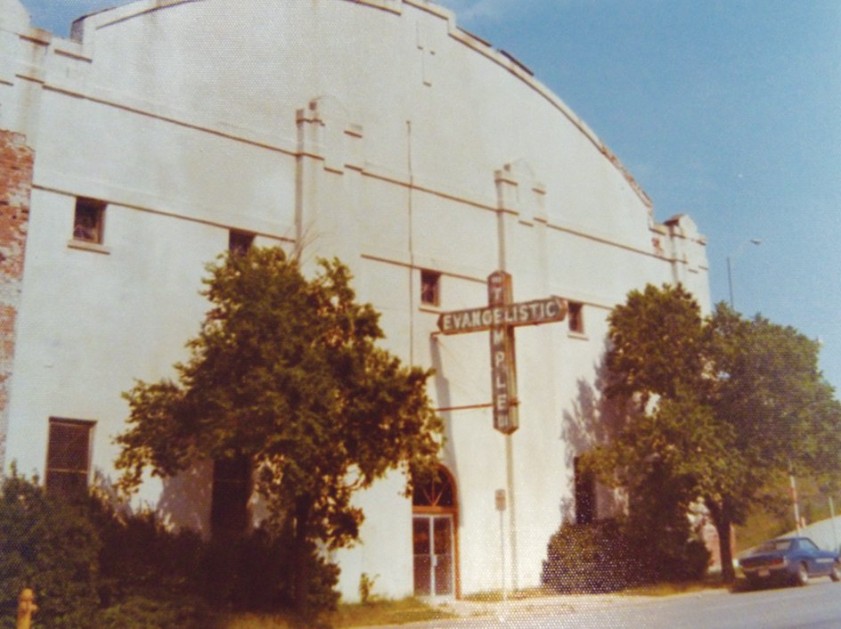
Editor's Note: In the years after the Tulsa Race Massacre of 1921, Beno Hall towered over the western edge of battered Greenwood—it was, in fact, one of the largest auditoriums in the southwest. In this story originally published in the September 2011 issue of This Land (when the event was still called a "race riot"), Steve Gerkin takes a look at the klavern that stood as a monument to the power of the Invisible Empire in 1920s Oklahoma.
The monstrous, three-story, steel reinforced, stucco building towered along the western edge of Greenwood. It dominated the landscape at the foot of Standpipe Hill, sporting a bright whitewash, the favorite color of its primary residents. Inside, its members vowed to protect their notion of “100% Americanism.” To become a guardian of liberty, they reasoned, you had to swear to secrecy and seclusion. And you had to embrace intimidation and violence as a way to assert your values.
In January of 1922, the Tulsa Benevolent Association of Tulsa, Oklahoma was officially formed as a holding company for the Knights of the Ku Klux Klan, Incorporated. Among its founding members was Washington E. Hudson, the attorney for Dick Rowland—the young black man who was a scapegoat for the 1921 Tulsa Race Riot. They provided the financing and leadership to begin building their Klan temple, or Klavern, known as Beno Hall. Locals jokingly called it “Be No Hall,” as in “Be No Nigger, Be No Jew, Be No Catholic, Be No Immigrant.”
Six months after its inception and bolstered by a raffle of 13 Ford automobiles netting nearly half of the $60,000 purchase price, the Benevolent Association bought the Centenary Methodist Church, at Main and Easton streets. The organization quickly outgrew this facility and the church was razed, making way for the future monument of white supremacy. Beno Hall was built for $200,000 ($1.5 million in today’s currency). Financing of the construction was kept quiet, but the land for the building was owned by the entrepreneur, politician, and early booster of Tulsa, Tate Brady, and his wife Rachel Brady, who received a large parcel of land as a Cherokee allotment in 1910. When Beno Hall was completed, it was one of the largest auditoriums in the Southwest, holding 3,000 people. Its size alone provided Tulsa with a visual reminder of the Invisible Empire’s power, passion and presence.
Abundant evidence points the finger at the Klan for fanning the sociological tinderbox that was 1920s Tulsa. Yearning for a spark, if even an invented one, a fired-up mob of whites took the bait and burned Greenwood to the ground in the Memorial Day, 1921 Race Riot. Two months later, a national Klan official, Caleb Ridley, who was also a Baptist minister, lectured at the Tulsa Convention Hall on the principles of the Klan, calling the Riot a complete success, adding that it “was the best thing to ever happen to Tulsa and that judging from the way strange Negroes were coming to Tulsa we might have to do it all over again.”
Stay in touch
Sign up for our free newsletter, The Talegate
Under the watchful eye of its Tulsa leader, the Exalted Cyclops William Shelley Rogers, membership grew to include all civic and social levels: from law enforcement to welders, bankers, dry cleaners, judges, commissioners, and oil field workers. All partook in the Beno Hall sessions that focused on increasing membership and efforts to keep Tulsa free from moral corruption and centered on family values.
Barely three months after the Riot, some 300 Tulsans, supported by a throng of 1,500 onlookers, were initiated as the first class of the Tulsa Klan No. 2. A year later, in a field north of Owasso, a nighttime “naturalization” ceremony initiated 1,020 Tulsa Klavern members before a fiery, 70-by-20 foot cross.