

"Southern Ems" by Regina Dao, Nic Annette Miller, and Đan Lynh Phạm
Positive Space Tulsa
Through April 26
“Our artist statement is here,” Regina Dao said, directing me to the left as I walked into Positive Space’s new exhibit Southern Ems. “And our timeline”—she pointed to the opposite wall—“goes this way.”
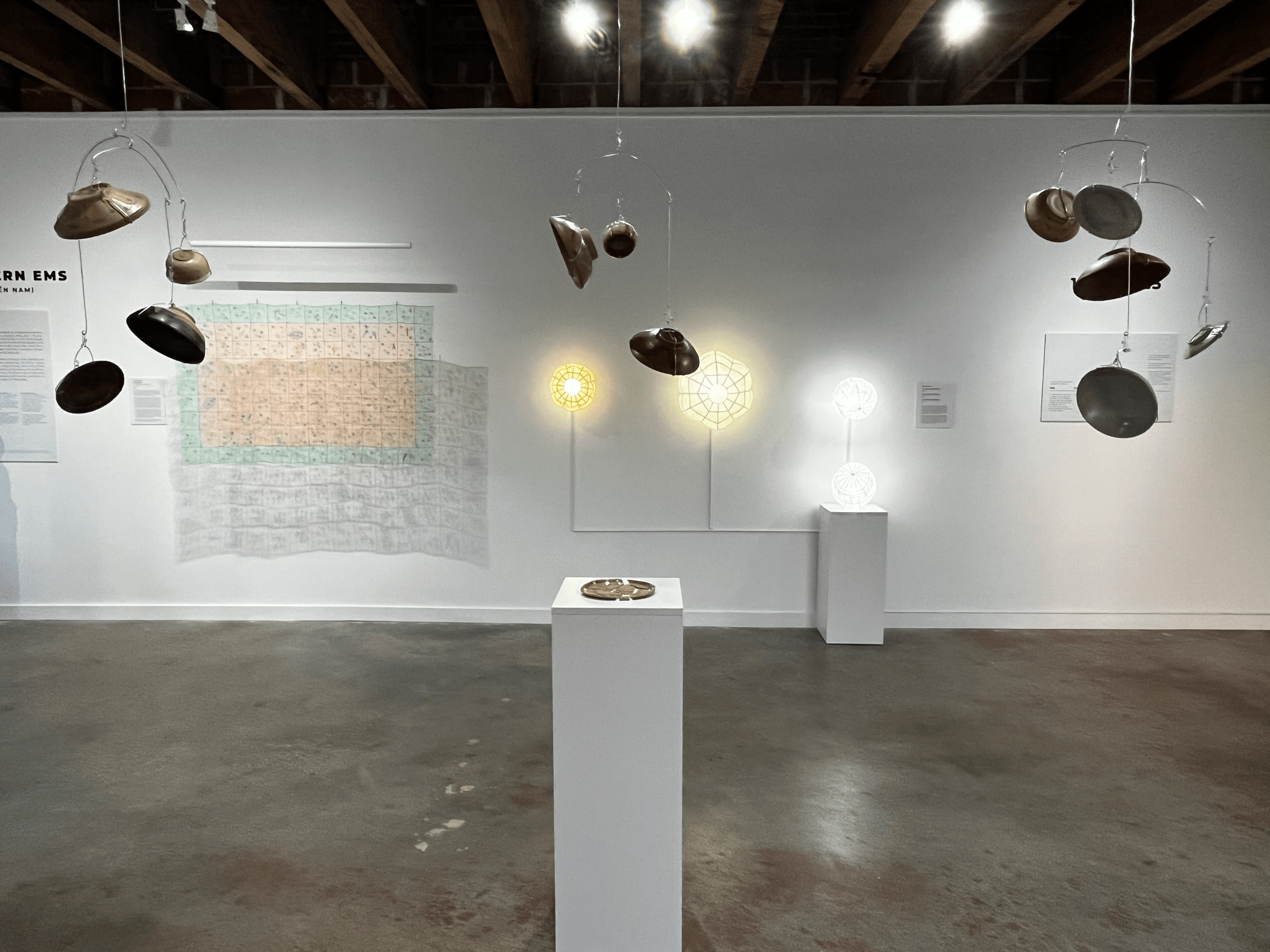
For as many individual pieces as there are in Southern Ems, the space between them feels vast. The short journey around this small white room is full of distances, covering miles, centuries, and unquantifiable experiences: from Vietnam to Oklahoma; from family roots to family branches; from 1858, when French colonial rule began in Vietnam, to 2025, when three Tulsa-based Vietnamese American artists—Dao, Nic Annette Miller, and Đan Lynh Phạm—created this group show.
That feeling of distance creates the show’s delicacy. Phạm’s pieces are literally translucent; Dao’s are suspended overhead or balanced on pedestals; Miller’s hover midway up the walls or rest on the floor. A thin line separates global stories from personal ones on three wall panels that mark the historical timeline and move you from one artist’s work into the next. Above: relations between powers, proclamations of war, international relocation programs. Below: the movements of Dao’s mother, aunt, and cousin, of Phạm’s family, of Miller herself.
The lightness in the room feels like a whisper through time. Generational inheritances see-saw across the show and travel forward through conflict, migration, and love. Many of these pieces are neutral-toned, but there are notable exceptions, like the bold red pen Miller used to correct a 1975 newspaper report, or the baby’s-room hues of Phạm’s haunting “Security Blanket,” the grid-like shadow behind which shows up as strongly as the quilted form itself. Miller’s poem about mushrooms (printed on fluorescent yellow paper), her ASL poem “The Land” (which runs on an old-school iPhone), and her video installation “Our Tones, Our Wrists, Our Home” (located somehow outside the timeline as it plays in a corner down a hallway, moving with its own pulse of communication) are likewise vivid in color, the latter topped with a migratory ascent of orange and black butterflies.
Lightness doesn’t mean a lack of weight, and a sense of distance doesn’t mean something’s actually far away. There’s space in here to feel these long, deep journeys. The personal histories on those three timeline panels hang from that line like Dao’s bowls hang from the ceiling—bowls among which I unexpectedly found myself, almost banging my head against them, as if they’d been caught in the act of falling around me, or were waiting for a familiar hand to reach up and take one down the way a grandma would in her well-loved kitchen. I put a hand up to shield the hanging installation from my movement and noticed, below my sight line, a broken plate painted with the words “No one thought to save us, too.”